
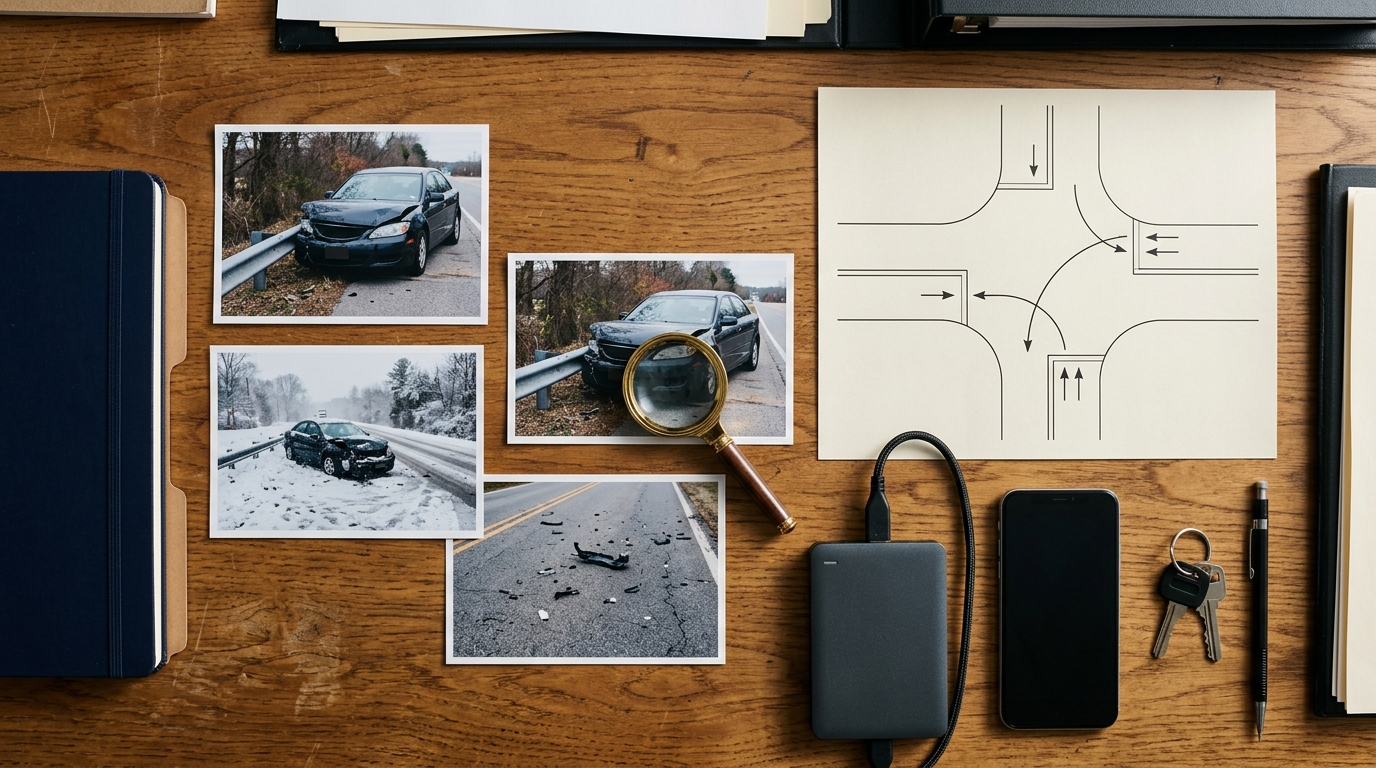

After a crash, the story may feel obvious to you. The other driver ran the light. The truck drifted into your lane. The impact left you in pain and unable to work.
An insurance company does not simply accept that story. It tests every part of it.
Was its driver really responsible? Did you contribute to the crash? Did the collision cause all of the medical problems you are describing? Were the treatments necessary? Are the work losses documented? Is there another insurance policy or responsible party?
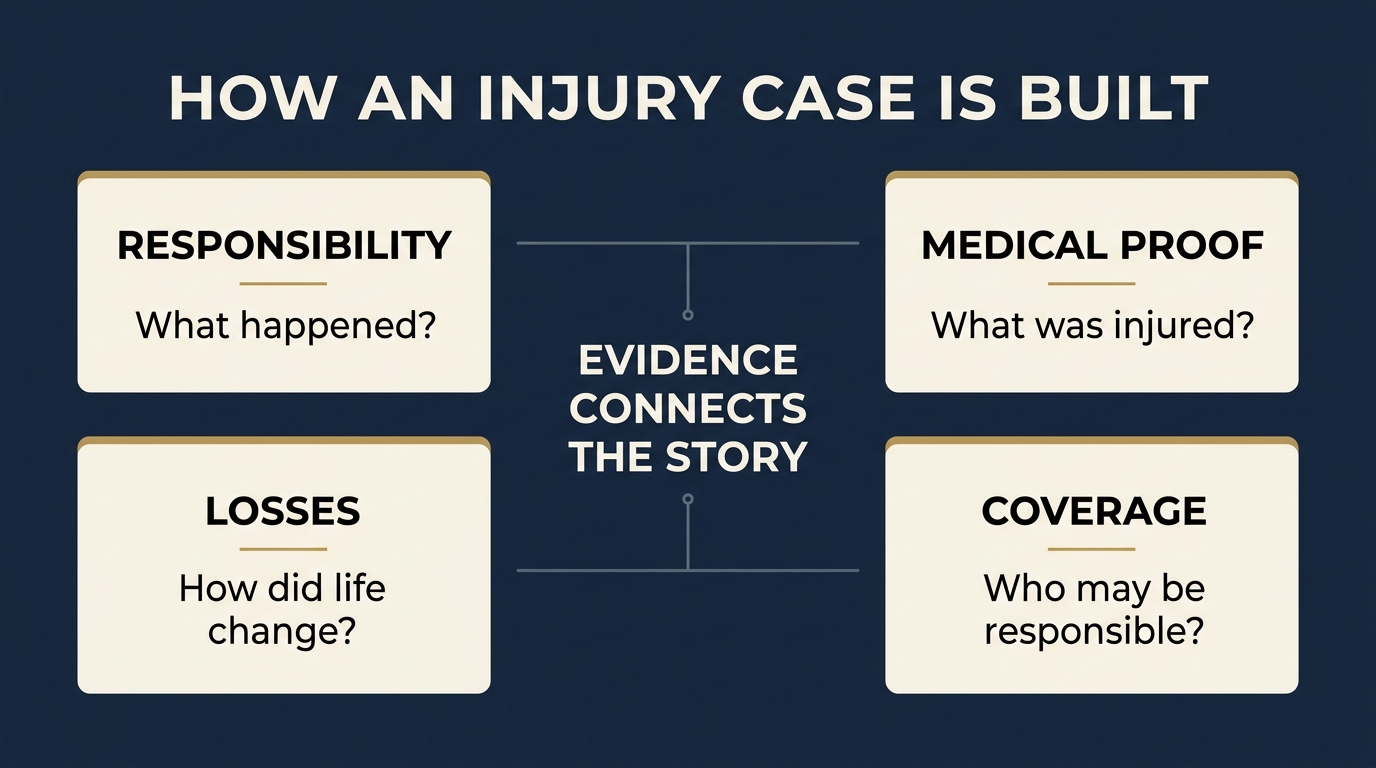
That is why a Tennessee injury attorney investigates more than the moment of impact. A well-prepared claim connects three things with reliable evidence: what happened, who was legally responsible, and how the crash changed the injured person’s life.
The Investigation Starts With Your Account
The client is often the first and most important source of information. Your attorney may ask you to describe:
- Where you were going and what happened before impact.
- What you saw, heard, and felt during the crash.
- What the other driver, passengers, or witnesses said afterward.
- When symptoms began and how they changed.
- Every place you received medical care.
- Work, household, and family activities you can no longer do normally.
- Any earlier injury involving the same part of the body.
Tell the truth even when a fact feels unhelpful. A prior back injury, a citation, a treatment delay, or a social-media post is easier to address when your attorney learns about it from you. Surprises help the insurance company, not your case.
Responsibility Is Built From Independent Evidence
A crash report is useful, but it is only one piece of the investigation. The report may contain driver and witness information, a diagram, citations, and the officer’s observations. It may not include video, electronic data, later witness interviews, or a detailed reconstruction.
Depending on the facts, an attorney may look for:
- Scene and vehicle photographs.
- Body-camera, dashcam, traffic, business, or doorbell video.
- Witness statements and 911 recordings.
- Vehicle inspection, repair, and event-data information.
- Cellphone, app, GPS, or fleet records.
- Commercial driver’s logs, training, hiring, and maintenance records.
- Road design, signal timing, construction, or weather information.
Our April post on proving distracted driving shows how small facts—timestamps, video, a lack of braking, or phone activity—can combine into a persuasive explanation of a crash.
Evidence Must Be Preserved Before It Disappears
Some evidence lasts for years. Other evidence may be gone within days.
A business may automatically record over surveillance footage. A vehicle may be repaired, sold, or crushed. An app provider may keep detailed records only under its own retention schedule. Witnesses move, change numbers, and forget details.
When the risk is serious, the attorney may send a preservation letter identifying the evidence and asking the person or organization that controls it not to alter or destroy it. In a filed lawsuit, Tennessee Civil Procedure Rule 34 allows parties to request documents, electronically stored information, photographs, recordings, data, and tangible things within the rule’s scope. The state’s civil rules also address testing and the loss of relevant evidence.
Preservation is not proof by itself. It keeps the potential proof from disappearing before it can be examined.
Medical Records Connect the Crash to the Injury
An injury claim is not built only from bills. The legal team may request emergency records, imaging, physician notes, therapy records, prescriptions, and itemized charges to understand:
- What symptoms were reported and when.
- Which diagnoses and objective findings were documented.
- What treatment providers recommended.
- Whether restrictions affected work or daily activity.
- Whether the condition improved, remained stable, or required more care.
- Whether a provider connected the condition to the collision.
Prior medical records may matter when the same body part was treated before. A pre-existing condition does not automatically erase a claim, but the attorney needs enough history to distinguish the earlier condition from a new injury or aggravation.
The lawyer should not tell you to receive unnecessary treatment or keep treating only to increase a claim. Medical decisions belong between you and qualified providers. The legal work is to document the care you actually need and the effects you actually experience.
The Case Includes More Than Medical Bills
A serious injury can affect work, independence, sleep, mobility, relationships, and ordinary routines. Those effects must be described accurately and supported where possible.
Your legal team may collect:
- Wage statements and missed-time records.
- Employer verification of duties, restrictions, or lost opportunities.
- Receipts for necessary out-of-pocket expenses.
- Photographs showing property damage or the recovery process.
- Statements from family members or others who observed meaningful changes.
- A simple client journal documenting symptoms and limitations over time.
The goal is not to make daily life sound worse than it is. The goal is to replace vague phrases such as “I am still hurting” with specific, truthful information about what the injury prevents or makes more difficult.
Other Responsible Parties and Coverage Are Checked
The driver who caused the crash may not be the only relevant party. A vehicle owner, employer, contractor, manufacturer, bar, property owner, rideshare company, or government entity may be involved, depending on the facts and the law.
Insurance investigation can be just as important. The attorney may look at the other driver’s liability coverage, your own uninsured/underinsured motorist coverage, medical-payments coverage, commercial policies, umbrella policies, or other potential sources.
More parties do not automatically make a case stronger. Each theory must have factual and legal support. Identifying the correct parties early matters because every claim is subject to deadlines and evidence can be different for each one.
Experts May Be Needed in More Complex Cases
Many claims can be evaluated with records, witnesses, photographs, and treating-provider information. Others require specialized analysis.
An attorney may consult an accident reconstructionist, engineer, medical expert, vocational professional, economist, or another qualified person when the issues justify it. Experts can be especially important when:
- The parties dispute how the collision occurred.
- A commercial vehicle or defective component is involved.
- The medical cause or future effects of an injury are contested.
- The injury affects long-term work capacity.
- Technical evidence must be explained to an insurer, judge, or jury.
Experts add time and expense, so the attorney should consider whether their work is likely to answer an important question in the case.
A Lawsuit Adds Formal Discovery Tools
An insurance claim before suit depends heavily on voluntary exchanges, records requests, and negotiation. Once a lawsuit is filed, the Tennessee Rules of Civil Procedure provide formal discovery methods.
Those can include:
- Written questions called interrogatories.
- Requests for documents and electronic information.
- Requests to admit or deny specific facts.
- Depositions taken under oath.
- Subpoenas to nonparties.
- Examinations or expert disclosures when permitted and appropriate.
Discovery runs both ways. The defendant can request information from you, too. That is one reason your attorney asks detailed questions before the other side does.
Why a Careful Investigation Can Feel Slow
Clients sometimes see a quiet stretch and assume nothing is happening. In reality, the firm may be waiting for a crash report, tracking down a witness, requesting records, reviewing hundreds of pages of medical material, or waiting for a provider to explain the likely course of recovery.
That does not mean silence is ideal. Ask for a status update and a clear explanation of the current stage. A useful update should tell you what has been completed, what is still outstanding, whether anyone else controls the next step, and what the firm needs from you.
Investigation is not about making the file as thick as possible. It is about finding the evidence that answers the questions the insurer or court will actually ask.
We’re Here to Help
If you or a loved one was hurt in a Tennessee crash, the evidence that explains what happened may not remain available forever. We can help preserve the important records, investigate responsibility, and document the full effect of the injury.
Call 615-244-2111 or reach out through our online contact form.
Because we care,
Stillman & Friedland