


Hiring a lawyer after a serious crash can bring relief. You finally have someone to deal with the insurance companies, watch the deadlines, and help make sense of what comes next.
Then a few days pass.
You may wonder whether anything is happening behind the scenes. Should you still answer an adjuster’s calls? Who is getting your medical records? What does the firm need from you? And when will anyone talk about resolving the claim?
The first week is usually less dramatic than television makes legal work look. But it can be one of the most important stages of a Tennessee injury claim. This is when the attorney learns the facts, identifies urgent risks, and begins building the structure that will carry the case forward.
Every firm and every claim is different. Still, here is what injured clients can generally expect.
You Review the Representation Agreement
The attorney-client relationship usually begins with a written agreement. Read it, keep a copy, and ask questions about anything that is unclear.
The agreement may explain:
- What matters the firm has agreed to handle.
- How attorney fees and case expenses are addressed.
- How either side may end the representation.
- What the firm needs from you.
- How the firm will communicate about the claim.
Do not assume that hiring a lawyer for an injury claim automatically includes every related issue. Property damage, traffic charges, health-insurance disputes, disability benefits, or another legal matter may have to be discussed separately. Knowing the scope at the beginning prevents confusion later.
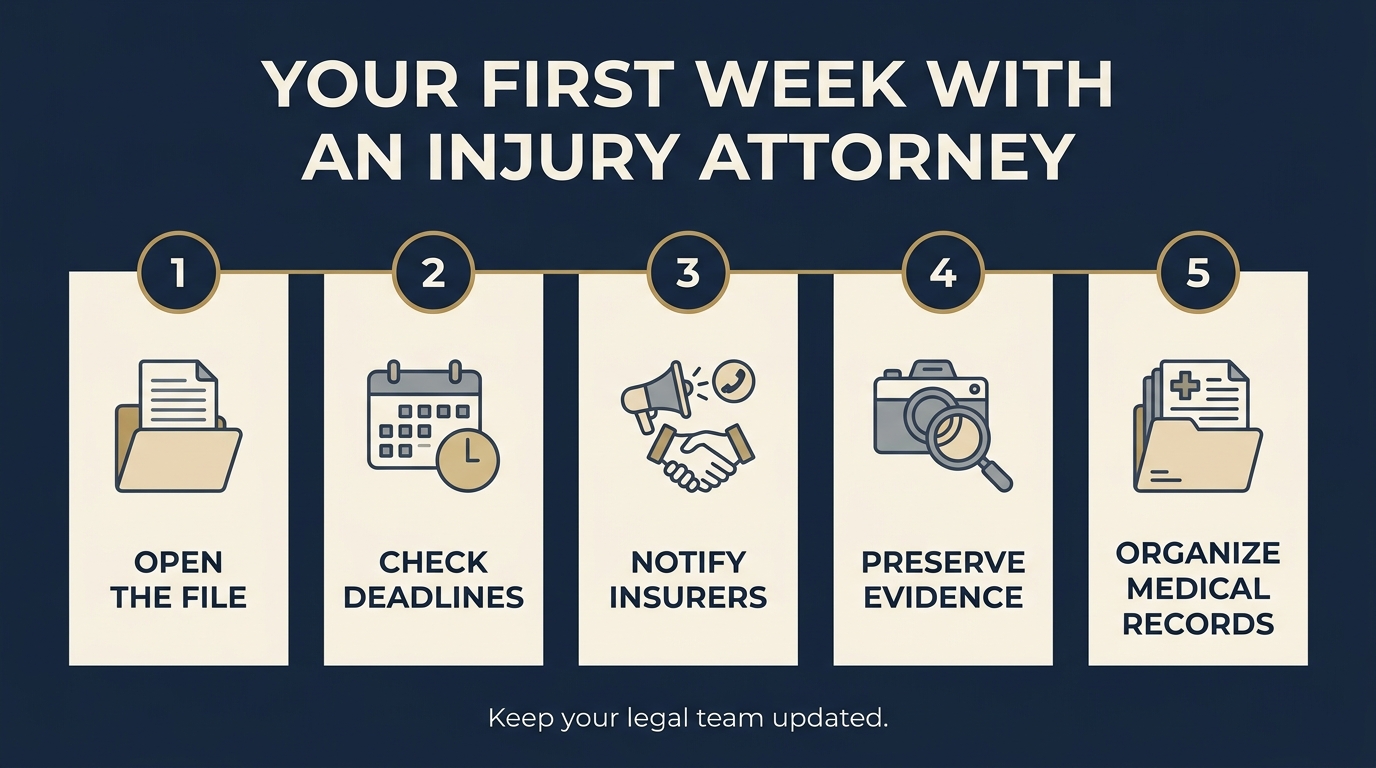
The Firm Opens and Organizes Your File
Your legal team needs more than a crash date and the other driver’s name. During the first week, the firm may begin collecting and organizing information about:
- Every person and vehicle involved.
- The investigating law-enforcement agency and crash report number.
- Auto, health, medical-payments, and uninsured/underinsured motorist coverage.
- Your doctors, hospitals, therapy providers, pharmacies, and prior related conditions.
- Missed work, job duties, and employer contact information.
- Photographs, videos, witness names, messages, and insurance correspondence.
- Family members or others who saw how the injuries changed your daily life.
This early intake is not busywork. A name spelled incorrectly, an insurer left unidentified, or a missing photograph can create problems months later. A careful file makes it easier to see what is known, what is missing, and what needs immediate attention.
Deadlines and Special Risks Are Checked
Tennessee gives injured people a limited time to file many personal injury lawsuits. Tenn. Code Ann. § 28-3-104 generally provides a one-year limitation period for actions involving injury to the person, but the correct deadline can depend on the facts, the parties, and the type of claim. Claims involving a government entity or other special circumstances may require different or earlier action.
That is why a responsible attorney does not rely only on the date someone typed into an online form. The firm may verify the crash date, determine when an injury claim accrued, identify every potential defendant, and calendar more than one reminder.
Other urgent risks may matter even sooner than a filing deadline. Video can be overwritten. Vehicles can be repaired or destroyed. Electronic data can disappear. Witnesses can become difficult to locate. The first-week review helps the attorney decide what must be preserved now.
Insurers and Other Parties May Be Notified
Once representation begins, the attorney may send letters telling insurance companies and other involved parties that the firm represents you. These letters can direct claim-related communications to the law office and request important information, such as policy details or claim numbers.
That does not mean you will never hear from an insurer again. An adjuster may call before the notice reaches the right file. A property-damage issue may still require your input. Your own carrier may need your cooperation under the policy.
If someone contacts you about the crash, get the caller’s name, company, phone number, and claim number. Then check with your attorney before giving a recorded statement, signing an authorization, or discussing a settlement.
Evidence Preservation May Start Immediately
Some evidence can wait to be requested. Other evidence cannot.
Depending on the case, the firm may send preservation notices for:
- Business or residential surveillance video.
- Dashcam, rideshare, delivery, or fleet records.
- Vehicle event data or onboard electronic information.
- Cellphone or digital-account records.
- Commercial driver logs, inspection records, or maintenance records.
- The vehicles or physical parts involved in the crash.
A preservation notice does not automatically give the lawyer the evidence. It tells the person or company holding it that the material may be important and should not be destroyed. If a lawsuit is later filed, the Tennessee Rules of Civil Procedure provide formal tools for requesting documents, electronic information, testimony, and other evidence.
Medical Documentation Begins to Take Shape
Your attorney is not your doctor and should not direct medical care. But the legal team needs to understand where you were treated, what conditions were diagnosed, what care was recommended, and how the injuries are affecting you.
You may be asked to sign targeted authorizations so the firm can request records and bills. You may also need to send new provider names as treatment continues. Keep appointments when you reasonably can, follow your providers’ instructions, and tell the firm if transportation, cost, scheduling, or another barrier interrupts care.
Gaps in records can make it harder to show what happened medically. Our February series explains how insurers use gaps in treatment and why medical records matter to an injury claim.
You Set Communication Expectations
The first week is a good time to learn who will be working on the file and how updates will happen. Ask:
- Who is my primary contact?
- Should I call, email, or use a client portal?
- How quickly should I report new treatment, missed work, or an insurer’s call?
- How often can I expect a routine status update?
- What should I do if my address, job, phone number, or insurance changes?
Tennessee’s Rules of Professional Conduct require lawyers to keep clients reasonably informed, respond to reasonable requests for information, and explain matters well enough for clients to make informed decisions. Good communication works both ways. Your attorney cannot act on a new medical problem, lost job, move, or insurance letter the firm never learns about.
What You Can Do Right Now
You do not need to investigate the case alone. But you can help protect it by taking a few practical steps:
- Send the firm every photograph, video, document, and claim number you have.
- Keep original files instead of relying only on screenshots or social-media copies.
- Save bills, receipts, mileage, work notes, and benefit statements.
- Write down new symptoms and practical limitations without exaggerating them.
- Avoid posting about the crash, your injuries, or your activities online.
- Forward insurer messages instead of ignoring or answering them on your own.
- Tell the legal team promptly about new treatment or major life changes.
The first week is not when most cases settle. It is when a strong working relationship begins and the claim’s foundation is checked for gaps.
We’re Here to Help
If you or a loved one was hurt in a Tennessee car, truck, or motorcycle crash, you deserve to understand what is happening with your claim. We can help identify the immediate priorities, explain the next steps, and protect evidence while it is still available.
Call 615-244-2111 or reach out through our online contact form.
Because we care,
Stillman & Friedland