


Most people who hire an injury attorney want a fair resolution without spending years in court. Most also want to know when the insurance company will make an offer and whether their lawyer can force the company to be reasonable.
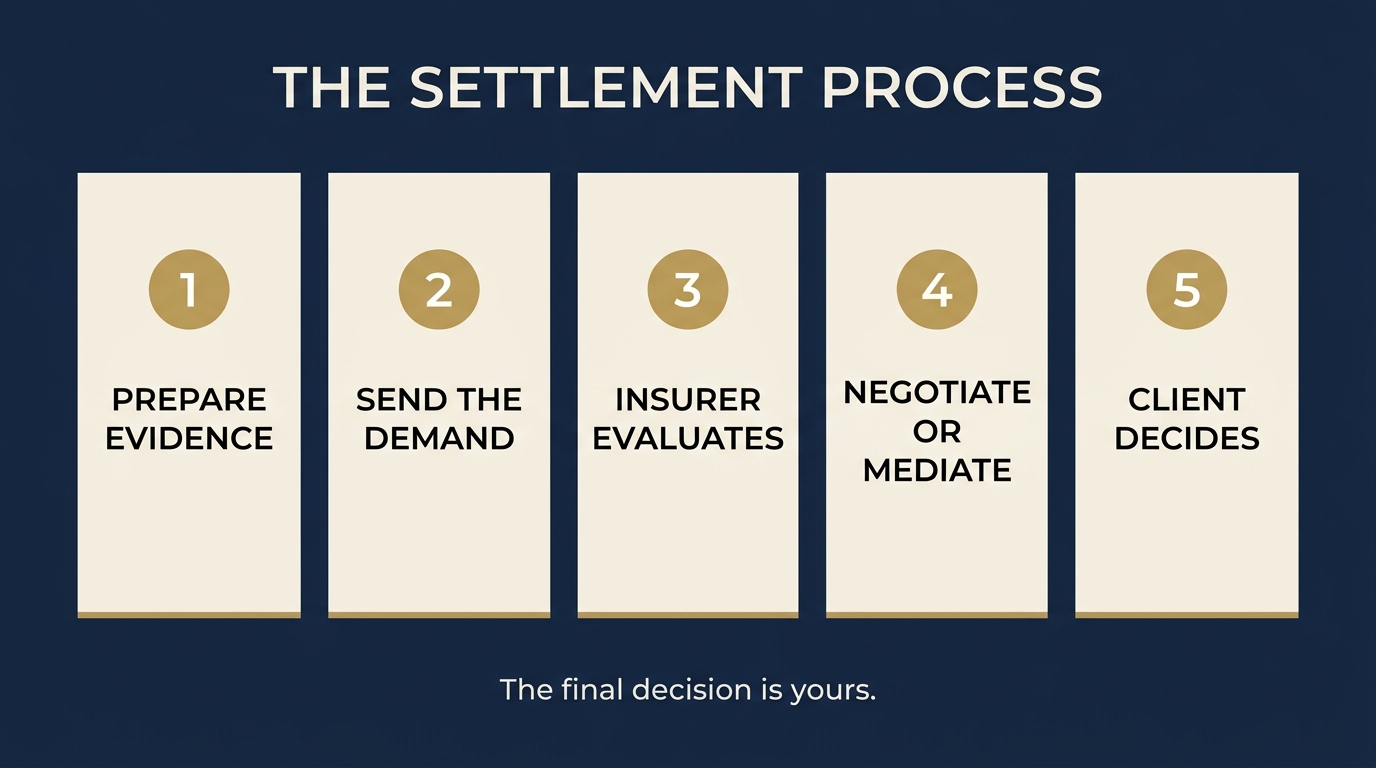
Settlement negotiations are rarely one dramatic phone call. They are a process of presenting evidence, identifying disagreements, evaluating risk, and deciding whether both sides can accept the same terms.
Some Tennessee injury claims settle before a lawsuit is filed. Some resolve during litigation or mediation. Some do not settle and must be decided in court. No attorney can promise which path a particular case will take, but understanding the process makes the decisions less intimidating.
A Claim Must Be Ready for Meaningful Evaluation
Negotiating too early can be risky. If the injured person is still being evaluated, the parties may not yet know:
- The full diagnosis.
- Whether a procedure or additional therapy will be recommended.
- Whether the person can return to the same work.
- Whether symptoms are likely to improve or continue.
- The complete amount of medical charges, lost income, and other losses.
That does not mean every client must wait until every symptom is gone. Some injuries do not fully resolve. It means the attorney needs enough reliable information to evaluate what accepting a release would give up.
Once a claim is settled and a broad release is signed, the injured person generally cannot come back for more because an unexpected bill arrived or the condition became worse. That is why a fast offer is not always a safe offer.
The Attorney Prepares a Settlement Presentation
When the case is ready, the attorney may send a demand package to the insurer or responsible party. A useful demand is more than a large number at the bottom of a letter.
Depending on the case, it may include:
- A factual explanation of how the crash happened.
- Evidence supporting responsibility and addressing comparative fault.
- Medical records, bills, and a clear treatment summary.
- Wage-loss and employment documentation.
- Photographs, witness information, or other important exhibits.
- A description of the injury’s effect on daily life.
- Information about future limitations or care when supported by qualified evidence.
- A proposed amount and a deadline for response.
Tennessee’s comparative fault system makes the liability section important. If an insurer argues that the injured person shares responsibility, it may reduce its evaluation of the claim. Our November series explains how Tennessee’s comparative fault rule works and how insurers use fault arguments to limit payouts.
The Insurance Company Conducts Its Own Evaluation
An adjuster may review the demand, compare it with the company’s claim file, seek additional records, speak with a supervisor, or consult defense counsel. The insurer may agree with some parts of the claim and dispute others.
Common disagreements include:
- Who caused the crash.
- Whether the impact caused all claimed injuries.
- Whether treatment was related, necessary, or reasonable.
- Whether a treatment gap weakened the connection to the crash.
- Whether work loss or future limitations are sufficiently documented.
- Whether another policy or party should pay first.
The insurer may accept the demand, reject it, ask for more information, or make a lower offer. A low first offer does not necessarily mean negotiations are over. It does reveal where the insurer has placed the case and may expose the issues that need a stronger response.
Offers and Counteroffers Narrow the Disagreement
Negotiation can happen by letter, email, phone, or a combination of all three. The attorney may challenge an insurer’s factual assumptions, provide missing documentation, explain why a comparison is unfair, or revise the demand after discussing the risks with the client.
The important questions are not simply, “Did the offer go up?” and “How much more can we ask for?” A client should also understand:
- What the insurer says is weak about the claim.
- Which disputes could be resolved with additional evidence.
- What litigation would cost in time, stress, and case expenses.
- What a judge or jury could reasonably decide, including an unfavorable result.
- Whether the offer resolves every claim and every party.
- What must be paid from the recovery.
Negotiation is not a game where every case has a secret correct number. It is a decision under uncertainty, based on the available proof and the risks on both sides.
You Decide Whether to Accept
Your lawyer advises you, but the settlement decision belongs to you. Tennessee Supreme Court Rule 8, RPC 1.2 states that a lawyer must abide by a client’s decision whether to settle. RPC 1.4 also requires the lawyer to communicate settlement offers and explain enough for the client to make an informed choice.
Your attorney should be able to discuss the strengths, weaknesses, likely deductions, and practical alternatives. The lawyer may recommend accepting or rejecting an offer. The lawyer should not accept a settlement without the authority required from the client.
Before deciding, ask for the offer in clear terms and request an estimate of what may remain after fees, expenses, medical balances, liens, or other valid obligations are addressed. An offer amount and the client’s expected net recovery are not the same thing.
Mediation Can Create a More Focused Conversation
If direct negotiation stalls, the parties may use mediation. Mediation can happen before or after a lawsuit is filed. In some eligible civil actions, a Tennessee court may order the parties to participate in a Rule 31 mediation.
A mediator is a neutral person who helps the parties discuss resolution. The mediator does not act as the injured person’s lawyer and does not decide the case. Tennessee Supreme Court Rule 31 describes mediation as a process designed to help the parties reach their own mutually acceptable agreement. Its standards emphasize informed, voluntary decision-making.
At mediation, each side can hear the risks identified by a neutral person, test possible compromises, and exchange offers in a structured setting. Mediation can settle all of a case, part of it, or none of it.
Settlement Terms Matter as Much as the Number
If the parties agree, the written documents must be reviewed carefully. A settlement may involve:
- A release of claims.
- Dismissal of a filed lawsuit.
- Confidentiality or non-disparagement terms.
- Allocation among multiple claimants or parties.
- Resolution of medical liens, benefit claims, or outstanding balances.
- A deadline and method for payment.
Do not sign a release because the first page looks familiar. Read the entire agreement and ask what each important provision means. A release may cover people or claims that are not obvious from the settlement amount alone.
Payment Is Not Always Immediate
After documents are signed, there are still closing steps. The settlement check must be issued, deposited, and cleared. The firm may need to confirm medical balances, resolve valid liens, account for case expenses, prepare a written distribution statement, and obtain the client’s approval where required.
The timing varies with the agreement and the issues that must be resolved. Ask your attorney what is still outstanding, who controls each step, and when you should expect another update.
What If the Claim Does Not Settle?
An insurer cannot be forced to make an acceptable voluntary offer. If the parties remain too far apart, the client and attorney may discuss filing or continuing a lawsuit and preparing for trial.
Litigation does not guarantee a better outcome. It creates formal tools for obtaining evidence and puts the dispute on a path toward a court decision. It also brings deadlines, depositions, motions, expenses, and the uncertainty of a judge or jury.
The next post in this series explains what actually happens when a Tennessee injury case moves toward trial.
We’re Here to Help
If you or a loved one is considering a settlement after a Tennessee crash, you deserve a clear explanation of the evidence, the risks, the terms, and the likely deductions before you decide. We can help you understand the offer and the options that remain.
Call 615-244-2111 or reach out through our online contact form.
Because we care,
Stillman & Friedland