
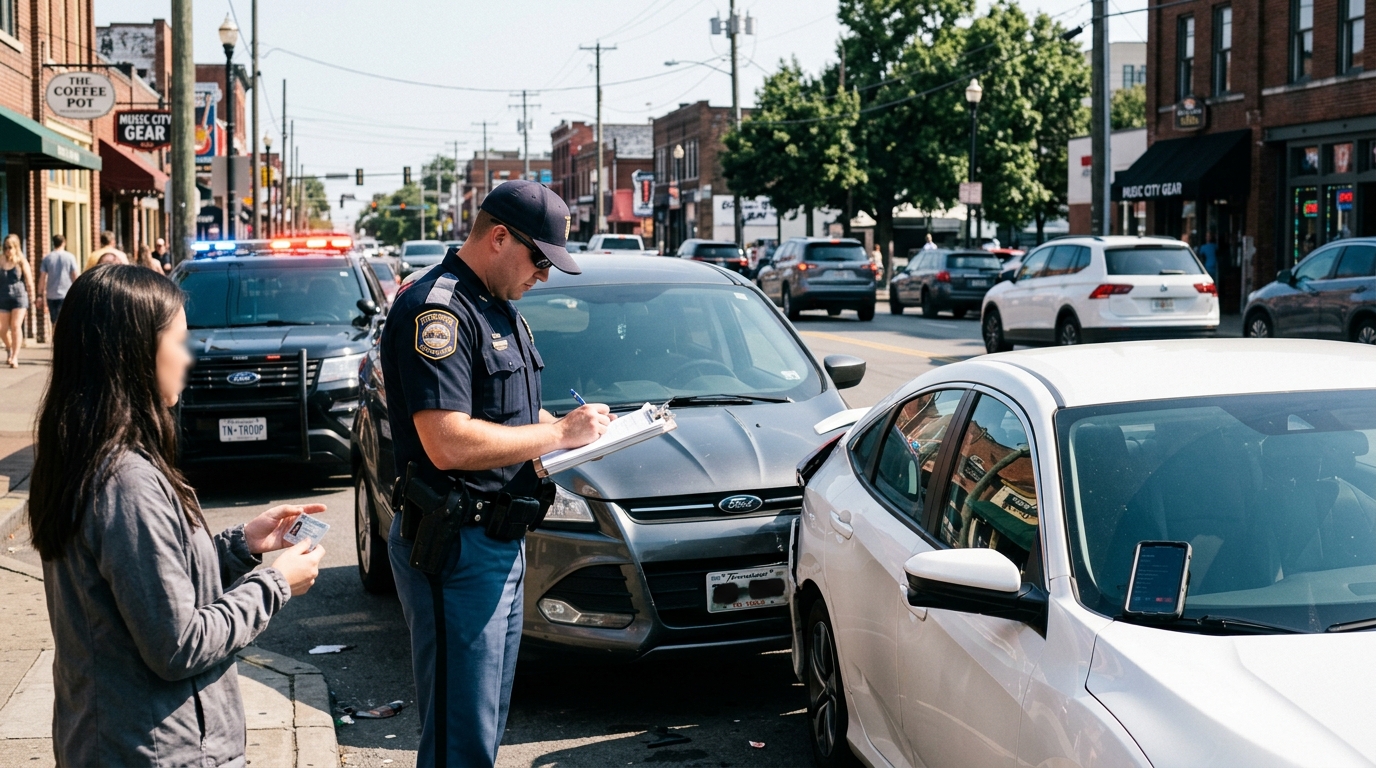

You saw it in the half-second before impact. The other driver wasn’t looking up. Their head was down, their hands were low, or they drifted straight into your lane as if you weren’t even there.
Then the police arrived, the other driver denied everything, and suddenly your “obvious” case feels a lot less obvious.
This is one of the most common and most frustrating situations for Tennessee crash victims. The good news is that distraction almost always leaves a trail. You just have to know where to look — and move quickly before that trail disappears.
Why Drivers Rarely Admit It at the Scene
Nobody walks up to a Tennessee state trooper and says, “Officer, I ran that red light because I was scrolling Instagram.”
Under Tennessee’s Hands-Free Law, admitting to phone use at the scene can mean a citation, points on the license, and — if someone was hurt — a $200 fine on top of the civil exposure. So drivers deflect. “The sun was in my eyes.” “They came out of nowhere.” “I don’t know what happened.”
An injured person listening to this in the minutes after a crash can feel like the truth is slipping away. It isn’t. The evidence that proves distraction usually isn’t a confession. It’s a collection of small, concrete facts that, put together, tell a clear story.
Cell Phone Records
Cell phone records are often the single most important piece of evidence in a distracted-driving case. They can show:
- Calls placed, received, and missed, with exact timestamps.
- Text messages and data activity down to the second.
- Which cell tower the phone connected to — sometimes useful for placing a driver at the scene.
These records exist with the wireless carrier, not the driver. That’s important because it means the other driver cannot simply delete them to make them go away.
The catch: carriers only keep detailed records for a limited period before they are purged. An attorney moving quickly after a crash can send a preservation letter — a formal request telling the carrier not to destroy the records — and later subpoena them through the civil discovery process. Waiting months to hire a lawyer can mean the records are gone before anyone asks for them.
The Scene Itself
Distracted-driving crashes often look different from other crashes. Some of the telltale patterns:
- No skid marks. An attentive driver hits the brakes. A distracted driver usually doesn’t — they never saw the hazard coming. A debris field without pre-impact braking is suggestive.
- Rear-end collisions at full speed. A driver who rear-ends stopped traffic without braking is almost always distracted, asleep, or impaired.
- Straight-line departures. Drifting across a lane line or off the road with no attempt to correct is a classic distraction signature.
- Delayed reactions. Video or witness testimony showing the driver reacting a beat too late — only after the horn honks, or after the impact is already happening.
A good investigator reads the scene like a story. Every mark on the pavement and every dent on a vehicle is a paragraph in that story.
Witnesses and 911 Calls
Other drivers see things. So do pedestrians, delivery drivers, and people sitting at nearby red lights. In the first few minutes after a crash, a witness might say, “That guy was on his phone the whole way down the road” — and then leave before anyone writes it down.
Two practical steps help capture this:
- Ask for names and phone numbers of anyone who stops at the scene, even briefly.
- Request the 911 call audio and dispatch timeline through the relevant Tennessee agency. Sometimes a witness calls 911 before the crash to report an erratic driver. That timeline can be powerful.
Surveillance, Dashcams, and Doorbell Cameras
Modern Tennessee roads are covered in cameras. Most drivers never notice them until they need them:
- Gas station, convenience store, and restaurant cameras often capture intersections.
- Traffic cameras operated by TDOT may record high-traffic corridors.
- Home doorbell cameras frequently catch residential-street wrecks.
- Commercial truck and fleet dashcams sometimes record other vehicles in frame.
- Your own dashcam, if you have one, may show the other driver’s behavior in the seconds before impact.
Most of this footage is overwritten on a rolling loop — often within 7 to 30 days. Acting quickly is the difference between having it and wishing you did.
Vehicle Data and Infotainment Systems
Modern vehicles are rolling computers. Many cars log:
- Speed, throttle, and braking in the seconds before a crash.
- Steering inputs and lane-departure warnings.
- Bluetooth pairing data — including whether a phone was connected and how it was being used.
- Infotainment touches — what apps or menus were being interacted with.
This data is not always easy to retrieve, but in the right case, it can show that a phone was actively sending data through the car’s system at the moment of impact.
Police Reports and Citations
A Tennessee crash report is a starting point, not an ending point. The investigating officer may list distraction as a contributing factor, or may issue a Hands-Free Law citation if the evidence at the scene supports it. If you want a deeper look at how police reports are used (and misused) in Tennessee injury claims, see our post from the November 2025 fault series on police reports and fault.
Even if the report doesn’t mention distraction, that doesn’t end the inquiry. Officers work with what they can see and confirm in a short window at the scene. A full civil investigation goes much further.
Why Time Matters
Almost every form of evidence we just discussed has an expiration date:
- Cell carrier records are routinely purged.
- Surveillance footage gets overwritten.
- Witness memories fade.
- Vehicles get repaired or totaled out, sometimes destroying on-board data.
- Crash-scene debris gets swept off the road.
The most important thing an injured Tennessean can do in the days after a distracted-driving crash is to make sure someone is sending preservation letters and tracking down evidence now, not months later.
We’re Here to Help
If you or a loved one was hit by a driver you believe wasn’t paying attention, the proof may still be out there — but it won’t wait. We can help you act quickly to preserve the evidence that makes your claim stronger.
Call 615-244-2111 or reach out through our online contact form.
Because we care,
Stillman & Friedland