


Handing a teenager the car keys can feel like a much bigger moment than passing a road test. Your teen may be ready to drive to school, work, practice, or a friend’s house—but their Tennessee license may still limit when they can drive, who can ride with them, and what paperwork they need.
Those rules are part of Tennessee’s Graduated Driver License program, usually called the GDL program. It does not move every young driver from a permit directly to a full license. Instead, it adds freedom in stages while the driver gains experience.
That matters before a family says yes to a late practice, a school carpool, or a weekend trip. It can also matter after a crash, when an insurer asks who was in the vehicle and whether the teen was following the restrictions printed on the license.
Here is a plain-English guide to the stages and the questions Tennessee parents should check.
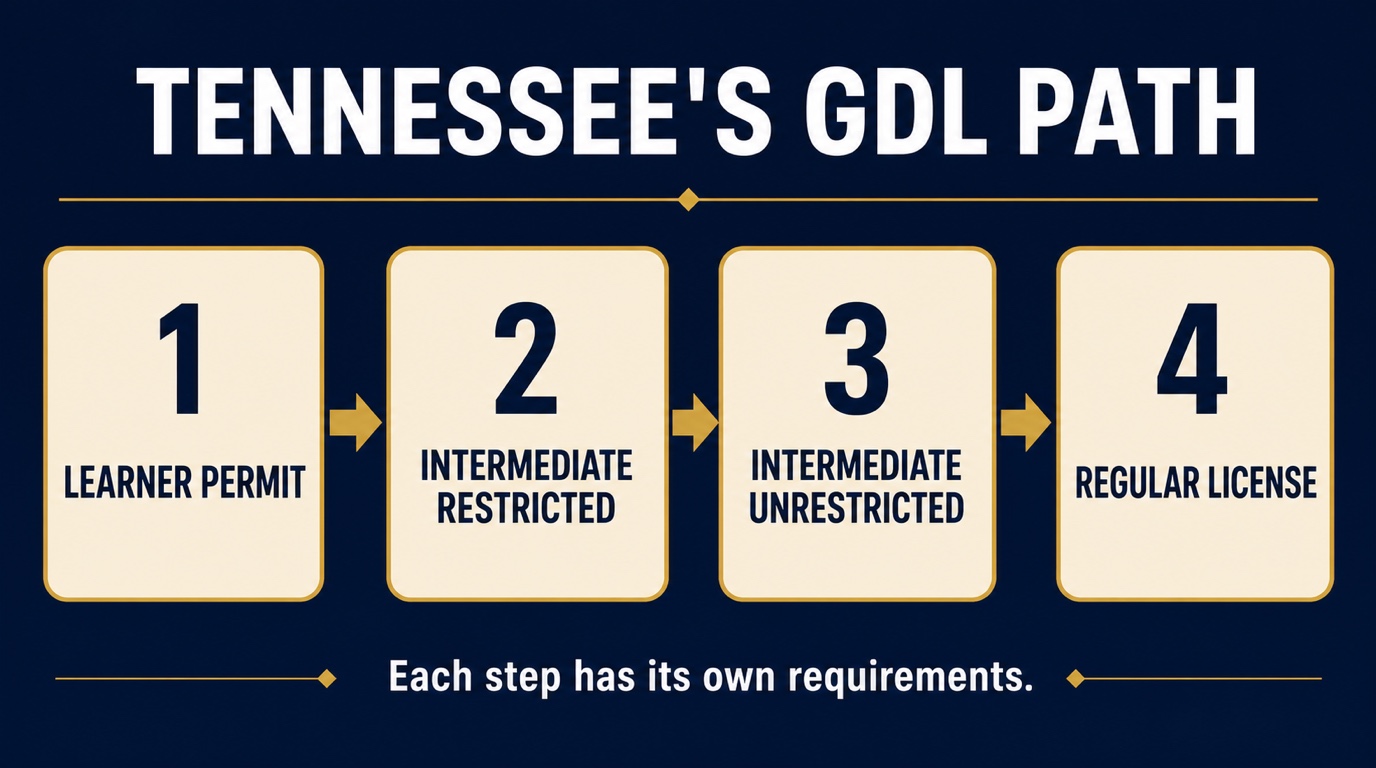
Tennessee Uses Four Graduated Licensing Steps
The current Tennessee Comprehensive Driver License Manual describes four steps for drivers under 18:
- Learner Permit
- Intermediate Restricted License
- Intermediate Unrestricted License
- Regular Driver License
Each step has its own requirements. A teenager’s birthday alone does not automatically move the driver to the next level. Holding periods, supervised practice, driving history, testing, and an application are also part of the process.
If you are unsure which stage applies, look at the teen’s current credential and verify the requirements with the Tennessee Department of Safety and Homeland Security. The department’s Regular Driver License page directs first-time applicants under 18 into the Teen/Graduated Driver License process.
Learner Permit: Supervised Driving Comes First
A Tennessee learner permit may generally be issued beginning at age 15 after the applicant passes the required written and vision examinations and has the necessary parental or guardian approval.
At this stage:
- A licensed driver who is at least 21 must be seated in the front passenger seat.
- The permit holder may not drive between 10 p.m. and 6 a.m.
- The driver and passengers must wear seat belts.
- The permit must generally be held for at least 180 days before the teen can move to the next stage.
Supervision should be more than an adult silently riding along. The learner stage is the family’s opportunity to practice the situations a new driver will eventually face alone: merging, left turns, rain, darkness, school traffic, two-lane roads, and recovering calmly from a missed turn.
The law establishes minimum experience. Parents can require more practice when a teen is not yet comfortable or consistent.
Intermediate Restricted: More Independence, Real Limits
The first Intermediate License level is usually available beginning at age 16. The teen must satisfy the permit holding period, pass the driving skills test, and provide certification of at least 50 hours of supervised driving experience, including 10 hours at night.
This license permits independent driving, but it is still restricted.
Nighttime driving
An Intermediate Restricted driver generally may not drive between 11 p.m. and 6 a.m. Tennessee law recognizes limited exceptions, including certain trips with a parent or designated licensed adult and documented travel to or from work or specifically identified school-sponsored activities.
Do not rely on a casual text such as “practice ran late.” The law describes particular circumstances and written permission requirements. Families should check the current rule before treating an exception as automatic.
Passengers
An Intermediate Restricted driver generally may not carry more than one passenger. Exceptions can apply when a passenger is at least 21 and has an unrestricted license or when additional passengers are the driver’s siblings traveling to or from school under the conditions Tennessee law describes.
This rule can surprise families with carpools. A parent saying that a trip is okay does not necessarily remove the passenger restriction. Before a teen agrees to drive several friends or teammates, count the passengers and verify that the trip fits the license.
Intermediate Unrestricted: Fewer Restrictions, Continued Accountability
A driver may generally seek the Intermediate Unrestricted License beginning at age 17 after holding the restricted license for one year and maintaining the driving record required by Tennessee law.
The current manual identifies several conditions, including:
- No accumulation of more than six points on the driving record.
- No traffic crash for which the teen was at fault.
- No two safety-belt violations.
This stage removes the restricted-level nighttime and passenger limits, but it is not a signal that supervision should end. The first months of independent driving are still a period of rapid learning. Parents should continue talking about unfamiliar routes, weather, fatigue, passengers, and what to do when a plan changes.
The Regular License Is the Final GDL Step
Tennessee’s manual says a young driver may obtain a regular Class D license at age 18, or upon graduating from high school or receiving a GED, whichever occurs sooner, if the other legal requirements are met.
Until the driver has actually moved to the next credential, families should follow the restrictions on the license currently held. Do not assume the limits disappeared because a birthday or graduation date passed.
Phone Rules Apply at Every Stage
Tennessee’s Hands-Free Law applies broadly to drivers, and permit or intermediate-license holders also face specific mobile-phone restrictions. The safest family rule is simple: set navigation before moving, turn on Do Not Disturb While Driving, and keep the device out of the driver’s hands.
A phone can distract a driver even when no message is sent. Reaching for a dropped device, reading a notification at a stoplight, or changing music can pull attention from pedestrians, buses, and sudden braking ahead.
Our distracted-driving series explains what Tennessee’s Hands-Free Law prohibits and how phone-use evidence may be preserved after a crash.
Family Rules Can Be Stricter Than the License
The legal limit is not always the right family limit. A parent who knows that a teen struggles with night driving, heavy rain, or multiple conversations in the car can set a narrower rule.
Consider a written agreement covering:
- Which vehicles and routes the teen may use.
- When the teen must ask before carrying a passenger.
- What to do if weather becomes unsafe.
- A no-questions-asked call for a safe ride if a driver is tired, impaired, upset, or pressured by friends.
- Who to contact after a breakdown, ticket, or crash.
- What consequences follow a broken rule.
NHTSA’s teen-driving guidance encourages parents to set clear rules, model safe behavior, and stay involved after a teen begins driving independently.
A License Violation Does Not Answer Every Crash Question
If a teen was driving outside a restriction when a crash happened, that fact may be important. But it does not automatically decide why the collision occurred or who is legally responsible for every injury.
The investigation still needs to address what each driver did, whether the restriction was connected to the crash, who owned and insured the vehicle, and what evidence supports the competing accounts. The next article in this series explains why responsibility can involve more than the young driver alone.
We’re Here to Help
If your teen was involved in a Tennessee crash—or if you were hurt by a young driver—you do not have to interpret the license, insurance policy, and responsibility questions alone. We can help you understand what matters and what evidence should be protected.
Call 615-244-2111 or reach out through our online contact form.
Because we care,
Stillman & Friedland