

To check your uninsured motorist coverage in Tennessee, start with the declarations page for the policy that was in effect on the crash date. Then read the UM endorsement and any signed rejection or lower-limit form. An insurance card or a promise of “full coverage” isn’t enough to confirm what applies.
The declarations page is the policy’s summary. An endorsement is a document that adds or changes policy terms. Both matter when you’re trying to understand whether your insurance can help after another driver causes a crash.
This guide gives you a practical way to review those documents. If you’ve already been injured, notify the insurer promptly while you gather them. Don’t wait until you understand every term to report the crash.
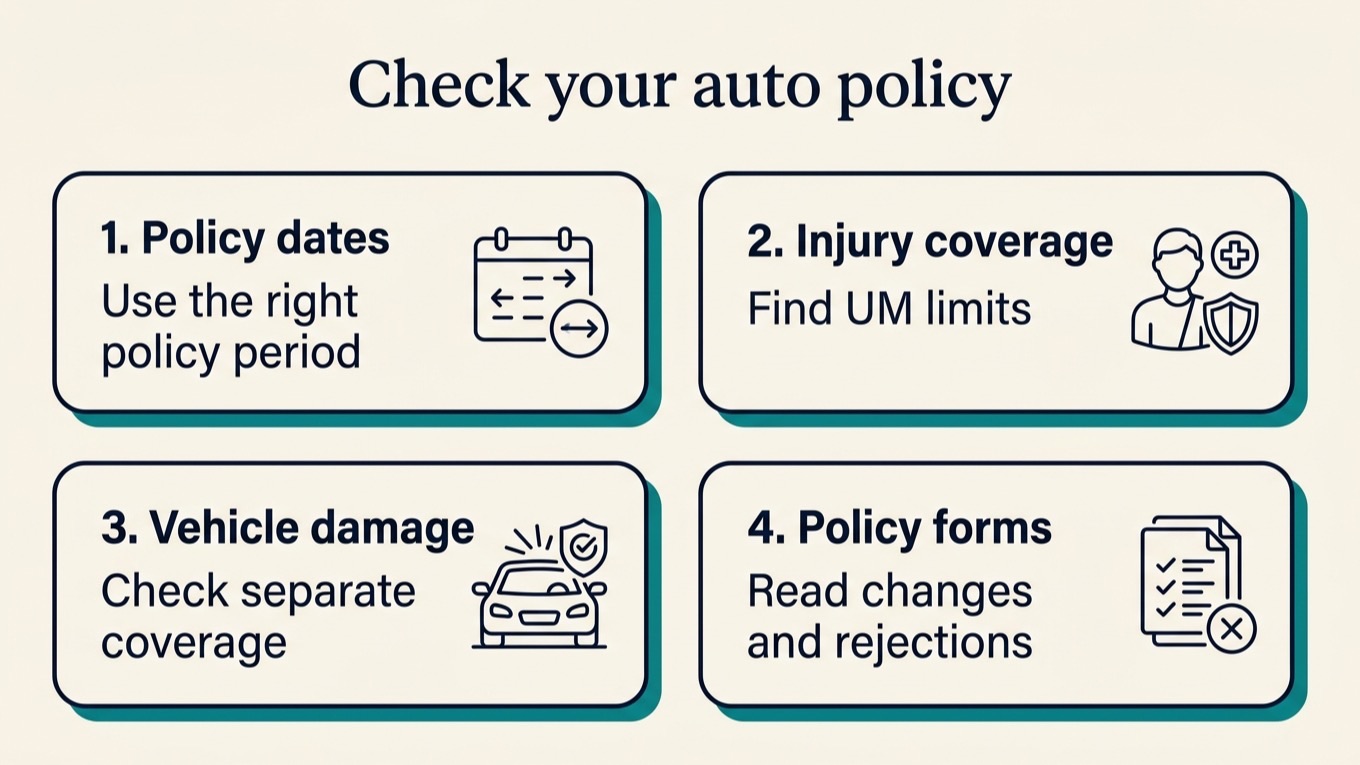
First, get the right version of your policy
Ask your agent or insurer for the complete policy in effect on the date of the accident, including its declarations, endorsements, and coverage-selection forms. A current renewal may have different vehicles, drivers, limits, or terms.
If you’re reviewing coverage before a crash, ask for your current policy and the effective date of any proposed change. A change made now generally doesn’t add protection for a loss that already happened.
Check that the name, address, policy period, and vehicle information match your situation. Tell your agent about a new household driver, a different vehicle, or a change in how you use the car. Don’t assume a driver’s name appearing somewhere on the paperwork resolves every coverage question.
Find the UM coverage entries
Your documents may use “uninsured motorists,” “UM,” “UM/UIM,” or a similar label. Ask the insurer to identify the relevant provision rather than guessing from an abbreviation.
| Item to find | Question it helps answer |
|---|---|
| UM bodily injury | Is there coverage for qualifying injury claims involving an uninsured or underinsured driver? |
| Each-person and each-accident limits | How are the stated injury limits divided among injured people? |
| UM property damage | Is vehicle or other covered property damage included separately? |
| Deductibles | What portion of a covered property claim may you pay? |
| Endorsements and exclusions | What changes or restrictions apply to the coverage? |
| Rejection or lower-limit form | Was coverage declined or selected below the liability limits? |
A coverage limit is a cap under the contract, subject to applicable rules. It isn’t a promise to pay that amount. Fault, covered losses, exclusions, and other available insurance still matter.
Is uninsured motorist coverage automatic in Tennessee?
Tennessee’s UM statute, § 56-7-1201(a), generally requires qualifying auto liability policies to include UM bodily-injury coverage at the bodily-injury liability limits. A named insured can reject it in writing or select permitted lower limits. A signed selection can affect other people insured under the policy and later policy renewals.
That is why “I don’t remember declining it” isn’t the end of the inquiry. Request the actual form and the policy history. If the documents don’t agree, have an attorney examine them before accepting a coverage denial or assuming coverage exists.
The Tennessee Supreme Court’s Kiser decision illustrates why the signed application itself matters when lower UM limits are disputed. It doesn’t establish that every form or every rejection is valid.
Don’t confuse injury coverage with car-repair coverage
UM bodily-injury coverage and UM property-damage coverage address different losses. Collision coverage is another separate policy feature. Ask the insurer which provision it is using for each part of your claim and whether a deductible applies.
For example, you may receive repair instructions while the insurer is still reviewing whether your injury claim qualifies for UM benefits. Approval of one does not necessarily resolve the other.
Health insurance and medical-payments coverage also serve different purposes. Ask how medical bills should be submitted and keep records of payments. Don’t assume every bill will be paid immediately through the eventual injury claim, or that payments from different sources can be kept without checking reimbursement obligations.
Ask who is covered in your particular situation
Coverage can depend on your relationship to the policyholder, where you live, which vehicle you occupied, who owns it, and whether an exclusion applies. The analysis may change for a passenger, someone borrowing a car, or a person struck while walking.
Give the insurer or attorney the actual facts. Useful questions include:
- Am I an insured under this policy for this crash?
- Does the vehicle I occupied have its own UM coverage?
- Could a household policy apply, and in what order?
- Does driving for work, delivery, or rideshare change the answer?
- Which policy language supports your conclusion?
Tennessee sets rules for which UM coverage applies and limits combining coverage from multiple policies. Don’t add the limits for every household vehicle and assume that total is available. If more than one policy may apply, have them reviewed together.
Check the hit-and-run conditions separately
An unknown driver presents additional questions. Ask what the policy requires for reporting, cooperation, and proof of the crash. Tennessee also has special statutory conditions for unknown-driver claims, including a physical-contact or independent-evidence requirement.
If another car forced you off the road without contact, mention that clearly. Preserve witness details and recordings promptly. Our hit-and-run first-steps guide explains why the evidence may matter before anyone knows the other driver’s name.
A short request you can send your agent
Use the crash date or current policy period that applies to you:
Please send my complete auto policy, declarations, endorsements, and any UM rejection or lower-limit forms for the relevant policy period. Please identify my UM bodily-injury and property-damage limits, applicable deductibles, and the policy provisions that explain who is covered.
Keep the response with the policy documents. If an answer is given by phone, write it down and ask for written confirmation of the relevant terms. Don’t rely only on a broad description of the product.
What if the insurer says there is no coverage?
Ask for the reason and the policy language in writing. Find out whether the issue is a rejection, an excluded person or vehicle, the policy dates, or the facts of the crash. Those are different problems and require different records.
The Tennessee Department of Commerce and Insurance’s consumer resources provide a route for insurance questions and complaints. A complaint does not replace legal advice or stop a lawsuit deadline. If you were injured, have the denial and time limits reviewed promptly.
Bring the paperwork, even if it feels incomplete
Our Tennessee car accident attorneys can help you understand coverage questions after an injury crash. You don’t need to know every insurance term before asking for help. Start with the policy, the crash date, and the insurer’s letters.
Call 615-244-2111 or reach out through our online contact form.
Because we care,
Stillman & Friedland