
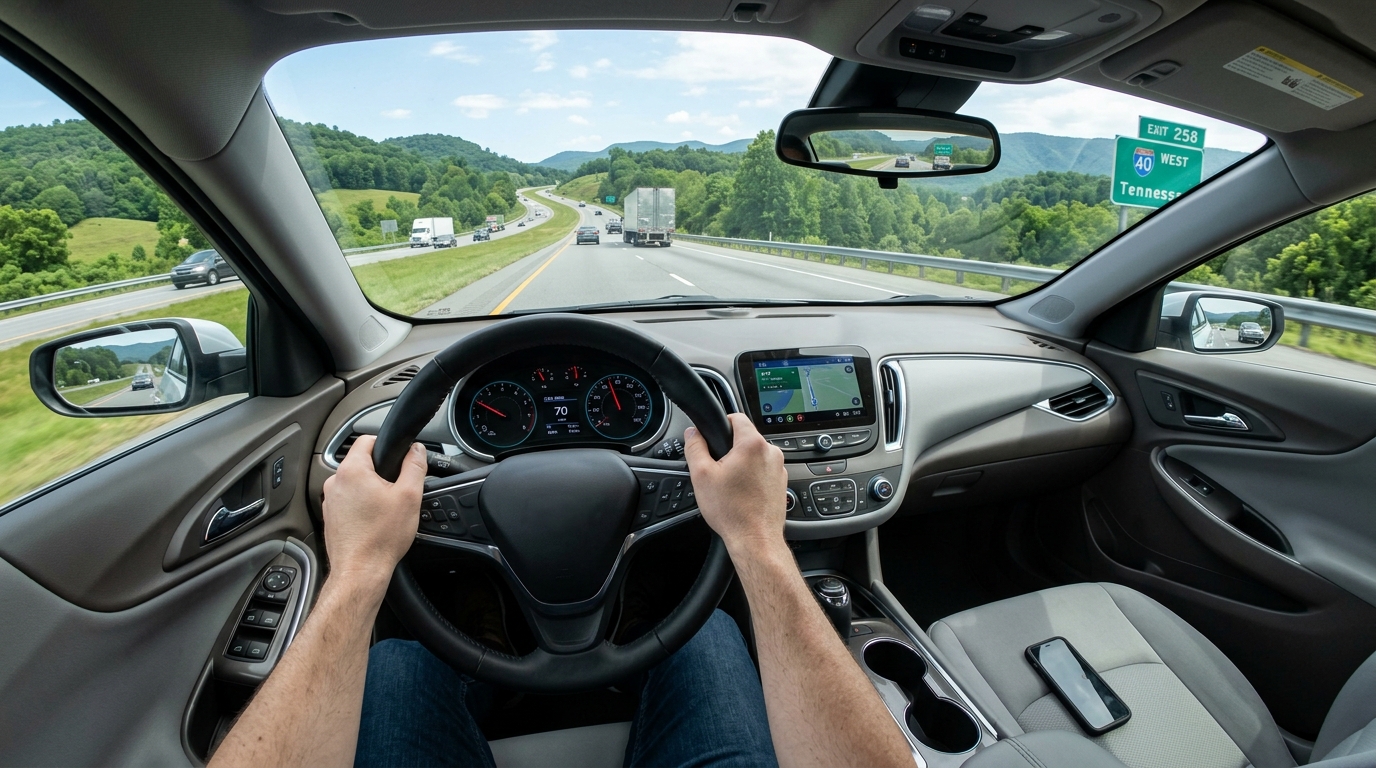

If you ask ten Tennessee drivers what the state’s Hands-Free Law actually says, you’ll probably get ten different answers. Some think it only bans texting. Others think it only applies while the car is moving. A few still believe it’s a recommendation rather than a real law.
Tennessee’s Hands-Free Law has been on the books since July 1, 2019, and it is very real. It shapes how police investigate distracted driving, how insurance adjusters evaluate fault, and — if you’ve been hurt in a crash — how strong your claim may be against the driver who hit you.
Here is a plain-English walk-through of what the law prohibits, what it still allows, and why it matters so much after a wreck.
Where the Law Comes From
The Hands-Free Law is codified in Tenn. Code Ann. § 55-8-199. It replaced Tennessee’s older, narrower ban on texting while driving, which was difficult to enforce because officers had to prove the driver was specifically typing a message.
The 2019 update took a much broader approach. Instead of listing every prohibited activity, the legislature made a simple rule: drivers cannot hold a wireless communication device with any part of their body while operating a motor vehicle on a Tennessee road.
What the Law Prohibits
Under § 55-8-199, a driver operating a motor vehicle on a public road or highway in Tennessee cannot:
- Physically hold or support a wireless telecommunications device with any part of their body.
- Write, send, or read any text-based communication — including text messages, instant messages, email, and social media posts.
- Reach for a device in a way that requires the driver to no longer be in a seated driving position or properly restrained by a seat belt.
- Watch a video or movie on a wireless device other than watching data related to the navigation of the vehicle.
- Record or broadcast video on a wireless device.
Notice what this list includes. It isn’t just texting. It’s picking up the phone to look at a notification. It’s glancing at a TikTok at a red light. It’s reaching into the passenger footwell to grab a phone you dropped.
What the Law Still Allows
The Hands-Free Law isn’t a total ban on phones in vehicles. Tennessee drivers can still legally:
- Use hands-free or voice-activated features.
- Wear a wireless earpiece, headphones, or use a speakerphone, as long as the device itself isn’t being held.
- Use a one-button or single-touch activation to start or end a call.
- Use hands-free GPS and navigation features, including viewing navigation data.
- Use a device while lawfully parked or stopped outside a lane of travel (for example, in a parking lot — not at a red light in a travel lane).
The law also recognizes limited exceptions for:
- Reporting an emergency — a crash, a medical issue, a hazard, or a crime in progress.
- On-duty first responders such as law enforcement, firefighters, EMTs, and certain utility workers responding to an emergency.
- Certain commercial vehicle communications devices that meet federal standards.
The Penalties for a Violation
A violation of Tennessee’s Hands-Free Law is a Class C misdemeanor. The base penalties are:
- $50 for a first, second, or most general offenses.
- $100 for a third or subsequent offense, or for any violation in a marked work zone when workers are present or in an active school zone.
- $200 if the violation caused a crash.
There are also court costs (capped by statute), and the violation adds points to the driver’s record. Enough points can trigger license suspension and higher insurance premiums.
For many drivers, the fine isn’t the biggest consequence. The bigger consequence comes if they’re involved in a wreck while violating the law.
Why the Law Matters So Much After a Crash
Even when a distracted driver isn’t charged or convicted under § 55-8-199, the law still shapes Tennessee injury claims in a major way.
Tennessee follows a modified comparative fault rule under Tenn. Code Ann. § 29-11-103. Under this rule, an injured person can recover damages as long as they were less than 50% at fault for the crash, and the compensation is reduced by their share of fault. You can read more about how that works in our comparative fault series from November 2025.
When a driver violates a clear, specific safety statute — like the Hands-Free Law — that violation can be powerful evidence of negligence. A plaintiff’s attorney doesn’t have to argue in the abstract that the driver was careless. They can point to a statute, point to the evidence of the violation, and say: the Tennessee legislature already decided this was dangerous enough to ban.
That shifts the conversation with the insurance company. Instead of debating whether a driver was “distracted enough” to be at fault, the discussion becomes about whether the violation can be proven and how much it contributed to the crash.
Know Your Rights, Whether or Not There’s a Ticket
It’s worth saying clearly: a driver doesn’t have to be ticketed, charged, or convicted for their Hands-Free Law violation to matter in your civil injury claim. Civil cases use a lower standard of proof than criminal cases, and they can rely on evidence the criminal system never even considered.
We’ll talk more about how that evidence is gathered in the next post in this series. For now, the takeaway is this: if you believe the driver who hit you was on their phone, you are not just imagining a pattern. Tennessee law has drawn a clear line, and if that line was crossed, it may strengthen your claim in ways a general “they weren’t paying attention” argument never could.
We’re Here to Help
If you or a loved one was injured by a driver who wasn’t paying attention to the road in Tennessee, you don’t have to prove it alone. We can help you understand your rights and the evidence that may be out there.
Call 615-244-2111 or reach out through our online contact form.
Because we care,
Stillman & Friedland