
A school-zone crash can happen in seconds: a driver brakes for a flashing sign, a child steps toward a crosswalk, a bus extends its stop arm, or traffic backs up farther than anyone expected.
Afterward, people often reduce the entire collision to one phrase: “It happened in a school zone.”
That location matters, but it does not answer every question. Investigators and insurers still need to know which signs were posted, whether flashers were operating, where the vehicles and pedestrians were, whether a bus was loading students, and what each person could see.
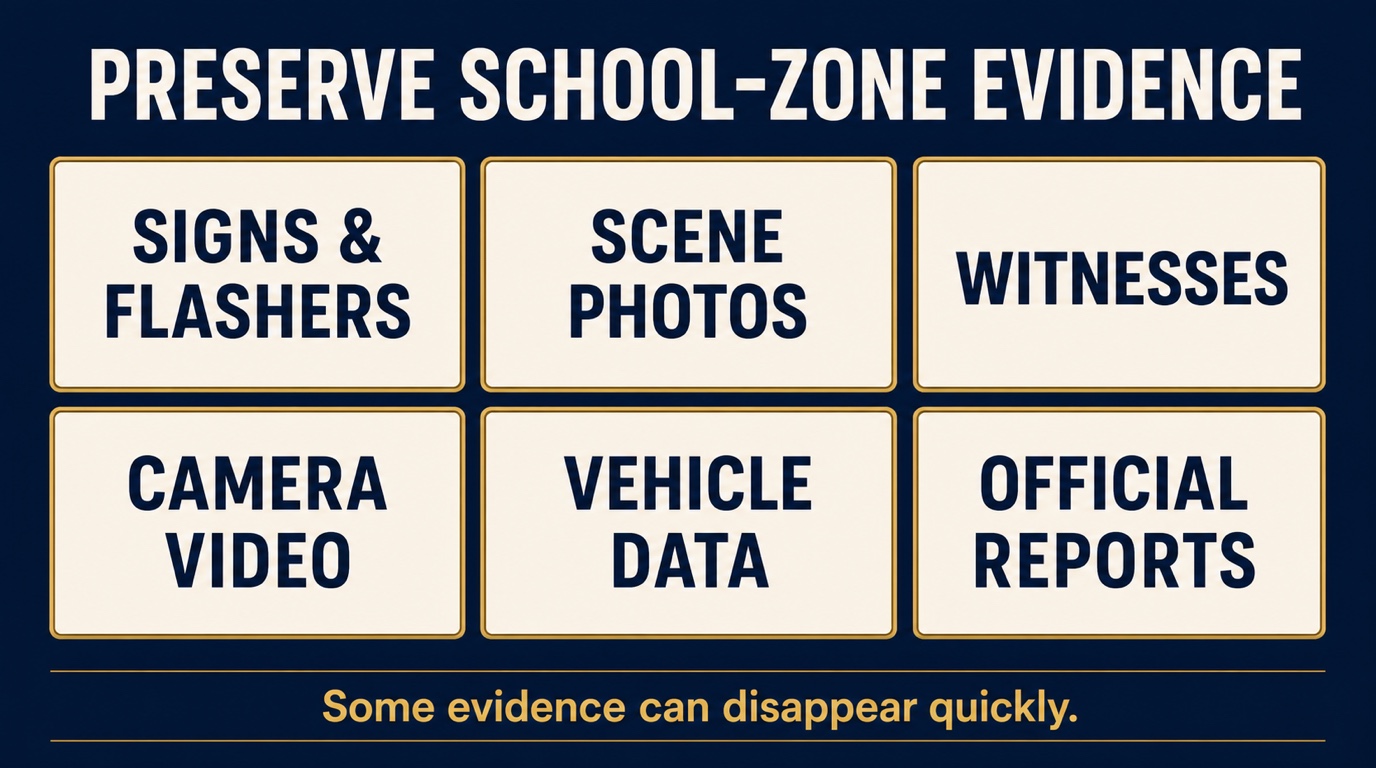
Much of that proof can disappear quickly. Knowing what to preserve may be as important as knowing the rule.
“School Zone” Does Not Mean One Statewide Speed
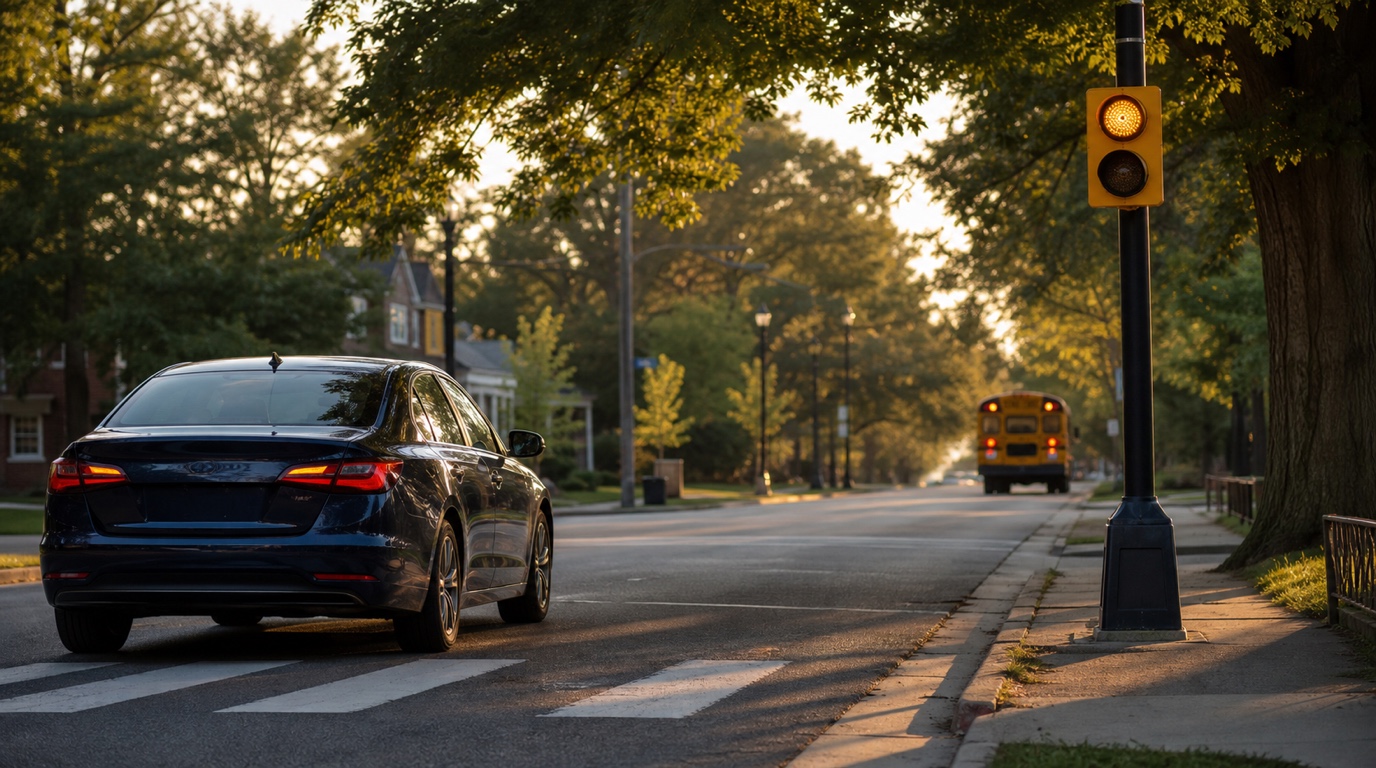
Tennessee law allows government authorities to establish special school-zone speed limits under the conditions described in Tenn. Code Ann. § 55-8-152. The posted limit may depend on the road, engineering review, signs, warning flashers, time, and the presence of children.
Drivers should follow the limit displayed at the specific school. They should not assume every Tennessee school zone is 15, 20, or 25 miles per hour.
After a crash, photograph:
- The speed-limit sign facing each driver’s direction.
- Any school-zone warning sign.
- The location and condition of warning flashers.
- The approach to the school, not only the point of impact.
- Nearby signals, lane markings, crosswalks, and sight obstructions.
If possible, record the time. A photograph taken days later may show the same sign but not whether its flashers were operating when the collision happened.
Speed Is Only One Part of the Fault Analysis
A driver can obey the posted number and still fail to use reasonable care. School arrival and dismissal create predictable risks: children crossing, buses stopping, cars turning into drop-off lanes, parents opening doors, and traffic slowing suddenly.
On the other hand, a crash in front of a school does not automatically prove that a driver was speeding. Vehicle damage, video, skid or tire marks, event data, witness accounts, and the movement of traffic can all help reconstruct speed and reaction time.
Tennessee’s comparative-fault system looks at conduct that contributed to the collision. The analysis may include more than one driver, and it should not be based only on who received a citation.
School-Bus Signals Create Specific Duties
The current Tennessee Comprehensive Driver License Manual explains what motorists should do around school buses:
- Yellow warning lights mean the bus is preparing to stop; drivers should slow and prepare to stop.
- When red lights flash and the stop arm is extended, motorists must stop and remain stopped until the signals are withdrawn and the bus begins moving.
- Drivers approaching from either direction generally must stop.
- A driver meeting the bus from the opposite direction does not have to stop when the highway has separate roadways divided by a median space or barrier that is not suitable for vehicles. A center turn lane is not that kind of barrier.
The road’s actual design matters. Take photographs far enough back to show whether there was a raised median, barrier, center turn lane, or undivided roadway.
Bus-Camera Evidence May Be Available
Tennessee law permits local education agencies to install exterior cameras on school buses for certain stop-arm violations. In 2026, Tennessee enacted Public Chapter 764, addressing whether local law enforcement or authorized school safety personnel reviews that camera evidence.
The law does not mean every bus has a camera or that every recording will be kept indefinitely. If a stopped school bus was involved, identify the bus number, district, route, approximate time, and direction of travel as soon as possible. A preservation request may be needed before routine retention systems overwrite the video.
Other possible video sources include:
- School-building and parking-lot cameras.
- Doorbell and residential security cameras.
- Nearby businesses.
- Dashcams and in-car cameras.
- Traffic or intersection systems.
- Phones used by witnesses after the crash.
Do not assume someone else has already requested the footage.
Crosswalks and Crossing Guards Matter Too
School zones bring together drivers, children, parents, cyclists, and crossing guards. Tennessee law requires drivers to yield under the circumstances described in the state’s crosswalk laws and to exercise due care to avoid colliding with pedestrians.
Children do not always judge distance or speed the way an adult would. That is one reason drivers must be especially attentive near schools. But a fair investigation still needs the precise facts:
- Was the pedestrian in a marked or unmarked crosswalk?
- What did the traffic signal show?
- Where was the crossing guard positioned?
- What instruction was being given?
- Was a stopped vehicle blocking another driver’s view?
- Could the driver see the pedestrian in time to respond?
Our pedestrian series explains Tennessee crosswalk and right-of-way rules and the steps to take after being hit while walking or jogging.
Witnesses Often See Different Parts of the Event
A crossing guard may see the signal. A bus driver may see the stop arm. A parent in the car line may see a vehicle pass. A student may hear a horn or see where a pedestrian entered the roadway.
Collect names and reliable contact information without pressuring anyone to choose a side. Ask witnesses to preserve any original photos or videos. A screenshot of a social-media post may lose timestamps, location information, or image quality found in the original file.
The investigating officer’s report is important, but it may summarize rather than capture every witness’s complete account. Tennessee Rule of Evidence 803 also excludes certain police observations and accident reports from hearsay exceptions used in court. Save the report number and confirm which agency handled the crash, but preserve independent evidence too.
Vehicle and Phone Data Can Clarify the Timeline
Depending on the vehicles and the seriousness of the crash, evidence may exist in:
- Event data recorders.
- Advanced driver-assistance systems.
- Dashcams.
- Navigation and route history.
- Fleet or rideshare platforms.
- Phone records and application data.
This evidence is not self-explanatory, and access may require consent, a preservation request, or formal legal process. Do not reset, sell, repair, or dispose of a device or vehicle that may contain important information without first asking how the evidence can be protected.
Public-School Involvement Can Add Special Rules
Some school-zone crashes involve only private drivers. Others may involve a public-school bus, crossing guard, roadway design, traffic-control device, or public employee.
Potential claims involving a government entity can have different immunity, notice, procedure, and deadline issues. The presence of a public vehicle or employee does not automatically make the government responsible, but it is a reason to identify all involved entities and get case-specific advice promptly.
Preserve the Scene Before It Returns to Normal
By the next morning, cones may be moved, a tree may be trimmed, a vehicle may be repaired, and camera systems may begin overwriting footage. A careful record should capture:
- The entire approach from each relevant direction.
- Signs, flashers, lanes, medians, barriers, crosswalks, and bus position.
- Vehicle damage and final resting positions.
- Weather, light, visibility, and traffic conditions.
- Witnesses and camera locations.
- School, route, bus, and investigating-agency information.
Take those steps only when it is safe. Do not stand in traffic or interfere with emergency responders to get a photograph.
We’re Here to Help
If you or your child was injured in a Tennessee school-zone or school-bus-related crash, the most useful evidence may not remain available for long. We can help identify what should be preserved and explain how the location, traffic rules, and people involved may affect the claim.
Call 615-244-2111 or reach out through our online contact form.
Because we care,
Stillman & Friedland