
Ask the average Tennessee driver who has the right of way in a crosswalk and you’ll get a confident answer that’s only half right. People generally know they’re supposed to “yield to pedestrians”, but they don’t always know when, where, or what yielding actually requires.
The result, every spring and summer, is a steady stream of crashes that didn’t have to happen. People hit in marked crosswalks. People hit at intersections that don’t have any paint at all. People hit by drivers turning right on red who never looked left. In almost every case, the driver insists they had no idea anyone was there.
If you were hurt while walking, jogging, or pushing a stroller in Tennessee, the law is probably more on your side than the other driver’s insurance company would like you to believe. Here’s a plain-English walk-through of what the rules actually say.
The Core Rule: Yield to Pedestrians in Crosswalks
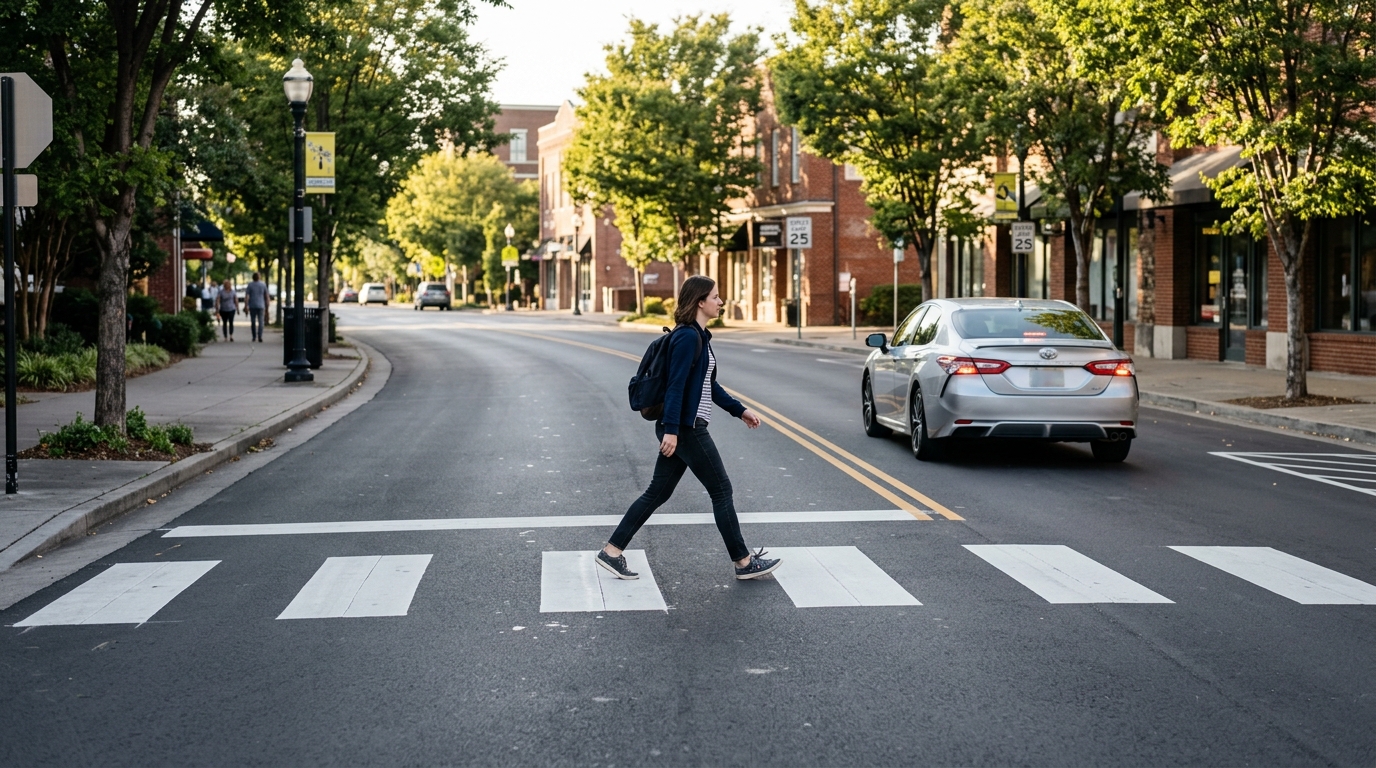
The starting point is Tenn. Code Ann. § 55-8-134. Under that statute, when traffic-control signals are not in place or not in operation, the driver of a vehicle must yield the right-of-way to a pedestrian crossing the roadway in a crosswalk if the pedestrian is on the driver’s half of the roadway, or close enough to it to be in danger.
In plain English: if a person is in the crosswalk on your side of the road, or about to step into it, you stop. You don’t roll. You don’t ease forward. You stop.
The same statute also tells pedestrians not to “suddenly leave a curb or other place of safety and walk or run into the path of a vehicle which is so close that it is impossible for the driver to yield.” That language matters, because insurance adjusters love to argue it. But the bar is high — “so close that it is impossible for the driver to yield” is a much narrower defense than “the pedestrian moved without warning.”
Marked vs. Unmarked Crosswalks
Here is one of the most misunderstood points in Tennessee traffic law: every intersection has a crosswalk, even if no paint is on the pavement.
Under Tennessee’s traffic code, a “crosswalk” includes both the marked white lines you see at busy intersections and the unmarked extension of a sidewalk across the roadway at any intersection. So when two streets meet and a pedestrian is crossing along the natural line of the sidewalk, that pedestrian is in a crosswalk — even on a quiet residential corner with no paint, no signal, and no signs.
That single fact is the answer to a surprising number of “but there was no crosswalk” arguments after a wreck.
When a Pedestrian Crosses Outside a Crosswalk
Tenn. Code Ann. § 55-8-135 addresses pedestrians crossing somewhere other than at an intersection or in a marked crosswalk. The general rule is that a pedestrian crossing “at any point other than within a marked crosswalk or within an unmarked crosswalk at an intersection” must yield the right-of-way to vehicles on the roadway.
Two things to understand here.
First, “yield” doesn’t mean “give up your right to be there.” A pedestrian crossing mid-block is allowed to cross — they just have to yield to traffic. If a driver had a clear view, plenty of time and distance, and still hit them, the driver is not off the hook simply because the pedestrian wasn’t at an intersection.
Second, even when a pedestrian is technically out of position, drivers still have an independent duty to avoid hitting them. That duty comes from the next statute on the list.
The “Due Care” Rule Drivers Forget
Tenn. Code Ann. § 55-8-136 is the safety net underneath every other right-of-way rule in Tennessee. It requires every driver to exercise due care to avoid colliding with any pedestrian on the roadway and to give a warning by sounding the horn when necessary.
This is the statute that an insurance company would prefer you not know about. It means a driver doesn’t get a free pass just because the pedestrian was technically jaywalking, or wearing dark clothes, or stepped off a curb at the wrong moment. If a reasonably attentive driver could have seen the pedestrian and avoided the collision, the driver is on the hook.
For more on how Tennessee’s modified comparative fault rule then divides up that responsibility, see our November 2025 series on comparative fault.
The Mistakes Drivers Make Most Often
A few patterns show up over and over again in Tennessee pedestrian cases:
- Rolling right turns on red. Drivers turning right are looking left for cars and miss the pedestrian crossing in front of them. The pedestrian had the walk signal. The driver simply didn’t look.
- Blocking the crosswalk at red lights. Stopping with the front of the car halfway into the crosswalk forces pedestrians to walk into the travel lane. When the next car comes through, that’s where the impact happens.
- Passing a vehicle stopped at a crosswalk. A car stopped for a pedestrian is a giant warning sign. Drivers who go around it at speed are responsible for what happens on the other side.
- School zones and bus stops. Children move unpredictably. Tennessee gives them extra protection for a reason.
- Parking lots and driveways. Pedestrians have right-of-way on a sidewalk when a vehicle is crossing it to enter or leave a driveway. This is a near-constant source of low-speed but serious injuries.
What This Means If You Were Hit
If you were struck by a vehicle while walking in Tennessee, the question of who had the right of way is rarely as simple as the at-fault driver’s adjuster will make it sound. The statutes above interact, and so does Tennessee’s modified comparative fault rule. Even if a piece of the situation works against you, that’s not the end of the analysis — it’s the beginning.
The next post in this series walks through exactly what to do in the hours and days after a pedestrian crash, including how to protect a claim that the insurance company is already starting to evaluate.
We’re Here to Help
If you or a loved one was hit while walking, running, or pushing a stroller in Tennessee, you don’t have to argue the law alone. We can help you understand your rights and the evidence that may already be working in your favor.
Call 615-244-2111 or reach out through our online contact form.
Because we care,
Stillman & Friedland