
Most people imagine pedestrian and cyclist crashes as the kind of thing that happens because of one bad driver on one bad day. Sometimes that’s true. Just as often, the wreck is the predictable result of conditions that were stacked against the person on foot or on the bike long before the impact: poor visibility, a sidewalk that ends without warning, a bike lane that disappears mid-block, a crosswalk so faded it’s invisible at sunset.
This last post in our May series looks at the conditions that make Tennessee streets and paths more dangerous than they need to be, the equipment and habits that meaningfully reduce risk, and the rights that come into play when bad design or poor maintenance contributes to a crash.
Visibility Is the Single Biggest Factor
Federal and state safety data tell the same story year after year: a disproportionate share of pedestrian and cyclist fatalities happen at dawn, dusk, and after dark. The reasons are simple and stack on each other — drivers’ eyes are still adjusting, contrast is low, headlights only do so much, and pedestrians and cyclists assume they’re more visible than they actually are.
If you’re going to be on Tennessee roads as the days get longer, a few habits make a measurable difference:
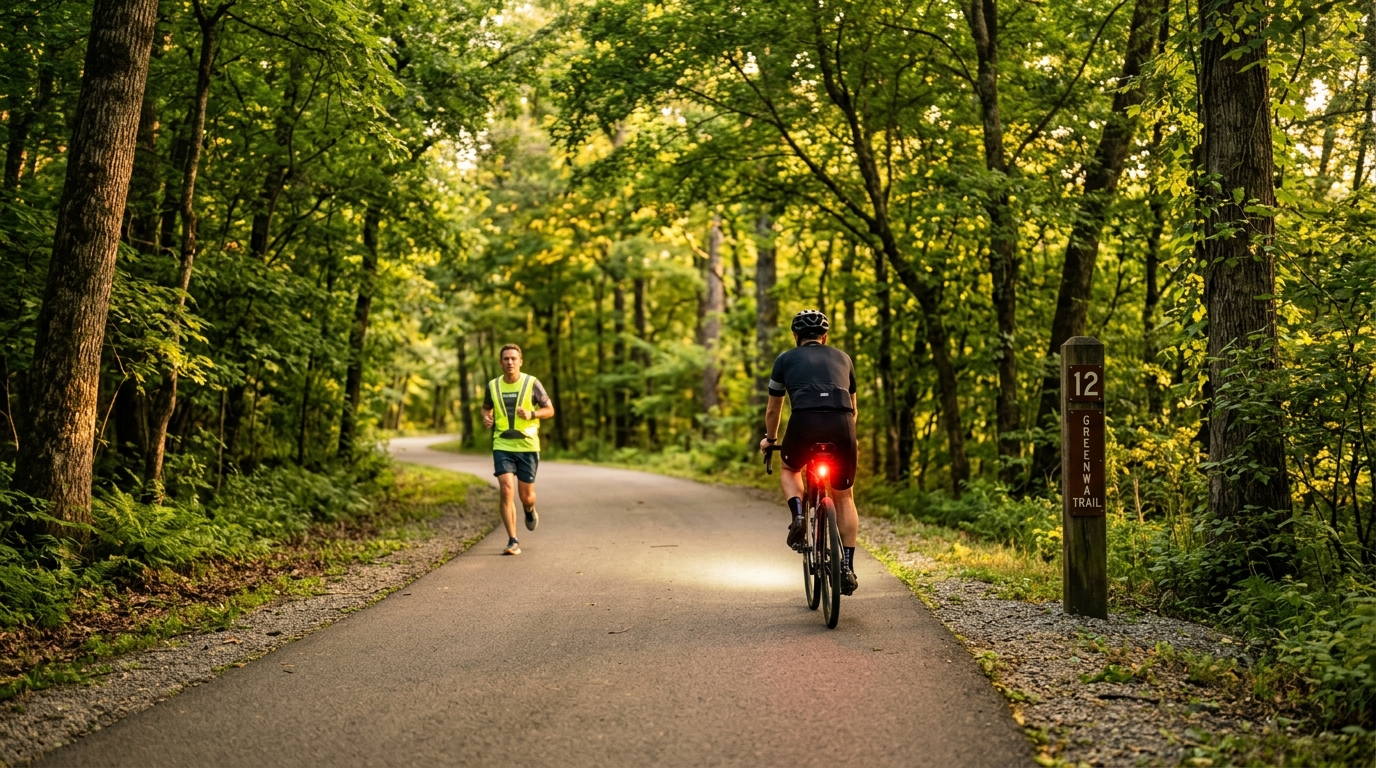
- Lights on bikes, both directions. A steady or blinking white front lamp and a red rear lamp are the absolute minimum for any ride that runs into evening hours.
- Reflective gear. Reflective ankle bands, vests, and trim on backpacks are some of the cheapest, most effective pieces of safety equipment available. They catch headlights long before any color of clothing does.
- Bright, contrasting clothing. Not just light-colored — high-visibility yellow and orange show up well even in low-contrast conditions.
- A predictable line. Drivers struggle most with movement they don’t expect. Walking and riding in straight, predictable paths gives them more time to react.
None of this is required by law for a pedestrian on a sidewalk, and most of it is required for cyclists only after dark. But on the practical safety side, it’s the single biggest lever you control.
What Tennessee Law Actually Requires for Cyclists
We touched on this in our post on bicycle accident claims. The short version: Tenn. Code Ann. § 55-8-177 sets the equipment baseline for bikes ridden on Tennessee roads, particularly at night.
In general terms, Tennessee bicycles ridden after dark must have:
- A front lamp emitting a white light visible from a substantial distance ahead.
- A rear red reflector (or a rear red lamp) visible from a substantial distance behind.
- Working brakes capable of stopping the bicycle on dry, level pavement.
Tennessee’s three-foot safe-passing rule lives in Tenn. Code Ann. § 55-8-175, and applies to drivers passing cyclists in the same direction at any time of day.
If you’re riding without lights at night and a driver hits you, lighting will come up. It rarely ends a claim by itself, but it can affect how comparative fault is allocated.
Greenways, Shared-Use Paths, and E-Bikes
Tennessee has invested heavily in greenways and shared-use paths, especially in and around Nashville, Knoxville, Chattanooga, and Memphis. These paths are wonderful — and they’re not the same as the street.
A few realities to keep in mind:
- Pedestrians, runners, dogs, strollers, and cyclists share the same space. Speed differences are larger than on a street, and sight lines around bends are often worse.
- Path “rules of the road” vary by jurisdiction. Most paths follow some version of “stay right, pass on the left, announce yourself.” Speed limits, where posted, are often 15 mph or lower.
- E-bikes complicate things. Tennessee defines e-bike classes, and local rules sometimes restrict where higher-class e-bikes can ride on shared-use paths. Speeds that feel reasonable on a road are dangerous on a path.
- Headphones, distraction, and pets. Many path-vs-path crashes involve a pedestrian or cyclist who didn’t hear the call from behind. Dogs on long retractable leashes are a quiet but constant cause of falls.
When two people on a path collide, the case looks more like a typical negligence claim and less like a car-vs-pedestrian case. Liability turns on who was paying attention, who was where they should have been, and who had the time and space to avoid the impact.
When Road Design or Maintenance Contributes
Some crashes happen on roads that were dangerous before either driver or pedestrian arrived. The most common road-design issues we see in Tennessee pedestrian and cyclist cases:
- Sidewalks that end without warning — forcing pedestrians into the travel lane.
- Faded or missing crosswalk paint at intersections that need it most.
- Bike lanes that disappear mid-block, or that drop riders into a right-turn lane without a transition.
- Poor sight lines at intersections — overgrown vegetation, parked-car obstructions, or curves that hide oncoming traffic.
- Inadequate school-zone signage and lighting in neighborhoods with high foot traffic.
- Pothole and surface defects that cause cyclist falls and force evasive maneuvers into traffic.
When poor road design or maintenance is a real factor in a crash, a claim against the responsible government entity — city, county, or the State of Tennessee — may be possible alongside any claim against the driver.
These claims are more complicated than a typical injury case. Tennessee has specific notice requirements (often very short — sometimes a matter of months), specific damage caps, and specific procedures that vary depending on which entity is responsible. Missing a deadline can end the claim before it begins.
If a road, intersection, or path condition seems like it played a role in your crash, this is one of the strongest reasons to talk to a Tennessee attorney quickly rather than waiting.
Practical Safety Heading Into the Tennessee Summer
A few last reminders for runners, walkers, families with kids on bikes, and serious cyclists heading into the long days ahead:
- Don’t assume drivers see you. Make eye contact at intersections. If you don’t get it, don’t enter the lane.
- Beware the right-hook. When a car passes you, expect it to turn. Even when there’s no signal.
- Watch the doors of parked cars. Ride one full door-width away from any parked vehicle that might be occupied.
- Lights on early. As the sun gets low, turn lights on before you think you need them, not after.
- Treat children as unpredictable, because they are. Slow down through any zone with bikes, scooters, strollers, or kids playing. Tennessee drivers in residential neighborhoods routinely move faster than the conditions allow.
- Keep your evidence kit ready. A phone with a charged battery and a few minutes of sense-memory at the scene of a wreck — vehicle description, witness names, camera locations — is worth more than any photo you can take a week later.
Looking Ahead in 2026
This series wraps up our May focus on pedestrian and cyclist safety. Coming up:
- June 2026 — Rideshare wrecks. If you’ve ever wondered who’s actually liable when you’re hit by an Uber or Lyft driver — or while you’re a passenger in one — that series is for you.
- October 2026 — Hit-and-run and uninsured motorist claims. A deeper dive into the coverage issues introduced in post 4 of this series.
If you want to revisit the foundations of Tennessee fault and negligence law, our November 2025 fault series is the best place to start.
We’re Here to Help
If you or a loved one was hurt while walking, running, or riding a bike in Tennessee — and you suspect the road, the design, or a government entity’s maintenance played a role — please don’t wait. The deadlines on those claims can be short. We can help you understand your rights and act in time.
Call 615-244-2111 or reach out through our online contact form.
Because we care,
Stillman & Friedland