


Before discussing a Tennessee truck accident with an insurance adjuster, find out who the caller represents, write down the claim number, and ask what they need. Give truthful information without guessing. You can ask to arrange a detailed conversation after you understand the request and have had a chance to get legal advice. Your own policy may require prompt notice and cooperation.
That first call can arrive while you’re still arranging a ride home or trying to understand your medical paperwork. A calm voice on the phone may ask whether you’re feeling better, what happened, and whether you’d like to get the claim settled. You may not yet know the answers.
You don’t have to reconstruct a truck crash from memory during an unexpected call. Start by putting the conversation in context.
Who does this adjuster represent?
A commercial truck may involve a driver, a motor carrier, separate equipment owners, and several insurers. The name painted on the trailer may not match the name the caller gives you.
Ask for the caller’s name, company, direct phone number, claim number, and the person or business they represent. Ask whether the call is being recorded. If anything seems unclear, verify the contact through an independent company number before sharing sensitive information.
An adjuster assigned by the trucking company’s insurer evaluates the claim for that insurer. A friendly conversation doesn’t make the adjuster your legal adviser. The same person may handle only one part of the loss, such as vehicle damage, while another person handles injuries.
Write those roles down. They matter when deciding where to send documents and whom to ask about a decision.
Is this your insurer or the trucking company’s insurer?
These calls can involve different responsibilities.
| Caller | What to clarify first |
|---|---|
| Your auto insurer | What notice, information, and cooperation your policy requires; which coverages may apply |
| The trucking company’s insurer | Whom it insures, whether it has accepted or is investigating responsibility, and what it is requesting |
| An independent claims service | Which insurer or company hired it and which part of the claim it handles |
| Someone offering a settlement | Which claims and people a proposed payment or release would cover |
Don’t ignore your own insurer because another company has opened a file. The National Association of Insurance Commissioners’ auto-claim guidance recommends prompt reporting, cooperation with the investigation, and keeping notes of conversations. The exact obligations depend on your policy and the request.
If you’re unsure whether you must provide a statement, ask for the request and relevant policy provision in writing. Have an attorney review it promptly rather than assuming every request is optional.
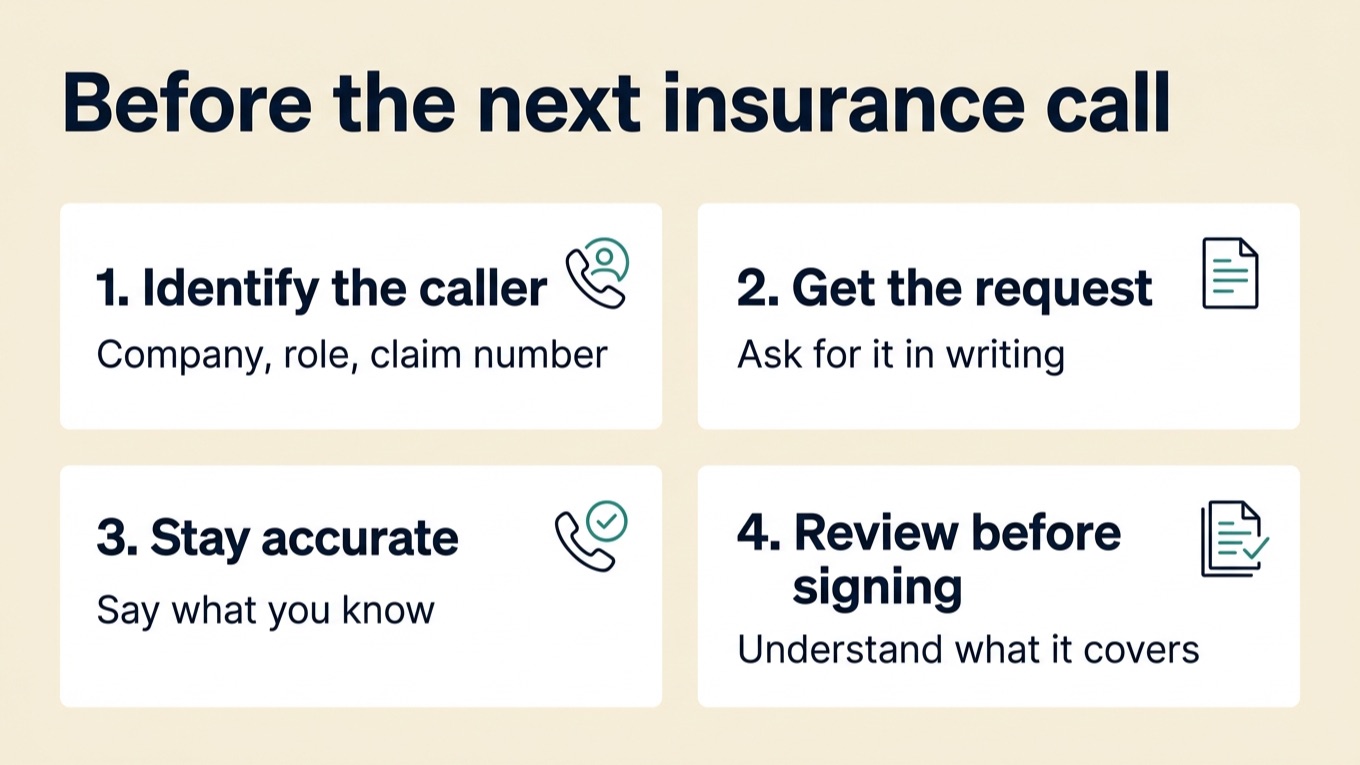
What can you say during an unexpected first call?
Keep the conversation accurate and manageable. You can confirm basic contact information after verifying the caller, collect the claim details, and ask for written requests.
For example, you might say:
I’m still gathering information and getting medical care. Please send me your contact details, claim number, and what you’re requesting in writing so I can review it.
Use wording that is true for you. Don’t say you’re receiving treatment if you aren’t, and don’t suggest you have an attorney if you haven’t hired one.
If you already have an attorney handling this claim, give the caller the attorney’s contact information and tell your attorney about the call. Keep any voicemail or message that came with it.
Should you give a recorded statement right away?
Find out why the statement is requested, who will receive it, and whether a policy obligation applies before agreeing. A recorded statement creates a lasting account of what you said. It is easy to give an estimate that later sounds more certain than you intended.
Suppose the adjuster asks how fast the truck was going. You may know it moved into your lane, but you may never have seen its speed. Say what you observed. Don’t turn a guess into a number.
The same applies to distances, signals, and timing. “I didn’t see a turn signal” and “the driver never signaled” aren’t always the same statement. Describe what you could actually see from your position.
Never invent facts, hide relevant information, or rehearse a false account. The goal is an accurate record. If pain, medication, or distress makes a detailed conversation difficult, explain that and ask about arranging it at an appropriate time.
How should you answer questions about injuries?
Describe your present symptoms and the care you’ve received without making a medical prediction. Feeling better today doesn’t necessarily tell you when treatment will end or whether you’ll need follow-up care.
If you’re still being evaluated, say so. If you don’t know whether a condition is related to the crash, explain what you know and let your treating professional evaluate it.
Keep your appointment information, bills, discharge instructions, and work restrictions together. Our guide to medical records after a Tennessee crash explains how those records help document the claim.
If a caller requests a medical authorization, read what it permits, which providers and dates it covers, and who can receive the information. Ask an attorney about the scope before signing something you don’t understand.
What if they offer to pay for your car immediately?
Clarify whether the offer concerns vehicle damage, injuries, or both. Don’t rely on the caller’s short description of a document. Read the actual payment terms and any release.
A release can end claims within its scope. Ask which claims it resolves and whether accepting it would affect any other part of the case. Get legal advice before signing a broad release while your injuries or the responsible parties remain unclear.
Vehicle decisions also affect evidence. Before authorizing salvage, disposal, or repairs that could change crash evidence, ask whether an inspection or data download is needed. Tell your attorney about storage charges and any pending deadline so preservation can be arranged without an open-ended delay.
Does opening an insurance claim preserve truck evidence?
Don’t assume it does. A claim number doesn’t tell you whether someone has preserved the truck’s electronic records, camera footage, dispatch messages, or damaged parts.
Save what you already have, including original photographs, dashcam files, witness contacts, and the truck’s identifying information. Let an attorney identify the people and companies that may hold additional evidence. Our truck black box and driver-log guide explains why each source needs separate attention.
Also keep reporting duties separate from insurance calls. Tennessee’s Owner Operator Report guidance explains when that report is required, including crashes involving injury or death. When required, it must be submitted within 20 days and is additional to the investigating officer’s report.
What if you already gave a statement?
Giving a statement doesn’t, by itself, tell you whether a claim will succeed or fail. Write down when you spoke, whom you spoke with, and anything you believe was inaccurate or incomplete. Ask for a copy of the recording or transcript, and tell your attorney about it.
Don’t create a new version to make the facts sound better. Explain any real mistake and what information helped you recognize it.
Before your next call, have your claim number, written requests, and questions ready. Ask who is handling the next step and when you should expect a response. Insurance discussions can continue while legal deadlines run, so have those deadlines checked early.
Get help with the next conversation
Our Tennessee truck accident attorneys can help you understand the requests you’re receiving after a Tennessee truck crash and what evidence may need attention now. Bring the claim details and any documents you’ve been asked to sign.
Call 615-244-2111 or reach out through our online contact form.
Because we care,
Stillman & Friedland