


When a teenage driver causes a crash, the first question may be simple: Is everyone safe?
The questions that follow are not.
Whose insurance applies? Is the teen legally responsible? What about the parent who signed the license application, the person who owned the car, or the family member who gave permission to drive it? If the teenager was violating a passenger or nighttime restriction, does that decide the injury claim?
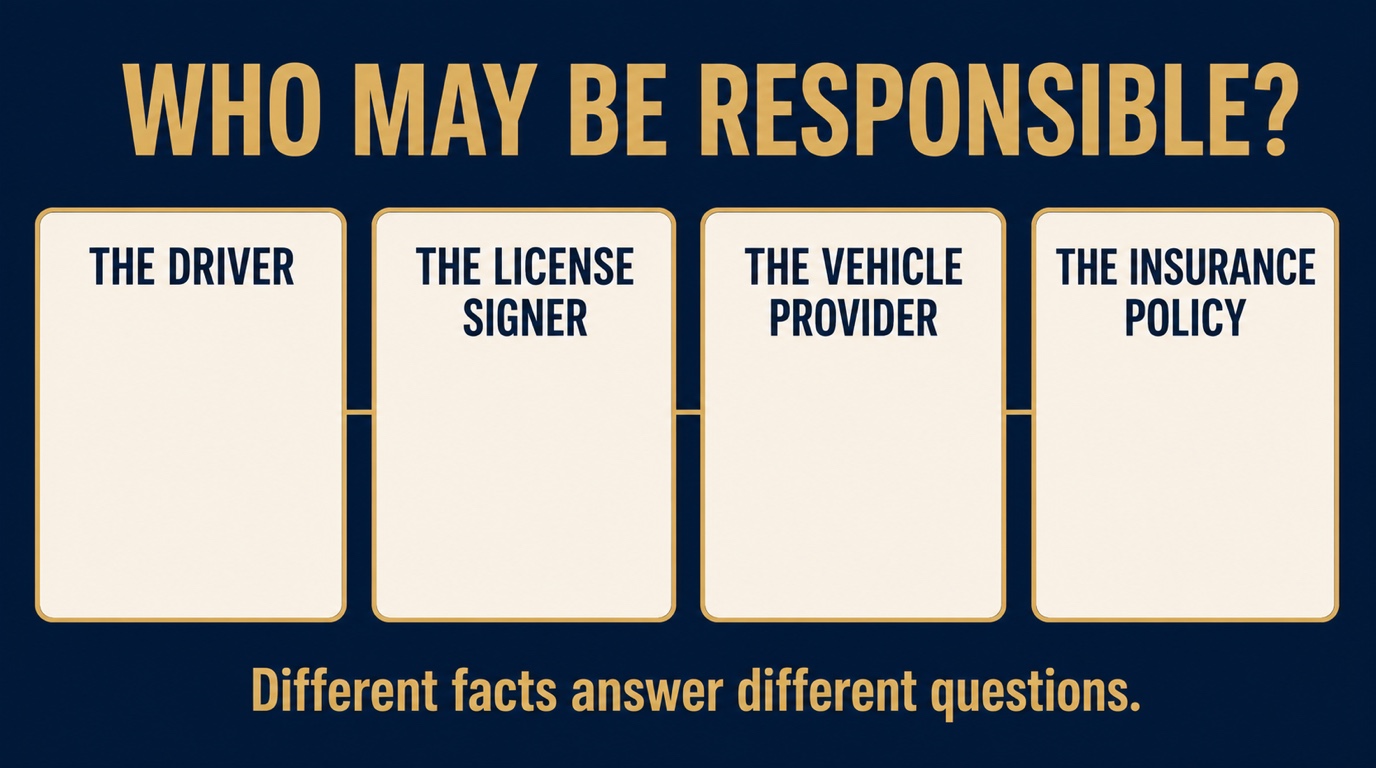
Tennessee law does not answer all of those questions with one automatic rule. Several different paths to responsibility may apply, and they depend on different facts.
Here is how those pieces fit together.
Start With What Each Driver Did
A teenager is not automatically at fault because the driver is young or inexperienced. The first question is the same one asked in other Tennessee crashes: what did each person do, and how did those actions contribute to the collision?
Evidence may show that a driver:
- Failed to yield.
- Followed too closely.
- Drove too fast for the conditions.
- Used a phone or became distracted by passengers.
- Disregarded a traffic signal, crossing guard, or school-bus stop arm.
- Made an unsafe lane change or turn.
It is also possible for another driver to share or carry most of the fault. Tennessee’s comparative-fault system looks at the conduct of everyone whose actions contributed. A ticket can matter, but it does not make the civil investigation unnecessary. Our November series explains why police reports do not always decide fault and how negligence is proven after a Tennessee crash.
The Person Who Signed the Minor’s Application May Matter
Tennessee has a specific statute for licensing drivers under 18. Tenn. Code Ann. § 55-50-312 requires a qualifying adult to sign and verify a minor’s application. Subject to an exception involving proof of financial responsibility, the statute provides that a minor driver’s negligence, willful misconduct, or motor-vehicle-law violation may be imputed to the person who signed the application. It also describes joint and several liability for resulting damages or fines. Tennessee’s official Minor/Teenage Affidavit and Cancellation reproduces the signer-liability warning from that statute.
That is more specific than the broad statement that “parents are responsible for their children.” The important questions include:
- Was the driver under 18 when the crash occurred?
- Who actually signed the permit or license application?
- Was the required proof of financial responsibility in place?
- Does the statutory exception apply?
The signer may be a parent, stepparent, grandparent, guardian, foster parent, or another qualifying adult described by the statute. Do not assume the vehicle’s owner and the application signer are the same person.
The Family Purpose Doctrine Is a Separate Question
Tennessee also recognizes the family purpose doctrine. This doctrine can make a head of household who furnishes and maintains a vehicle for family use vicariously responsible for negligent operation by a family member under the circumstances Tennessee law requires.
The Tennessee Supreme Court examined those requirements in Starr v. Hill, a case involving a sixteen-year-old driver and a vehicle owned, insured, and provided by his father. The Court focused on whether the owner was a head of household, whether the vehicle was furnished and maintained for the family’s pleasure or comfort, and whether it was being used for that purpose with express or implied permission and sufficient control.
That means ownership alone does not complete the analysis. A car titled to a parent, grandparent, sibling, business, or another person may raise different questions about who furnished it, why it was available, and who controlled its use.
Permission and Knowledge Can Create Additional Issues
Sometimes the dispute is not simply whether the teen had general permission. It is whether the owner entrusted the vehicle to someone the owner knew, or reasonably should have known, was not fit to drive it safely.
Facts that may require closer review include:
- No valid license or a suspended license.
- A known pattern of dangerous driving.
- Repeated serious rule violations.
- Impairment, extreme fatigue, or a medical limitation known before the trip.
- Permission to use a vehicle the teen was not capable of operating safely.
This type of claim is fact-specific. In Ali v. Fisher, the Tennessee Supreme Court described negligent entrustment as a direct claim based on the fault of the person who supplied the vehicle, including knowledge or reason to know that the user was unlikely to operate it safely. One mistake by a new driver does not automatically prove that another person negligently entrusted the vehicle.
Insurance Coverage Is Not the Same as Legal Fault
Families often hear an adjuster say, “The teen isn’t listed,” or “That driver wasn’t supposed to have the car,” and assume the claim is over. It may not be.
Auto coverage can depend on policy language addressing:
- Named insureds and resident family members.
- Listed and unlisted household drivers.
- Permission to use the vehicle.
- Excluded drivers.
- The vehicle involved.
- Other available household or umbrella coverage.
The policy should be reviewed, not guessed at from an insurance card or a short phone call. Legal responsibility and insurance coverage are connected, but they are not identical questions. A person may be legally responsible even when coverage is disputed, and a policy may cover a claim without making every insured person personally at fault.
Passenger Claims Need Their Own Analysis
The injured person may be a friend, sibling, teammate, or other passenger riding with the teen. That passenger generally did not control the vehicle, but an insurer may still ask about seat-belt use, knowingly riding with an impaired driver, or other conduct it believes contributed to the injury.
The fact that the passenger and driver are friends does not prevent a claim. In many cases, the practical claim is handled through insurance rather than a family personally paying medical bills out of pocket.
An Intermediate Restricted driver’s passenger limits can also be relevant. But a licensing violation does not automatically establish the cause of the collision. The investigation should determine whether the number or behavior of passengers affected the driver’s attention and whether the restriction applied to that trip.
Evidence Helps Identify Both Responsibility and Coverage
After a teen-driver crash, preserve information that answers more than “who hit whom.”
Useful evidence may include:
- The teen’s permit or license and its current stage.
- The license application and identity of the signer.
- Vehicle title, registration, and insurance policies.
- Household-driver and excluded-driver information.
- Messages about permission, destination, passengers, or return time.
- Photographs, video, witness contacts, and the crash report.
- Phone, vehicle, dashcam, school, or business records that may show what happened.
Do not delete messages or recreate a cleaner version of events. Preserve the original information and let the facts be evaluated honestly.
A Quick Insurance Answer May Not Be the Final Answer
A crash involving a minor can trigger several overlapping legal and coverage questions. The young driver, application signer, vehicle owner, head of household, and insurer may not be the same person. Each role must be checked separately.
That is why an early statement such as “the parents are always liable” or “no one can recover because the teen was not listed” is usually too broad. The documents, relationships, permission, control, and policy language matter.
We’re Here to Help
If you or your child was hurt in a crash involving a teenage driver, we can help identify the people, policies, and evidence that may matter. You do not have to accept a rushed conclusion before the full picture is known.
Call 615-244-2111 or reach out through our online contact form.
Because we care,
Stillman & Friedland