
There are few things more disorienting than being hit by a vehicle and watching it drive away. One moment you’re a person on the side of the road. The next moment you’re a person on the side of the road who doesn’t know who hit them, doesn’t know if they’ll ever know, and is suddenly worried that the wreck you couldn’t avoid is now a wreck no one will pay for.
Tennessee pedestrians and cyclists hit by drivers who leave the scene have more options than they often realize. The law takes hit-and-runs seriously, the investigation can do more than victims expect, and even when the driver is never identified, there are usually still ways to recover. Here’s how it works.
Tennessee Drivers Have a Legal Duty to Stop
Under Tenn. Code Ann. § 55-10-101 and the surrounding sections, a driver involved in a crash that results in injury — including a crash involving a pedestrian or cyclist — has a duty to:
- Immediately stop at the scene or as close as safely possible.
- Remain at the scene until the duties below are completed.
- Render reasonable assistance to anyone injured, including arranging transportation to medical care if it appears necessary.
- Provide identification — name, address, vehicle registration, and, on request, driver’s license — to anyone struck or to investigating officers.
Leaving the scene of a crash that resulted in injury is a serious offense in Tennessee, and the penalties scale with the severity of the injury. When the result is death, leaving the scene is a felony.
For our purposes, the bigger point is that this duty exists whether the person hit was in a car, on a bike, or on foot. A driver who hits a pedestrian and keeps going has broken Tennessee law the moment they passed the scene without stopping.
What to Do in the First 24 Hours
If you’ve just been the victim of a hit-and-run while walking or riding, the next day is the most important window you’ll have.
At the scene, if you’re able:
- Call 911 immediately. A prompt report makes everything that follows easier — including any later insurance claim that depends on showing you reported the crash without delay.
- Stay where you are if it’s safe. Moving even a few feet can change the scene the police investigate.
- Write down — or have someone write down — anything you can remember about the vehicle. Color, make and model if you know it, partial license plate, direction of travel, any damage you noticed, anything unusual about the driver. Memory fades within hours.
- Identify witnesses fast. Ask anyone who stopped for their name and number. People who saw the wreck often leave once they see help arrive.
- Photograph the scene. Your position, the damage to your bike or your clothing, debris, skid marks, the lighting.
In the hours afterward:
- Get medical attention. As we discussed in the previous post, adrenaline hides serious injuries. Get evaluated even if you “feel okay.”
- Save the clothes you were wearing and any damaged gear. Don’t wash them. Don’t throw them out. Paint transfer, fabric tears, and the way damage is distributed can all become evidence.
- Look for cameras. Doorbell cameras, business security cameras, gas station cameras, and traffic cameras often capture far more than people realize — but most are overwritten in 7 to 30 days.
The faster these steps happen, the more the police investigation has to work with.
How Police Investigate a Hit-and-Run
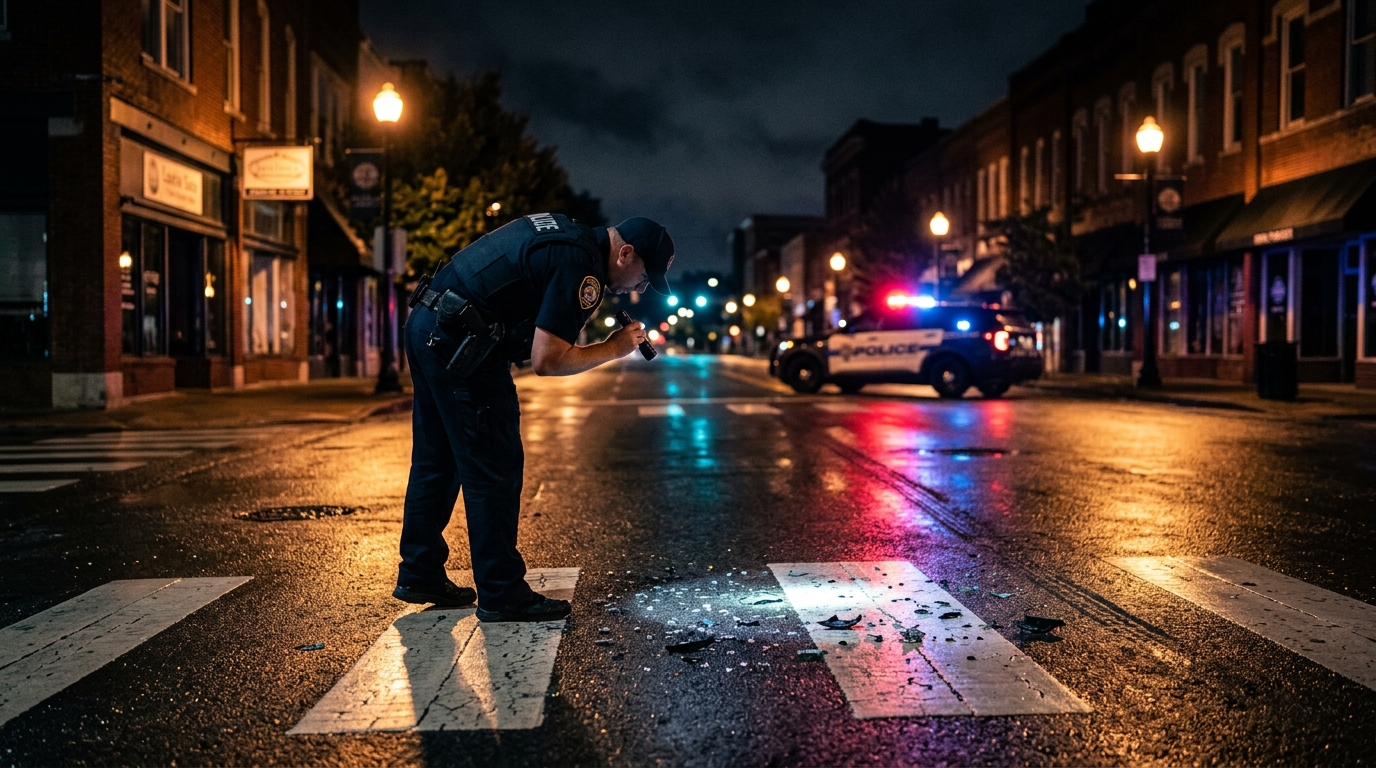
Tennessee police take pedestrian and cyclist hit-and-runs seriously, especially when there are injuries. A typical investigation can include:
- Vehicle parts at the scene. A bumper fragment, a side mirror, a piece of trim, even a small chip of headlight can be matched back to a specific make, model, and year. Collect anything you find — but if police are responding, let them collect it themselves.
- Paint transfer. Cars often leave paint on bikes, helmets, and clothing. That paint can be identified down to the manufacturer.
- Debris field analysis. Where pieces fell, how far they traveled, and the angle of damage all tell investigators about speed and direction.
- BOLO bulletins. A “be on the lookout” alert with the description of the vehicle and any partial plate.
- Camera canvases. Officers — and sometimes a victim’s attorney — will go door to door asking nearby homes and businesses to preserve and share footage.
- Body shop alerts. A vehicle that ran into a person and kept driving usually has visible damage that needs repair. Local body shops are sometimes asked to report suspicious damage.
Even when the driver isn’t identified at the scene, the investigation is often ongoing for days or weeks.
When the Driver Is Never Identified
Sometimes — despite everyone’s best efforts — the driver is never found. This is the part that most pedestrians and cyclists don’t realize: you may still have insurance coverage available.
The key is uninsured motorist (UM) coverage on your own auto policy.
In Tennessee, UM coverage protects you when the at-fault driver doesn’t have insurance — and most policies treat a hit-and-run driver as “uninsured” because they can’t be identified. UM coverage typically applies even when you’re not in your car. If you were walking, jogging, or riding a bike when a hit-and-run driver struck you, your UM policy may step in.
A few important wrinkles:
- Reporting matters. Most UM policies require that you report the crash to the police promptly and that you report the claim to your insurer within a specific window. The 911 call you made at the scene is exactly the documentation an insurer will look for.
- Physical contact requirements vary. Some UM provisions require physical contact between the unidentified vehicle and you for a hit-and-run claim. Where this matters most is “phantom vehicle” cases — for example, you swerved off the road to avoid a car that didn’t hit you. Direct-hit hit-and-runs almost always satisfy any contact requirement.
- Stacking and limits. Coverage limits, and how multiple policies stack, depend on the policy language and the people in your household. This is exactly the kind of thing a lawyer reviewing your declarations page can sort through.
How Coverage Stacks: MedPay, Health Insurance, UM
If you’re relying on your own coverage, the order in which it pays can matter:
- MedPay on your auto policy usually pays first for medical bills, regardless of fault, up to the MedPay limit.
- Health insurance typically pays beyond MedPay, often subject to a later subrogation claim.
- Uninsured motorist coverage is generally the source for the rest — pain and suffering, lost wages, and damages beyond what MedPay and health insurance cover.
How those interact, and what the insurers can and cannot subtract from one another, is one of the most common reasons a hit-and-run case ends up looking either fair or short-changed depending on whether someone fights for the right structure.
A Preview of October
Hit-and-run and uninsured motorist claims are also the focus of a dedicated series we’re publishing in October 2026. That series will go deeper on UM coverage, the difference between uninsured and underinsured, and how police investigate hit-and-run crashes generally. If you find this post helpful, watch for that series this fall.
We’re Here to Help
If you or a loved one was hit while walking, running, or riding a bike in Tennessee — and the driver took off — the case isn’t closed. We can help you understand your rights, your insurance, and the steps that may still uncover the driver.
Call 615-244-2111 or reach out through our online contact form.
Because we care,
Stillman & Friedland