
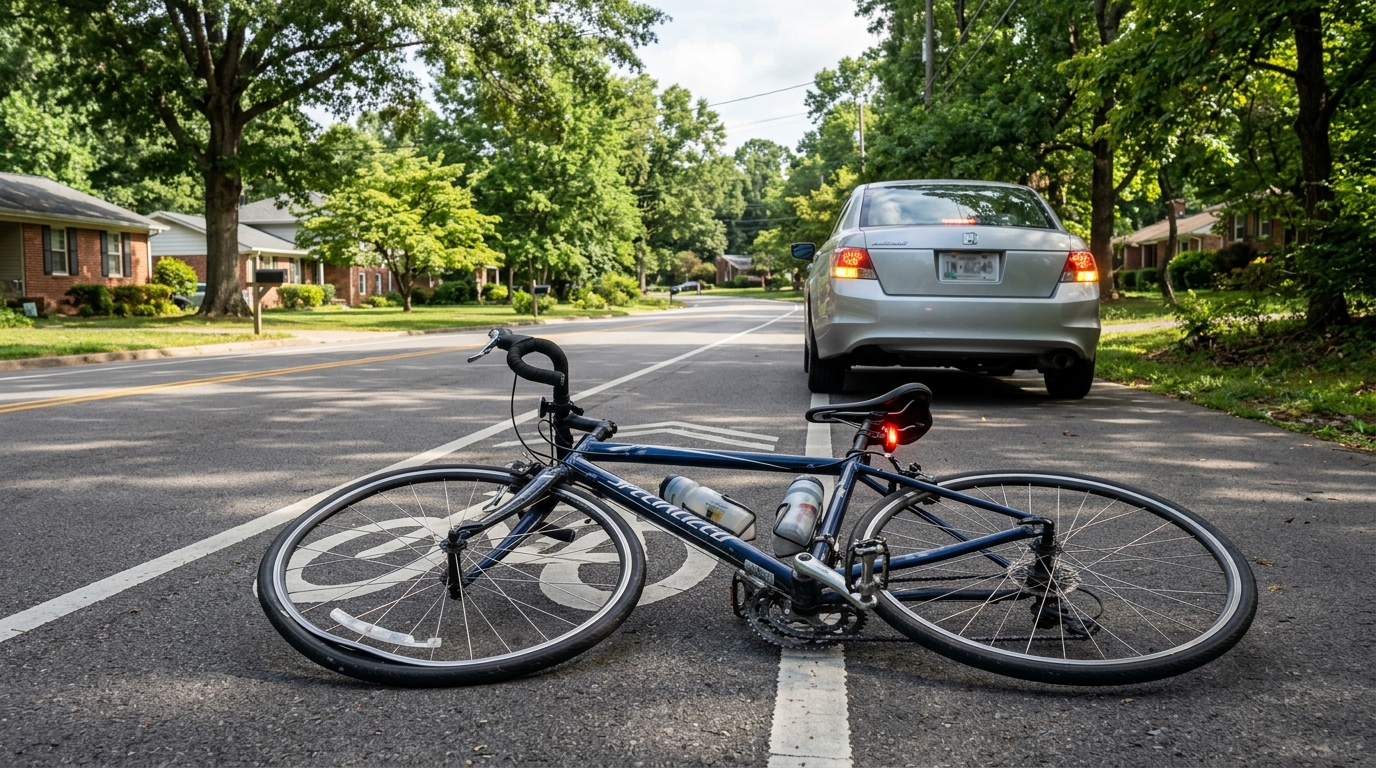

When a car and a bicycle collide, the cyclist almost always pays the higher physical price. There is no airbag, no door, no crumple zone — just a frame, a helmet if you’re lucky, and the road.
What surprises a lot of injured cyclists is how often the legal side feels just as one-sided in the wrong direction. Insurance adjusters tend to start from the assumption that the cyclist did something wrong: rode too far into the lane, ran a stop sign, didn’t have lights, “came out of nowhere.” Sometimes there’s a kernel of truth. Most of the time the picture is much more complicated than that, and Tennessee law gives cyclists more protection than insurers like to acknowledge.
If you’ve been hit while riding in Tennessee, here’s how fault and recovery actually work — and where insurers most often get them wrong.
Cyclists Have the Same Rights as Drivers
Start with this principle: Tenn. Code Ann. § 55-8-172 says that every person riding a bicycle on a roadway has all of the rights — and is subject to all of the duties — that apply to the driver of any other vehicle.
That single sentence does a lot of work. It means a cyclist on a Tennessee road:
- Has the right of way at the same intersections, in the same circumstances, that a car would.
- Is allowed to use a full travel lane when the lane is too narrow to safely share or when conditions require it.
- Can be hit by a driver with the same legal consequences as if the driver had hit another car.
It also means cyclists owe the same duties — stopping at stop signs and red lights, signaling turns, and yielding when required.
When an insurer treats a cyclist like a second-class road user, the answer is to come back to § 55-8-172. On a Tennessee roadway, a bike is a vehicle.
The Three-Foot Passing Rule
Tenn. Code Ann. § 55-8-175 is the safe-passing statute every Tennessee cyclist should know by heart. It requires drivers passing a bicycle in the same direction to leave a safe distance of not less than three feet between the vehicle and the bicycle, and to maintain that clearance until safely past the bike.
In practice, three feet is the floor. Faster traffic, narrower roads, and downhill curves all call for more.
Drivers who buzz a cyclist within three feet — whether out of impatience, distraction, or aggression — are violating a specific Tennessee safety statute. When that violation causes a wreck, it’s strong evidence of negligence, the same way a Hands-Free Law violation would be in a distracted-driving case. (For more on how violations of safety statutes feed into a claim, see our November 2025 post on proving negligence in Tennessee crashes.)
Lighting and Equipment Requirements
Tenn. Code Ann. § 55-8-177 covers the equipment a bicycle is required to carry, particularly at night:
- A front lamp visible from at least a specified distance ahead.
- A rear red reflector (or rear lamp) visible from a specified distance behind.
- Brakes capable of stopping the bicycle on dry, level pavement.
Riding without required lighting after dark doesn’t make a crash your fault on its own, but it does give insurers something to work with under Tennessee’s modified comparative fault rule. If you ride at dusk or after dark, lights are both a safety must and a claim-protection must.
The Crashes We See Most Often
Certain patterns show up again and again in Tennessee bicycle cases:
- Right-hook crashes. A driver passes a cyclist and then immediately turns right across the cyclist’s path. The cyclist has no time to react.
- Left-cross crashes. An oncoming driver turns left at an intersection, into a cyclist coming straight through. Drivers routinely tell investigators they “didn’t see” the bike.
- Doored cyclists. A driver or passenger opens a car door into the path of a cyclist riding past parked cars. Tennessee drivers have a duty not to open a door into traffic when it isn’t safe to do so.
- Failure to yield at intersections. Drivers rolling stop signs, blowing through residential cross-streets, or pulling out of parking lots without looking for bikes.
- Unsafe passing on rural and suburban roads. Two-lane country roads, twisty downhills, and the moment a driver decides they can’t wait any longer behind a cyclist.
In nearly all of these scenarios, the legal fault sits primarily with the driver. The insurance file often tells a different story until a lawyer pushes back.
How Comparative Fault Plays Out for Cyclists
Tennessee’s modified comparative fault rule means an injured cyclist can recover damages as long as they are less than 50% at fault. Recovery is reduced by the cyclist’s share of fault. We covered the mechanics of this in our post on recovering damages when partly at fault.
The factors insurers most often raise on the cyclist side:
- Helmet use. Helmet laws in Tennessee primarily apply to riders under 16. Adult riders are not legally required to wear a helmet on most Tennessee roads. Even where helmets aren’t required, an insurer may argue the absence of one increased the severity of head injuries — but they have to prove that connection, not just assert it.
- Lane position. Cyclists riding too far left without a reason can give insurers an angle. So can riding the wrong direction against traffic (“salmoning”), which is generally not legal under Tennessee’s vehicle-rules-apply principle.
- Lights and reflectors at night. As discussed above.
- Stop signs and signals. Cyclists are subject to the same traffic-control devices as cars.
None of these, on their own, is usually enough to bar a claim. They’re factors the insurer will weigh in early, and a Tennessee attorney’s job is to keep the comparative fault number where it should be.
What You Can Recover
In a successful Tennessee bicycle claim, an injured cyclist can typically pursue:
- Medical bills — emergency care, imaging, surgery, follow-up, physical therapy, future treatment.
- Lost wages — past and future, including reduced earning capacity if the injury is long-term.
- Bicycle and gear replacement — frame, wheels, helmet, components, GPS units, cycling computers, and clothing damaged in the wreck. Carbon and high-end components add up fast, and insurers routinely lowball this category. Save receipts.
- Pain and suffering — including the non-economic toll of a long recovery.
- Future care — for the kind of soft-tissue, spine, and brain injuries that don’t fully resolve in the first months.
For an overview of how insurers calculate (and shrink) these numbers, see our post on how insurers use fault to limit payouts.
Don’t Settle Before You Know What You’re Hurt With
Brain injuries, spine injuries, and complex orthopedic injuries often look better in week two than they do in month six. Insurers know this. Quick settlement offers in cycling cases are common, and they almost always undervalue the long tail of recovery.
Get evaluated. Document. Talk to a lawyer before signing anything.
We’re Here to Help
If you or a loved one was hit while riding a bike in Tennessee, the law gives you more standing than the at-fault driver’s insurance company will admit. We can help you understand your rights and pursue what your case is actually worth.
Call 615-244-2111 or reach out through our online contact form.
Because we care,
Stillman & Friedland