
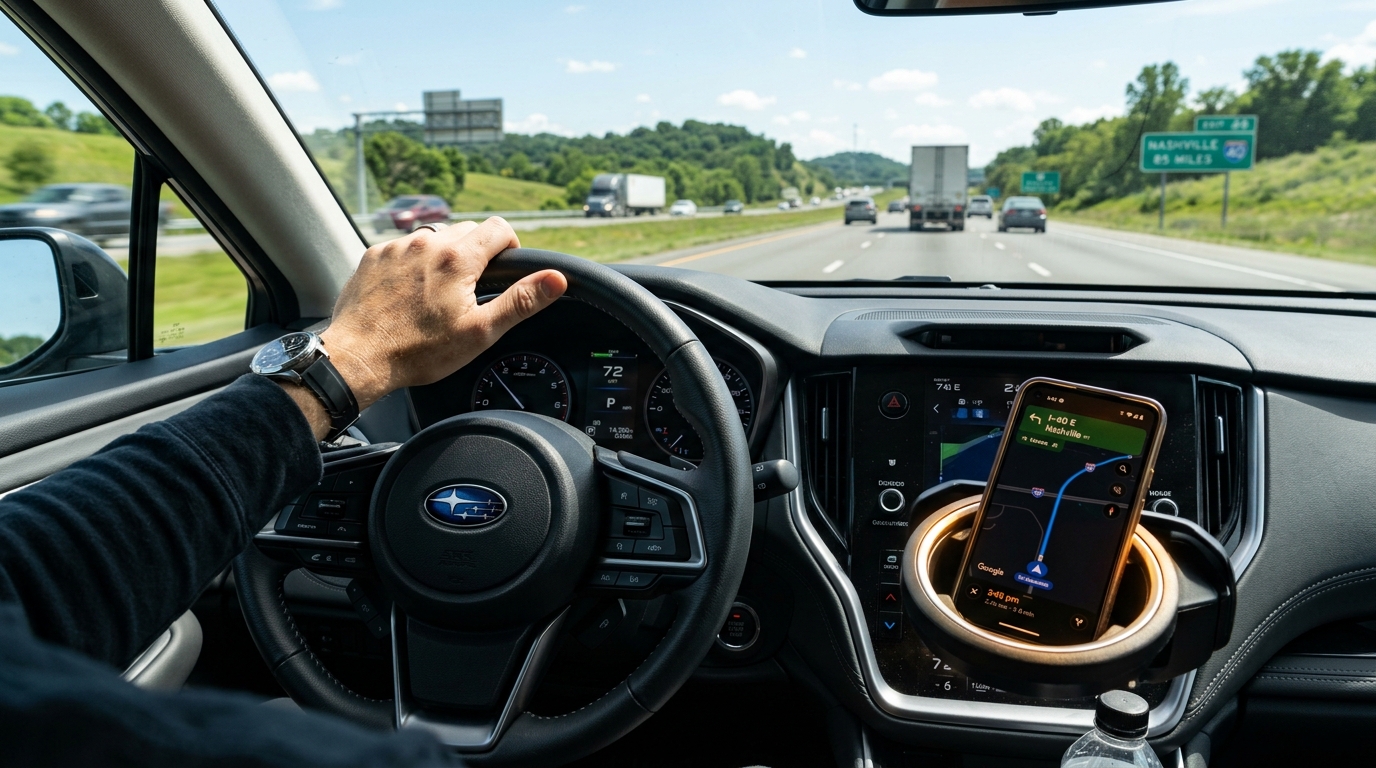

Almost every driver has done it. A notification chimes. The map app needs a new turn. A text from a spouse, a kid, or a boss lights up the screen. You tell yourself it’ll only take a second.
The problem is that the excuses we give ourselves behind the wheel don’t survive contact with physics, with the law, or with a Tennessee crash investigation. This post takes six of the most common distracted-driving myths and lays out what’s actually true — so Tennessee drivers can be honest with themselves, and so injury victims can understand why these excuses shouldn’t be the end of their claim.
Myth 1: “A Quick Glance Isn’t Really Distracted Driving”
This is the most common excuse, and the most dangerous one.
According to the National Highway Traffic Safety Administration (NHTSA), taking your eyes off the road for five seconds at 55 miles per hour is the equivalent of driving the length of a football field with your eyes closed. That isn’t a rhetorical flourish — it’s a direct, mathematical consequence of speed and time.
Five seconds is a quick glance. It’s long enough to read a short text, check the weather, or see who a call is from. It’s also long enough to miss a brake light, a pedestrian, or a car merging into your lane.
When a Tennessee driver says, “I only looked down for a second,” what they usually mean is: I was fine until something unexpected happened, and then I wasn’t. The whole point of attentive driving is being ready for the unexpected.
Myth 2: “Hands-Free Is Completely Safe”
Tennessee’s Hands-Free Law, which we covered in the first post in this series, focuses on keeping drivers’ hands off their phones. That’s an important and well-designed safety rule — but it is not the same thing as saying a hands-free phone call is risk-free.
Research from safety agencies and universities for more than a decade has consistently shown that cognitive distraction — the mental effort of a phone conversation — slows reaction time and narrows the driver’s focus, even when both hands are on the wheel. A driver deep in a hands-free argument with their insurance company isn’t fully engaged with the road.
Hands-free is safer. It is not safe. Tennessee law draws a legal line; the underlying physiology doesn’t care where the line is drawn.
Myth 3: “I’m an Experienced Driver — I Can Multitask”
This one feels true because experienced drivers genuinely do handle more than new drivers can. Years of muscle memory make lane keeping, braking, and scanning more automatic.
But study after study — including research cited by NHTSA and the CDC — has shown that human attention is not actually split evenly between tasks. It’s rapidly switched, with micro-gaps where nothing gets processed. An experienced driver multitasking is better than a new driver multitasking, but they are still worse than themselves when they are paying full attention.
Experience also creates a subtle overconfidence problem. Drivers who have “gotten away with it” a hundred times assume they will get away with it the hundred-and-first. The first crash changes that assumption permanently.
Myth 4: “I Was Stopped at a Red Light, So the Law Doesn’t Apply”
Many Tennessee drivers believe the Hands-Free Law is a moving-vehicle rule. It is not. Under Tenn. Code Ann. § 55-8-199, the restriction applies whenever the vehicle is being operated on a road or highway. A vehicle sitting in a travel lane at a red light, with its engine running and the driver in the seat, is still being operated.
The law’s genuine exception is for vehicles that are lawfully parked or stopped outside a lane of travel — a parking lot, a driveway, a shoulder pulled off for that purpose. A stoplight doesn’t count. A stop sign doesn’t count. A traffic jam doesn’t count.
This matters after a crash. A driver who rear-ends stopped traffic while checking their phone at a red light is violating the Hands-Free Law just as clearly as a driver who was actively texting at highway speed.
Myth 5: “There’s No Way to Prove I Was on My Phone”
This is the myth that gives distracted drivers the most false confidence. And it’s the one that falls apart the fastest in a real investigation.
As we discussed in Post 2 of this series, modern distracted-driving cases can draw on:
- Cell carrier records with second-by-second timestamps
- Vehicle infotainment and Bluetooth data
- Surveillance, dashcam, and doorbell footage
- Witness observations and 911 call timelines
- Scene evidence like the absence of pre-impact braking
Drivers who assume “nobody can prove it” often discover during discovery that a remarkable amount can, in fact, be proven — especially when an injury attorney moves quickly to preserve the evidence before it disappears.
Myth 6: “If No One Was Hurt, It Doesn’t Matter”
A near-miss feels like it doesn’t count. No crash, no damage, no injury — move on.
But Tennessee’s roads are a shared space, and patterns of distraction have a way of catching up with drivers. A Hands-Free Law violation can still result in a citation and points, even without a crash. And if the same driver causes a wreck later, their history — including prior citations — can become part of the bigger picture in a civil case.
More importantly, for an injured person looking back at a crash, the fact that a driver’s distraction didn’t hurt anyone the first ninety-nine times is not a defense. It’s actually part of the problem. Tennessee’s comparative fault rules don’t give a driver credit for past near-misses. They look at what happened in the crash that’s in front of the court.
Be Honest With Yourself — And With Your Claim
The reason to push back on these myths isn’t to scold drivers. It’s to make sure that injured Tennesseans don’t internalize the other side’s excuses.
If you’ve been hit by a driver who “only looked down for a second,” you don’t have to accept that as the end of the conversation. A quick glance is still distraction. A hands-free call is still cognitive load. A red-light scroll is still a violation. And “you can’t prove it” is almost never actually true.
We’re Here to Help
If you or a loved one was hurt in a Tennessee crash you believe was caused by distraction, don’t let a driver’s excuses define your claim. We can help you understand the law, the evidence, and your options.
Call 615-244-2111 or reach out through our online contact form.
Because we care,
Stillman & Friedland