
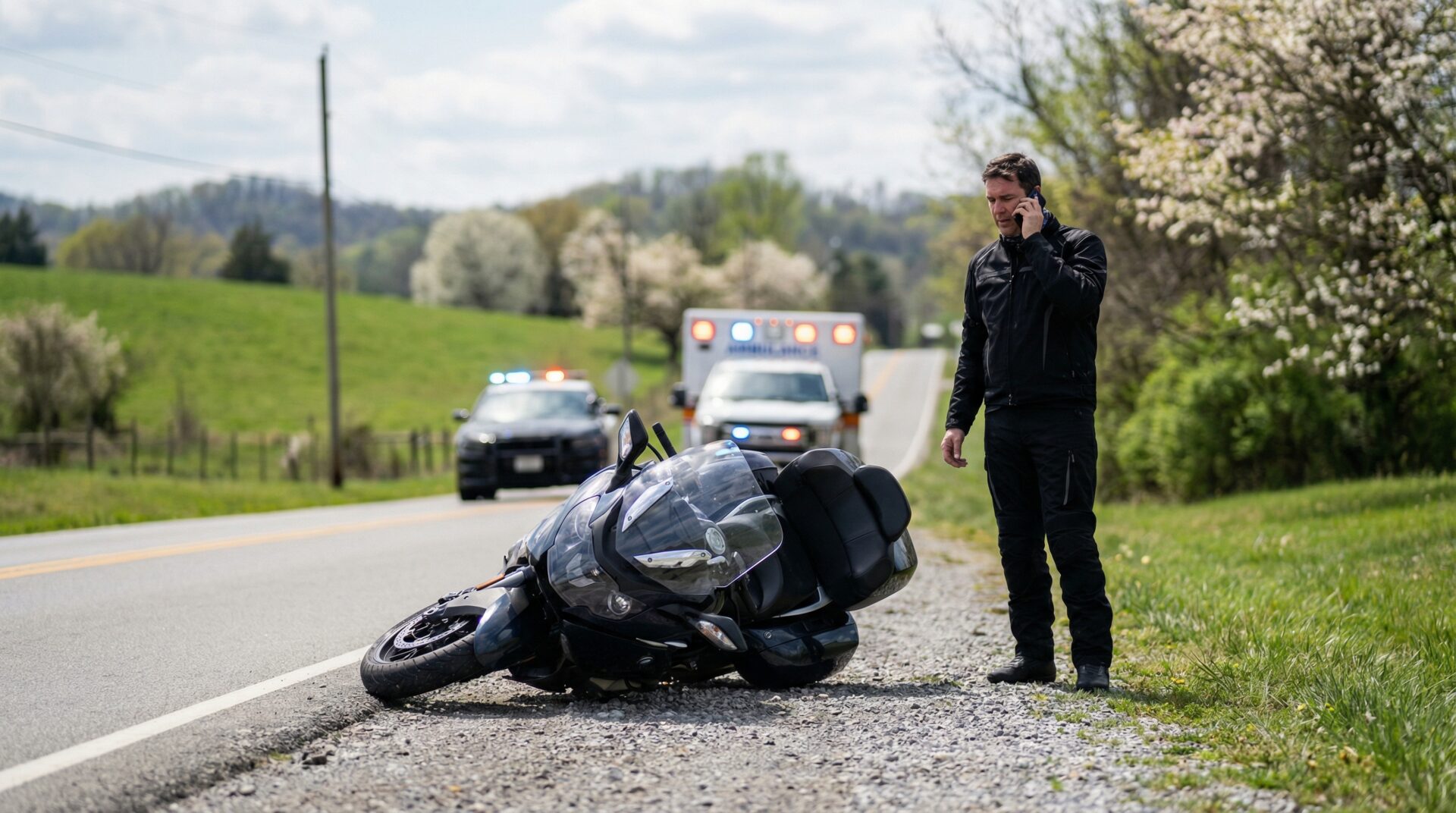

A motorcycle crash happens fast. One second you’re riding, and the next you’re on the ground — disoriented, in pain, and trying to make sense of what just happened. The adrenaline hits immediately, and you might feel surprisingly alert despite injuries you can’t yet feel.
What you do in the minutes, hours, and days after a motorcycle crash can shape your medical recovery and your legal options for months to come. And because motorcycle crashes involve unique evidence — your gear, the bike itself, road surface conditions — the steps are different from what a car driver would follow.
Here’s what Tennessee riders need to know.
First: Get Safe and Get Medical Help
Your immediate priority is survival and safety.
- Get out of the roadway if you can do so without worsening an injury. A rider down in a traffic lane is in danger of a secondary collision.
- Call 911 or ask someone nearby to call. If you suspect any head, neck, or spinal injury, stay still and wait for paramedics.
- Accept medical transport if it’s offered. Many riders decline ambulance transport because they feel okay at the scene. That’s almost always the adrenaline talking.
As we explained in our February series, your body’s stress response can mask serious injuries for hours or even days. Concussions, internal injuries, fractures, and soft tissue damage often don’t produce full symptoms until the adrenaline wears off. Getting evaluated at an emergency room or urgent care within the first 72 hours creates a medical baseline that protects both your health and your claim.
Even if you feel fine at the scene, get checked out. “I felt okay so I didn’t go to the doctor” is one of the first things an insurance adjuster will use against you.
Report the Crash
Tennessee law requires that crashes resulting in injury, death, or significant property damage be reported to law enforcement. When officers respond to the scene, they’ll create a crash report that becomes part of the official record.
At the scene:
- Ask the responding officer for the crash report number and how to obtain a copy once it’s filed.
- Provide your account of what happened — stick to facts. What direction you were traveling, what the other driver did, where the impact occurred.
- Don’t speculate about fault or say things like “I should have seen them.” Just describe what happened.
If you need a crash report later, you can request one through the Tennessee Department of Safety & Homeland Security.
If law enforcement doesn’t respond to the scene — which can happen with crashes that appear minor — you can still file a report. This is especially important for motorcycle crashes, because injuries that seem minor at the scene often turn out to be serious.
Preserve Your Gear — It’s Evidence
This is where motorcycle crashes differ most from car wrecks. Your riding gear isn’t just clothing — it’s physical evidence of the forces involved in the crash.
Keep everything:
- Your helmet. A cracked or scraped helmet tells the story of head impact. If the interior foam is compressed, it shows how much force your head absorbed. Do not throw away or replace your helmet until your claim is resolved.
- Your jacket, pants, and gloves. Tears, abrasions, and scuff marks show where your body contacted the pavement and at what angle. Road rash patterns on gear can corroborate road rash patterns on your body.
- Your boots. Ankle and foot injuries are common in motorcycle crashes, and damage to your boots can demonstrate impact points.
- Any torn or bloodied clothing. Even undergarments. If blood soaked through your gear, it documents the severity of your injuries at the scene.
Do not wash, repair, or discard damaged gear. Store it in a bag, exactly as it was after the crash. Take photos of each piece before storing it.
Document the Scene Thoroughly
If you’re physically able — or if someone with you can help — documentation at the scene is invaluable.
Photos to take
- Your motorcycle from multiple angles — overall damage, close-ups of contact points, bent or broken parts
- The other vehicle — damage, license plate, position on the road
- The road surface — skid marks, debris, gravel, potholes, oil, wet leaves, or any hazard that contributed to the crash
- The debris field — broken parts, scattered gear, glass, plastic. The spread of debris can help reconstruct speed and angle of impact.
- Traffic signals, signs, and lane markings — especially if right-of-way is going to be disputed
- Your injuries — road rash, bruises, swelling, cuts. Take photos at the scene and again over the following days as bruising develops.
- Weather and lighting conditions — a quick photo that shows the sky, shadows, or wet pavement can establish the conditions at the time of the crash
Information to collect
- The other driver’s name, phone number, address, insurance company, and policy number
- Names and contact information for any witnesses — including anyone who called 911 or stopped to help
- The officer’s name and badge number if law enforcement responded
Write this information down or put it in your phone’s notes app. Memory gets unreliable fast after a traumatic event.
Motorcycle-Specific Evidence
Your motorcycle itself is a piece of evidence, and how it’s handled after the crash matters.
- Don’t repair the bike until your claim is resolved — or at minimum, until every piece of damage has been thoroughly photographed and documented. The damage pattern on the bike can show speed, angle of impact, and which vehicle struck which.
- If the bike is towed, know where it’s going. Get the tow company’s name and the storage lot location. Make sure you can access the bike for documentation.
- Bent handlebars, scraped engine guards, punctured tires, and broken mirrors all tell a story. An accident reconstructionist can use this evidence to support your account of how the crash happened.
Helmet Camera and Dashcam Footage
If you ride with a helmet camera, GoPro, or dashcam, back up the footage immediately. Many action cameras record on a loop and will overwrite old footage as storage fills up. Don’t wait — copy the files to your phone, a computer, or cloud storage as soon as you can.
This footage can be the single most powerful piece of evidence in your case. It captures what happened in real time, without the bias of memory or witness perception.
Be Careful with What You Say
At the scene, you’ll likely talk to the other driver, witnesses, and the responding officer. A few things to keep in mind:
- Don’t apologize or accept blame. It’s natural to say “I’m sorry” — but an insurer can twist those words into an admission of fault. Stick to the facts of what happened.
- Don’t speculate. “I think I was going about…” or “Maybe I should have…” are the kinds of statements that get pulled out of context later. If you’re not sure about something, say so.
- Don’t discuss your injuries in detail with the other driver or their insurer. You don’t know the full extent of your injuries yet. A casual “I think I’m okay” at the scene can be used against you weeks later when you discover a herniated disc or a concussion.
Stay Off Social Media
This deserves its own section because it catches so many people off guard.
After a crash, it’s natural to want to post about what happened — to let friends know you’re okay, to process the experience, or to vent about the other driver. Don’t do it — at least not until you’ve spoken with an attorney.
Insurance companies routinely monitor claimants’ social media accounts. A photo of you smiling at dinner, a check-in at a local event, or even a comment like “Feeling better today!” can be taken out of context and used to argue that your injuries aren’t serious.
The safest approach: lock down your privacy settings, don’t post about the crash or your recovery, and don’t accept new friend or follow requests from people you don’t know.
The Days After: What to Do Next
The crash scene is just the beginning. Here’s what to focus on in the days and weeks that follow:
- Follow up on medical care. If you went to the ER, schedule a follow-up with your primary care doctor or a specialist within a few days. If new symptoms appear — headaches, neck stiffness, numbness, mood changes, trouble concentrating — report them and get evaluated. Delayed symptoms are extremely common after crashes.
- Keep a daily symptom journal. Note your pain levels, what activities you can and can’t do, how you’re sleeping, and how the injury is affecting your work and daily life. This becomes powerful documentation if your claim goes to negotiation or trial.
- Consider talking to an attorney before giving a recorded statement to the other driver’s insurance company. In general, you are not obligated to provide one, and what you say may be used to reduce your claim.
- Contact an attorney before the insurance process gets ahead of you. The other driver’s insurer will move quickly. Having someone in your corner early means evidence is preserved, deadlines are met, and you’re not pressured into a settlement that doesn’t reflect your actual injuries.
We’re Here to Help
If you or a loved one was injured in a motorcycle crash in Tennessee, the first few days matter more than most people realize. Your gear, your bike, your medical records, and the choices you make right now will shape your options going forward.
Our team at Stillman & Friedland helps Tennessee riders protect their rights, deal with insurance companies, and focus on what matters most — getting better.
Call 615-244-2111 or reach out through our online contact form.
Because we care,
Stillman & Friedland