
Every time you swing a leg over your motorcycle, you’re accepting a reality that car drivers rarely think about: you have no crumple zone, no airbag, and no steel cage between you and the road. That doesn’t mean riding is reckless — it means that when something goes wrong, the consequences are more severe.
Understanding the specific scenarios that cause the most motorcycle crashes in Tennessee can help you ride with awareness and, if you’re ever hurt, understand exactly what happened and who may be responsible.
Left-Turn Crashes: The Single Most Dangerous Scenario
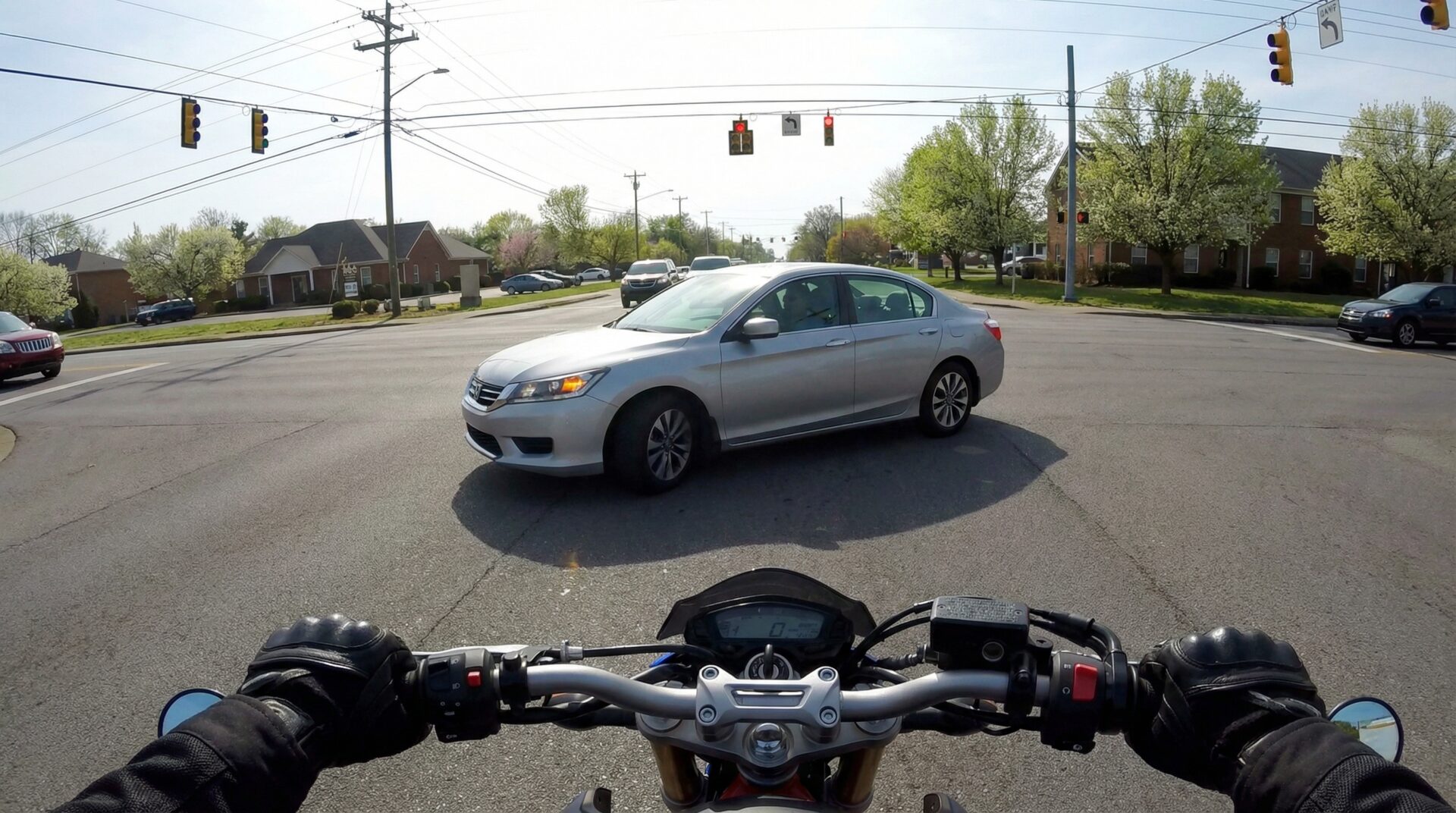
If there’s one crash pattern every Tennessee motorcyclist should know about, it’s the left-turn collision. It happens like this: a car or truck turns left at an intersection — across the path of an oncoming motorcycle — because the driver didn’t see the bike, misjudged its speed, or simply failed to yield.
According to NHTSA, left-turn crashes are among the most common — and most deadly — types of motorcycle accidents nationwide. Tennessee is no exception.
Why it’s so dangerous:
- The impact angle is devastating. The motorcycle strikes the turning vehicle broadside, or the rider is forced to lay the bike down to avoid the collision. Either way, the rider absorbs enormous force.
- Drivers misjudge motorcycle speed. A motorcycle’s narrow profile makes it harder for drivers to gauge how fast it’s approaching. A car that would wait for another car to pass may turn in front of a motorcycle traveling at the same speed.
- “I didn’t see the motorcycle” is treated as an excuse. As we discussed in our post on how insurers treat motorcycle claims differently, drivers frequently claim they didn’t see the bike — and adjusters sometimes accept that as if it’s a valid defense rather than a failure to look.
What riders can do
Approach every intersection assuming the other driver hasn’t seen you. Cover your brakes. Watch for vehicles waiting to turn — if you see a car’s front wheels start to move, prepare to react. Position yourself in the portion of your lane that gives the oncoming driver the best chance of seeing you.
None of this is victim-blaming. The driver has a legal duty to yield. But awareness can save your life while the law catches up to protect your rights.
Intersection Accidents Beyond Left Turns
Left turns get the most attention, but intersections are dangerous for motorcyclists in several other ways:
- Failure to yield at stop signs. A driver rolls through a stop sign or misjudges the gap, pulling into the path of a motorcycle that has the right-of-way.
- Red-light running. A car enters the intersection after the light changes, colliding with a motorcycle that’s lawfully crossing.
- Obscured sightlines. Large vehicles, overgrown vegetation, or poorly placed signs can block a driver’s view of an approaching motorcycle — but the driver still has a duty to proceed with caution.
- Right-turn-on-red conflicts. A driver turning right on red looks left for cars but doesn’t register a motorcycle approaching from that direction.
Tennessee’s comparative fault rules mean that fault in intersection crashes can be shared. But the fact that a motorcycle is smaller and harder to see does not shift legal responsibility away from the driver who failed to look.
Rear-End Crashes
When a car rear-ends another car, the results are usually a damaged bumper and maybe some whiplash. When a car rear-ends a motorcycle, the rider can be thrown from the bike entirely.
Common scenarios:
- A rider stopped at a red light is struck from behind by a driver who was following too closely or looking at their phone.
- A rider slowing for traffic on a highway is hit by a vehicle that didn’t notice traffic was decelerating.
- A rider braking for a hazard — a pothole, debris, an animal — and the vehicle behind can’t stop in time.
Motorcycles stop differently than cars. Riders use both front and rear brakes independently, and stopping distances vary depending on road surface, tire condition, and technique. Drivers behind motorcycles need to allow extra following distance — but many don’t.
These crashes are especially dangerous because the rider often has no warning and no time to react. The force of even a low-speed rear-end collision can launch a rider off the bike and onto the pavement — or into oncoming traffic.
Road Hazards That Cars Don’t Even Notice
One of the most frustrating realities of riding is that hazards barely noticeable to a car driver can be life-threatening to a motorcyclist:
- Gravel and loose debris — especially on curves, shoulders, and freshly maintained roads. A car’s four tires handle loose gravel easily; a motorcycle’s two tires can lose traction instantly.
- Potholes and uneven pavement — a car absorbs the bump. A motorcycle can be destabilized, especially at speed.
- Railroad tracks — crossing at the wrong angle on a motorcycle can catch the tire and pull the bike down.
- Wet leaves and oil patches — nearly invisible and extremely slippery on two wheels.
- Metal construction plates and painted road markings — both become dangerously slick when wet.
- Road kill and debris — objects that a car straddles may be impossible for a motorcycle to avoid.
When a rider goes down because of a road hazard, the question of liability becomes more complex. Was the hazard something a government entity should have maintained or warned about? Was there construction signage? Was a spill reported and not cleaned up? These are fact-specific questions, but they can be important to a claim.
Dooring
In urban areas like Nashville, Memphis, and Knoxville, riders face another hazard: dooring. This happens when the driver or passenger of a parked car opens their door directly into the path of an oncoming motorcyclist.
For a cyclist on a bicycle, dooring is dangerous. For a motorcyclist traveling at 25–35 mph on a city street, it can be catastrophic. The rider either strikes the door head-on, swerves into traffic to avoid it, or lays the bike down — none of which end well.
The person who opens the door may bear significant responsibility. Drivers and passengers generally have a duty to check for oncoming traffic before opening a door into the roadway. But proving fault in a dooring case can require witness statements, nearby security camera footage, or physical evidence from the door and bike damage patterns.
Multi-Lane Highway Dangers
Tennessee’s interstates — I-40, I-24, I-65, I-75 — carry heavy traffic year-round, and motorcyclists are especially vulnerable in highway scenarios:
- Blind-spot lane changes. A car or truck changes lanes without checking their blind spot and merges directly into a motorcycle. The rider may have nowhere to go — trapped between the merging vehicle and a guardrail, another lane of traffic, or the shoulder.
- Speed differentials. On highways where some vehicles are traveling at 75+ mph and others are merging at 45 mph, motorcycles can get caught in dangerous speed gaps.
- Wind blast from large trucks. Passing an 18-wheeler or being passed by one creates a powerful air blast that can push a motorcycle sideways. Experienced riders know to brace for it, but it can still be destabilizing — especially in crosswinds.
A Note on Fault: Other Drivers Bear Responsibility
It’s important to say this clearly: understanding dangerous scenarios is not the same as saying riders are responsible for preventing them. The legal duty falls on every driver to:
- Look carefully for motorcycles before turning, merging, or changing lanes
- Yield the right-of-way when required
- Maintain a safe following distance behind motorcycles
- Share the road — motorcycles have the same right to be there as any other vehicle
Tennessee’s fault system examines what each party did. A rider who was doing everything right — obeying the law, riding at a safe speed, wearing proper gear — is in a strong position to hold the at-fault driver accountable.
If you’ve been in any of the scenarios described in this post, the specifics of your situation matter. Evidence, witness accounts, and the physical damage to your bike and gear can tell the story of what really happened.
We’re Here to Help
If you or a loved one was injured in a motorcycle crash in Tennessee, you deserve a team that understands what riders face — on the road and in the claims process. We can help.
Call 615-244-2111 or reach out through our online contact form.
Because we care,
Stillman & Friedland