
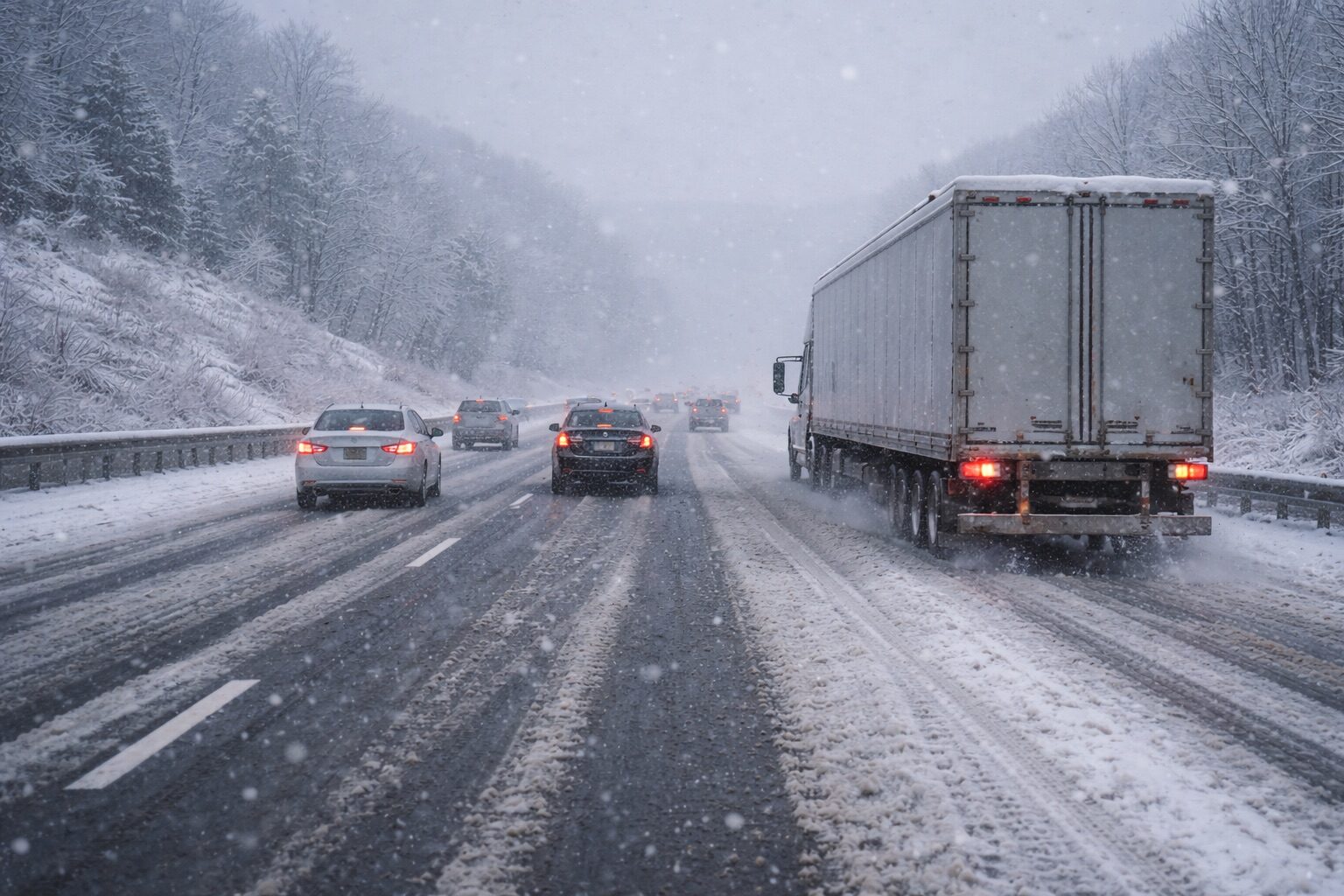

When a winter crash involves an 18‑wheeler or other large truck, many people assume the truck driver — or their company — must automatically be to blame. Others believe the opposite: that “it was just the snow,” so no one is responsible.
The truth in Tennessee is more complicated. Fault depends on what each driver did (or failed to do) given the weather and road conditions, plus the safety rules that apply to commercial trucks.
How Weather and Trucking Rules Interact
When snow, ice, or freezing rain hits Tennessee, big trucks become harder to operate safely for one simple reason: physics. A loaded tractor‑trailer weighs far more than a passenger vehicle and needs much more distance to stop. Traction loss can also trigger jackknifes or trailer swing in a way most drivers have never experienced.
That doesn’t mean truck drivers are automatically at fault. It means winter driving requires extra caution, and commercial drivers and carriers are expected to account for the risks.
At the federal level, commercial drivers are required to use “extreme caution” in hazardous conditions like snow and ice, reduce speed, and discontinue operations if conditions become sufficiently dangerous. (See 49 C.F.R. § 392.14: https://www.ecfr.gov/current/title-49/subtitle-B/chapter-III/subchapter-B/part-392/subpart-B/section-392.14.)
In real life, that often comes down to decisions like:
- How fast the truck was traveling for conditions
- How much following distance the driver left
- Whether the driver chose to keep driving in worsening weather
- Whether the carrier’s dispatch expectations pressured the driver to “push through”
Winter also affects maintenance and equipment. Tires, brakes, and lighting matter more when traction is limited and visibility drops early. When a truck can’t stop or can’t be seen, the consequences can be severe.
Common Winter Truck Crash Scenarios in Tennessee
Winter truck crashes in Tennessee often happen on interstates, bridges, and hilly routes—places where speed changes quickly and traction is unpredictable. Common scenarios include:
- Jackknife or trailer swing on slick pavement
A hard brake, a downhill grade, or an evasive maneuver on ice can cause the trailer to swing out and block multiple lanes. - Rear‑end collisions in slow or stopped traffic
On slushy interstates, traffic can come to a sudden stop. If a truck driver (or any driver) doesn’t leave enough distance for winter stopping distance, a rear-end crash can turn into a pileup. - Chain‑reaction crashes near ramps and bridges
Bridges and overpasses can ice first. A single loss‑of‑control event near an on‑ramp can lead to multiple collisions as vehicles approach too fast for conditions. - Passenger vehicles cutting in front of a truck
In winter traffic, some drivers change lanes aggressively to “get ahead,” not realizing a truck needs far more distance to stop on wet or icy pavement. - Loss of control by other drivers leading to truck involvement
Many winter truck crashes start with a passenger vehicle spinning or sliding into the truck’s lane. In those cases, the truck driver may have little room to react—even if they’re driving carefully.
Who Can Be Responsible After a Winter Truck Wreck?
One reason truck cases feel overwhelming is that responsibility may involve multiple people and multiple insurance policies. Depending on what happened, potentially responsible parties can include:
- The truck driver, if they were speeding for conditions, following too closely, distracted, fatigued, or operating unsafely in hazardous weather
- The trucking company/carrier, if company practices contributed (unsafe dispatch expectations, inadequate training, poor maintenance practices)
- A maintenance or repair provider, if a mechanical issue (brakes, tires, lights) played a role and inspections/repairs were mishandled
- A shipper or loader, if improperly loaded or secured cargo contributed to loss of control
- Another driver, if they cut off the truck, lost control, or caused the chain reaction
This is why “the truck driver is always responsible” is a myth. Sometimes the truck driver did everything they reasonably could. Other times, the evidence shows preventable decisions or company practices that made a dangerous situation worse.
It’s also why evidence matters early. Trucking cases can involve records that don’t exist in ordinary car crashes, such as electronic logging data, onboard camera footage, inspection and maintenance records, and post-crash testing documentation. The sooner an investigation begins, the more likely that information can be preserved.
Steps to Take After a Winter Crash Involving a Big Truck
If you’re in a crash with a tractor‑trailer, it’s normal to feel overwhelmed. Focus on safety and medical care first, then on documentation if you’re able.
1) Get medical help and report the crash
- Call 911 if anyone is injured or if the roadway is unsafe.
- Accept medical evaluation if offered, and seek follow-up care if symptoms develop later.
- Ask how to obtain the crash report and the report number.
If you need to order the Tennessee crash report later, the official page is here: https://www.tn.gov/safety/tnhp/crashreport.html.
2) Document conditions and identify the truck
If it’s safe to do so, take photos/video of:
- Road surface conditions (ice sheen, slush, standing water)
- Visibility (snowfall, darkness, glare, spray)
- The truck’s tractor and trailer, including company name, DOT number, and license plates
- Skid marks, gouge marks, debris, and where vehicles came to rest
3) Get witness information
In winter crashes, independent witnesses can be crucial—especially if someone claims the wreck was “just the weather.” Get names and contact information when possible.
4) Be cautious with early statements
Trucking claims can involve multiple insurers and investigators. It’s okay to stick to the facts you know and avoid guessing about speed, distance, or fault at the scene—especially when you’re hurt and still processing what happened.
5) Understand that fault may be shared
Tennessee allows fault to be divided between parties. In many winter crashes, the real question is how responsibility should be apportioned based on each driver’s choices and the conditions. (See Tenn. Code Ann. § 29-11-103.)
We’re Here to Help
If you or a loved one was hurt in a winter crash involving a commercial truck in Tennessee, you may be dealing with serious injuries, lost income, and an aggressive insurance company on the other side.
Stillman & Friedland helps truck crash victims and their families investigate what happened, identify all sources of fault, and pursue fair compensation under the law.
Call 615-244-2111 or reach out through our online contact form.
Because we care,
Stillman & Friedland