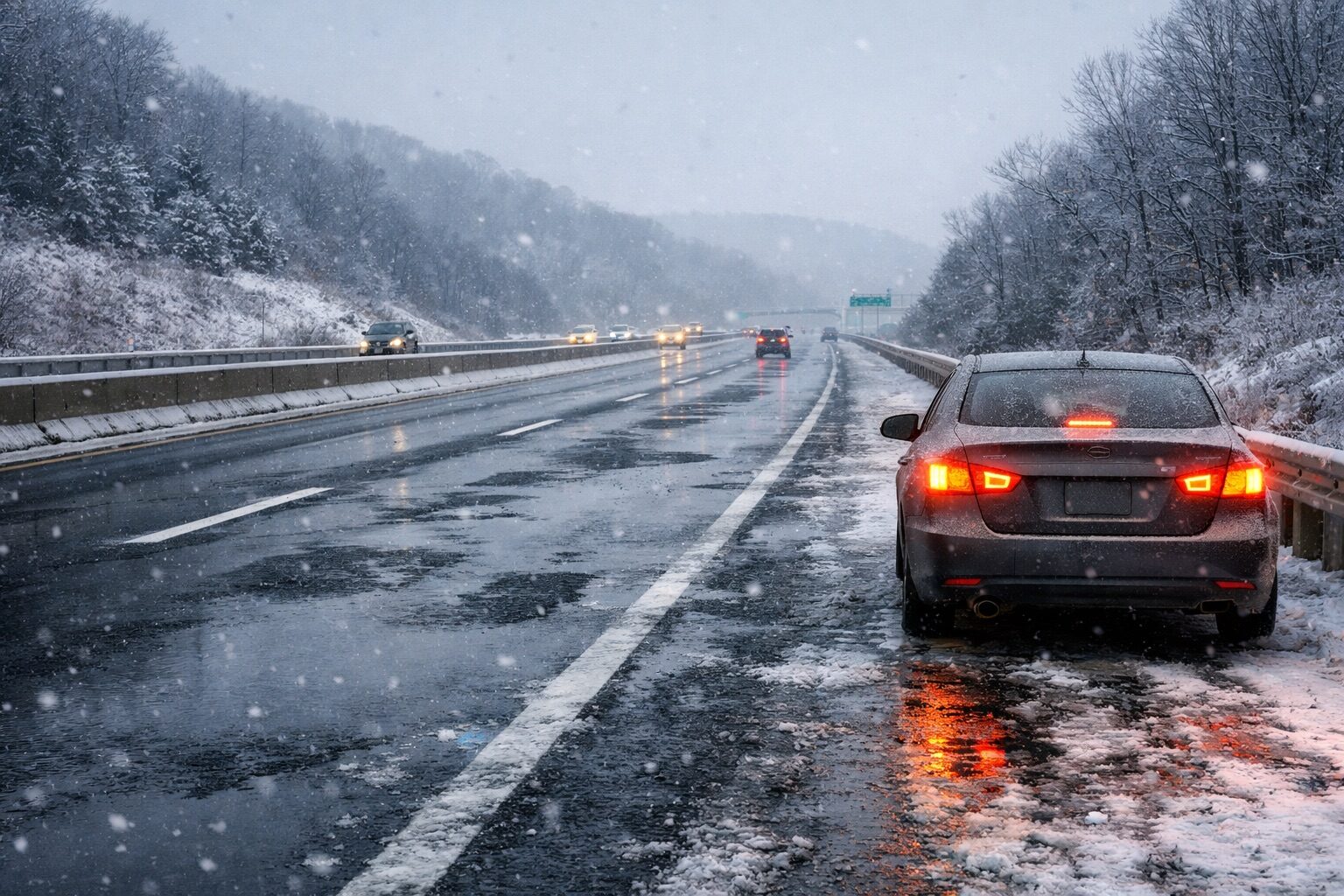

Many Tennesseans believe that when roads are icy or snowy, “no one is really at fault” for a crash. In reality, bad weather is just one factor the law and insurance companies consider — drivers still have a duty to adjust their speed, following distance, and attention to match road conditions.
This post will explain how fault is actually assigned in winter weather crashes and what you can do if you were hurt on black ice or slick roads.
Why Weather Doesn’t Automatically Erase Fault
In Tennessee, winter weather doesn’t cancel out a driver’s responsibility to use reasonable care. Snow and ice are exactly the kinds of conditions where safe driving requires extra caution.
That usually means:
- Slowing down (even if you’re under the posted limit)
- Leaving much more following distance than usual
- Braking gently and early, and avoiding sudden steering
- Keeping your headlights on and your windshield clear
- Watching for places that ice up first (bridges, overpasses, shaded areas, and ramps)
If you’re driving during a winter event, it’s worth checking road and travel updates first. TDOT and SmartWay provide Tennessee road conditions and travel tools here: https://www.tn.gov/tdot.html and https://smartway.tn.gov.
When a crash happens, insurance companies and (if needed) juries usually ask a common-sense question: Did each driver adjust to what the road required? If someone drove like it was a dry July afternoon, “the weather” typically won’t excuse the choices they made.
Even careful drivers can lose traction on black ice. But “black ice happened” is not the same as “no one could have prevented this.” Fault often comes down to what happened right before the slide: speed, spacing, attention, and whether the driver had time to react.
How Insurers Evaluate Icy Road Crashes
In a winter claim, adjusters often focus less on “who hit who first” and more on whether the drivers were operating safely for conditions. They may look at:
- Speed for conditions (not just the posted speed limit)
- Following distance and whether there was time to stop
- Braking and steering behavior (hard braking, sudden lane changes, loss of control)
- Visibility (snow, glare, darkness, fog, or a windshield that wasn’t cleared)
- Vehicle condition (tires with low tread, worn brakes, defroster issues)
- Scene evidence like skid marks, final rest positions, debris patterns, and vehicle damage
- Third‑party evidence (dashcam footage, nearby surveillance, witness statements, 911 audio)
- Crash report details about road surface and weather conditions
Two practical points if you’re dealing with an insurer after a black ice crash:
- Be careful with wording early on. People naturally say things like “I just slid” or “There was nothing I could do.” An insurer may treat that as an admission that you lost control because you were going too fast for the conditions. You can be honest without speculating. It’s okay to stick to facts: the road was slick, your vehicle lost traction, and you did (or did not) see the other car before impact.
- Winter evidence disappears fast. Snow melts, salt gets spread, and the scene changes. Photos and short videos taken right after the crash can be extremely helpful—especially shots that show the sheen of black ice, untreated patches, slush ridges, and visibility.
If you need to obtain your Tennessee crash report later, the Tennessee Department of Safety & Homeland Security explains the process here: https://www.tn.gov/safety/tnhp/crashreport.html.
Examples of Shared Fault in Winter Crashes
Winter crashes often involve shared fault. That doesn’t mean “no one is responsible”—it means more than one person may have contributed. Here are a few realistic examples:
- Rear‑end crash in stop‑and‑go traffic
A driver follows too closely on a slick interstate and can’t stop when traffic slows. Even if the front driver braked, the person behind may still be blamed for not leaving enough distance for winter conditions. - Loss of control on an icy bridge
A driver knows bridges freeze first but continues at highway speed, then spins into another lane. The icy surface matters, but the speed choice can matter too. - Unsafe lane change on wet or slushy pavement
A driver changes lanes quickly on slush, hits a patch of ice, and sideswipes a vehicle. The key question becomes whether the lane change was safe given the traction and visibility. - Multi‑vehicle pileup after one vehicle stops suddenly
One driver stops abruptly at the end of a ramp; others behind are traveling too fast for conditions and following too closely. Several drivers may share responsibility depending on spacing, speed, and evasive actions. - Intersection crash with poor visibility
A driver pulls out on a snowy morning when sightlines are limited by spray and windshield fog, while another driver is going too fast to stop on the slick approach. Fault may be split depending on what each person could see and how they responded.
These examples are general. The right outcome depends on evidence like vehicle damage patterns, the crash report, photos, and witness accounts.
It also depends on how fault is split under Tennessee’s comparative fault rule. In many cases, the question isn’t “is anyone at fault?”—it’s how much responsibility each person shares. In plain English, if you’re found 50% or more at fault, you’re generally barred from recovery, and if you’re 49% or less at fault, your recovery is reduced by your percentage of fault. (See Tenn. Code Ann. § 29-11-103.)
Steps to Protect Your Claim After a Winter Weather Crash
If you’re hurt or shaken up after a winter wreck, you don’t need to do everything perfectly. But a few practical steps can make it much easier to sort out fault later.
1) Put safety first
- If you can, move to a safe location away from traffic.
- Turn on hazard lights and stay alert for secondary collisions (they’re common in ice events).
- Call 911 if anyone is injured, if vehicles are blocking the roadway, or if conditions are dangerous.
2) Document the road and weather (quickly)
Winter conditions can change within minutes. If it’s safe:
- Take wide shots showing lanes, intersections, and how traffic was flowing.
- Take close-ups that show ice sheen, slush, standing water, and snow buildup.
- Photograph bridges/ramps and any warning signs.
- Record a short video walking through the scene; narrate the date/time and what you’re seeing.
3) Gather basic information
- Other driver’s name, phone, insurance, and license plate
- Names and contact info for witnesses
- If police respond, ask how to obtain the report and the report number
4) Get checked out, even if symptoms feel “minor”
Cold weather and adrenaline can mask pain. Neck, back, and head symptoms sometimes show up hours or days later. If you have any concerns—especially headache, dizziness, numbness, or increasing pain—get medical care and follow up as recommended.
5) Be careful with insurance statements
It’s reasonable to notify your own insurer that a crash happened. But before giving a recorded statement to the other driver’s insurer, consider getting advice. Winter crashes are often complex, and a single offhand comment can be taken out of context.
6) Keep a simple paper trail
- Photos of vehicle damage, tow and repair estimates
- Medical visit summaries and bills
- Missed work documentation (dates and time)
- A short daily journal of symptoms and limitations
We’re Here to Help
If you were injured in a car, truck, or motorcycle accident on icy or snowy Tennessee roads, you may still have a strong case — even if someone says “it was just the weather.”
Our team at Stillman & Friedland helps winter crash victims across Tennessee understand how fault really works, gather evidence, and pursue fair compensation.
Call 615-244-2111 or reach out through our online contact form.
Because we care
Stillman & Friedland