

Aggressive driving can involve several different Tennessee offenses. The driver’s conduct, the danger created, and the available evidence matter more than the label “road rage.” After an injury crash, the criminal investigation and your claim for compensation also raise different questions.
Maybe another driver followed too closely, swerved beside you, or braked sharply after a disagreement. You don’t need to identify the correct criminal charge before asking for help. Start with your safety, medical needs, and a clear account of what happened.
This guide explains the difference between everyday descriptions and legal terms, without treating every rude driver as someone who committed the same offense.
Aggressive driving, road rage, and reckless driving
“Aggressive driving” commonly describes dangerous behavior such as speeding, tailgating, and abrupt lane changes. “Road rage” often describes an encounter that escalates into threats or violence. Neither phrase, standing alone, tells you which charge applies to a particular Tennessee incident.
NHTSA distinguishes aggressive driving from road rage, including intentional assaults associated with a roadway encounter. That is a useful safety distinction. It isn’t a substitute for the elements of a Tennessee criminal offense.
Tennessee’s reckless-driving statute, Tenn. Code Ann. § 55-10-205, addresses driving with willful or wanton disregard for the safety of people or property. The ordinary offense is a Class B misdemeanor. The Tennessee Attorney General discusses that rule, and the published statutory text provides the specific language.
A single description such as “he cut me off” is not enough to decide whether the evidence meets that standard. Speed, distance, surrounding traffic, repeated behavior, and the driver’s actions before and after the collision may help explain the event.
Which penalties can apply?
There isn’t one penalty that covers every incident people call road rage. A traffic violation, reckless driving, a threat, and a physical attack present different legal questions. The charges and possible consequences depend on what can be established under the applicable law.
A misdemeanor classification can carry criminal consequences. Other conduct, including violence, may lead to different or more serious charges. An injured person’s civil case is concerned with responsibility for the injury and recoverable losses, rather than selecting a criminal sentence.
Be careful with online articles about proposed laws. A bill’s title or summary does not show that it became law. For example, the legislative history of Tennessee HB1191/SB1204, a road-rage proposal, shows committee actions rather than enactment as of this article’s November 2026 review. We don’t present its proposed penalties as current law.
If an officer tells you a citation or charge has been issued, keep the actual document or case number. An informal description of a charge can be incomplete. Your attorney can review the record and explain what it means for your particular injury claim.
Describe actions you observed
A useful account separates what you saw from what you think the driver intended. “The driver changed into my lane and then braked” describes an observation. “The driver wanted to hurt me” draws a conclusion that may require other evidence.
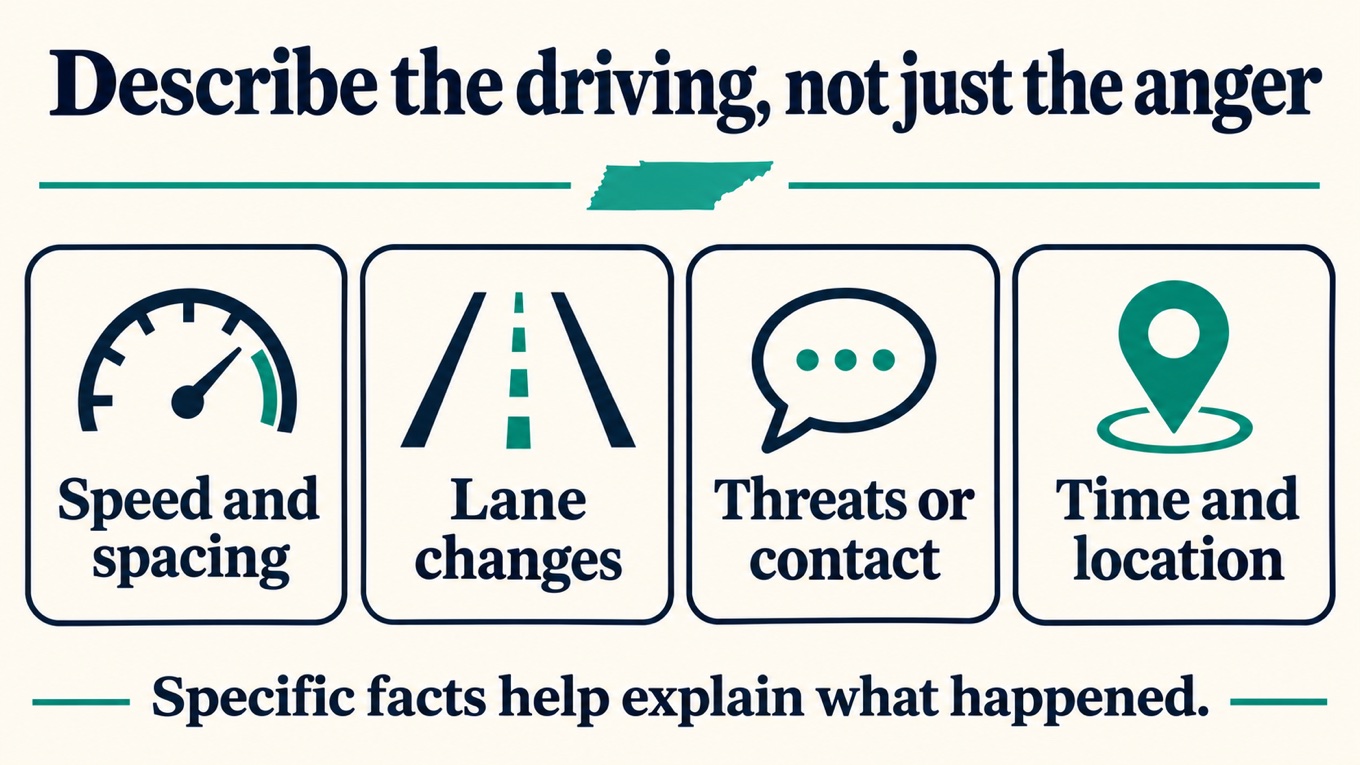
Write down details after you are safe:
- Speed and spacing: What made the vehicle seem unusually close or fast? Avoid inventing an exact speed.
- Lane changes: Where was each vehicle before the maneuver, and where did contact occur?
- Threats or contact: Record words you remember accurately. Note whether a window was open and whether you could hear clearly.
- Time and location: Include the road, direction, nearby exit or intersection, and approximate time.
- Sequence: Explain what happened first, what you did in response, and what happened next.
An honest gap is better than a guess. If you saw only part of a plate, preserve that partial information as partial. If a passenger saw something you didn’t, identify it as the passenger’s observation. Separate accounts help avoid turning several people’s recollections into one blended story.
The driving must connect to the crash
Consider a hypothetical example: a driver repeatedly moves between lanes, enters the space in front of another car, and brakes. The second car hits a barrier while trying to avoid a collision. Useful questions include whether the lane change left room to react, what the surrounding vehicles were doing, and whether a camera captured the full sequence.
Now change the example: an angry driver shouts from a parked vehicle after an unrelated collision. That behavior may need to be reported, but anger afterward does not, by itself, establish who caused the earlier crash.
These are illustrations, not reports of firm cases. They show why the case needs evidence connecting the conduct to the collision and the injury. The driver’s tone is one part of the account; vehicle movements and other records may be more useful to reconstructing what happened.
Our guide to proving negligence after a Tennessee crash explains why responsibility involves more than an accusation.
A citation does not finish an injury claim
A police investigation can identify witnesses and record important observations. It does not automatically collect your medical records, document missed work, or resolve insurance coverage. Keep those parts of the claim moving too.
Save insurer letters, claim numbers, treatment records, and receipts in a single folder. Write down questions for your attorney, including whether a statement is due and which documents need a response. If a provider gives you work restrictions, keep a copy with the dates they apply.
Describe the incident truthfully to your insurer. Don’t change a description from deliberate conduct to an accident merely because someone suggests it might help coverage. Policy wording and the actual facts need to be reviewed together.
For a closer look at the two processes, read our companion article about criminal charges and civil claims below.
Questions drivers often ask
Does a crash have to happen before dangerous driving can be reported?
No. If someone is creating an immediate threat, seek emergency help. You don’t need to wait for a collision. Once safe, give authorities the location and behavior you observed rather than trying to decide the charge yourself.
Should I confront the driver to get an admission?
No. A roadside argument can make a dangerous situation worse. Preserve what you already have and let officers investigate. Don’t follow a vehicle to obtain a plate number or better footage.
What if the police report uses a different description?
Keep the report and identify any factual issue precisely. Ask the agency about its correction or supplement process. You can also give your attorney the report alongside photographs, witness details, and your own account. Disagreement with a label does not mean you should alter the underlying evidence.
Get help after an aggressive-driving crash
If another driver’s dangerous behavior left you injured, Stillman & Friedland can review the circumstances and explain the next steps. Bring what you have; you don’t need a finished investigation before reaching out.
Call 615-244-2111 or reach out through our online contact form.
Because we care,
Stillman & Friedland