

A criminal case and a civil injury claim can arise from the same Tennessee road-rage crash. They serve different purposes, and one does not automatically resolve the other. Get advice about your injury claim early, even if a police investigation is still underway.
After a frightening collision, it is natural to focus on whether the other driver will face charges. You may also have treatment appointments, missed shifts, and a damaged vehicle. Those concerns don’t pause while investigators decide what happened.
Knowing which person handles which issue can help you keep important records together and avoid waiting for the wrong process to answer a question.
Two processes with different jobs
A criminal prosecution is brought by the government. Prosecutors decide how to proceed with charges, subject to the evidence and applicable law. The injured person may be a witness or victim, but does not control the prosecution as a private lawsuit.
A civil injury claim is brought by the injured person to seek compensation for legally recoverable losses. It may involve an insurance claim, settlement discussions, or a lawsuit. Responsibility, injury, causation, and available coverage all need attention.
The two proceedings also use different proof standards. Criminal guilt generally requires proof beyond a reasonable doubt. Ordinary civil negligence claims generally use a preponderance of the evidence, meaning more likely than not. The United States Courts’ explanation of criminal cases describes the criminal standard; its civil-case overview explains the different role of civil proceedings. Those are general process guides, not Tennessee filing instructions.
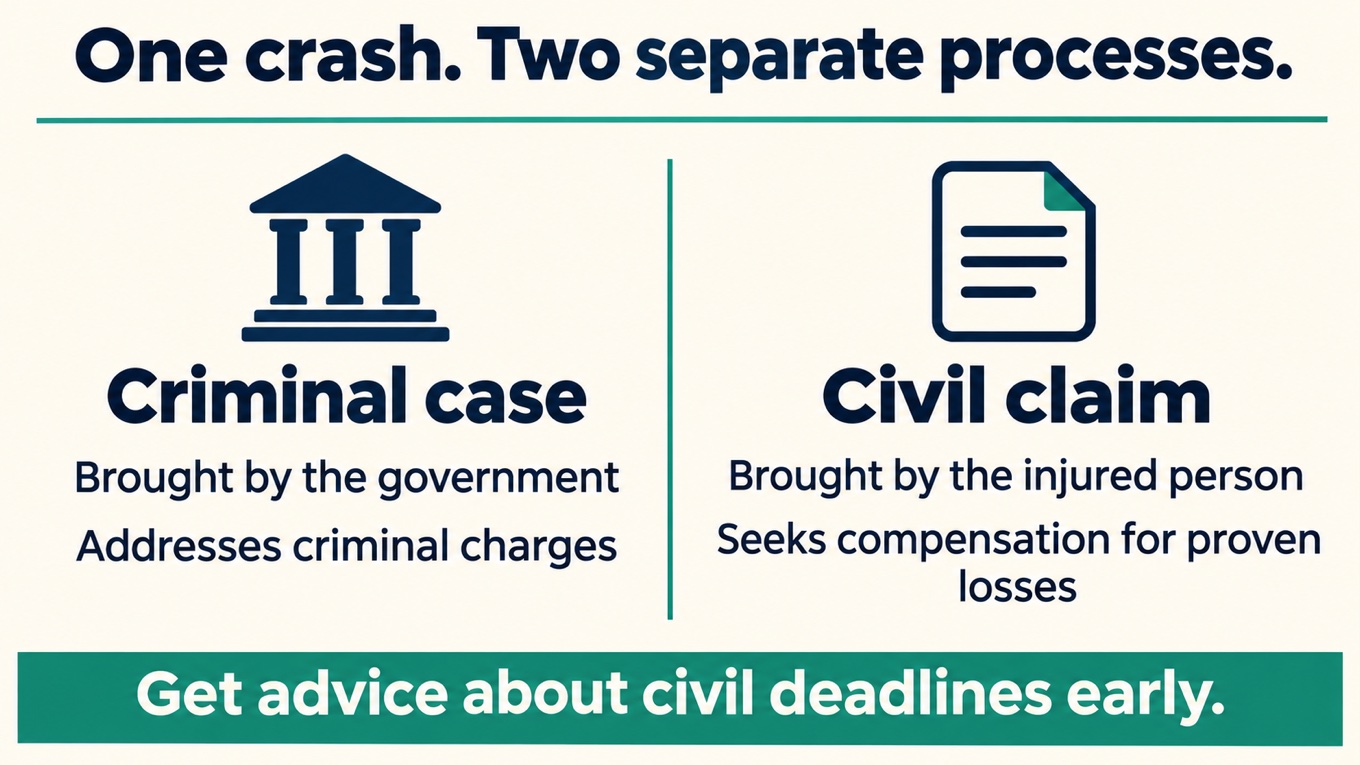
The practical point is simple: ask the prosecutor or victim-services contact about the criminal matter, and ask your injury attorney about the civil claim. Keep both case numbers if both processes exist.
What if there is no arrest or conviction?
The absence of a criminal conviction does not automatically defeat a civil negligence claim. The proceedings have different requirements. At the same time, a criminal charge does not automatically prove every part of a civil case.
A charge is an allegation, not a finding of guilt. A report may contain statements from several people who disagree. A plea, conviction, dismissal, or acquittal needs to be reviewed for its actual legal effect, rather than reduced to “we won” or “we lost” for insurance purposes.
For example, imagine a driver makes an unsafe lane change during an argument and causes a collision. Even if the evidence does not support a particular criminal allegation, the lane change and resulting injury may still require civil investigation. Conversely, threatening behavior after a collision may be serious without establishing who caused that collision.
Keep the actual court documents and hearing notices. Don’t rely solely on a relative’s account of a hearing or a short social-media update. If you don’t know the outcome, say so and let your attorney obtain the record.
What must the injury claim address?
An injury claim needs more than proof that the encounter was upsetting. An attorney will look at the conduct that caused harm and the losses supported by the facts. Useful records may include:
| Question | Records to gather |
|---|---|
| How did the collision happen? | Original video, scene photographs, witness contacts, reports |
| What injuries were evaluated? | Treatment records, discharge instructions, follow-up visits |
| How did the injury affect work? | Work restrictions, missed dates, employer and pay records |
| What expenses or damage followed? | Bills, receipts, repair estimates, towing documents |
| Who has responded to the claim? | Insurer letters, claim numbers, adjuster contact details |
A medical bill alone may not explain how an injury affected daily life. A short factual record can help: tasks you needed help with, appointments you attended, and restrictions your provider gave you. Don’t exaggerate symptoms or minimize them to seem resilient. Give your providers an accurate history and follow their guidance.
Our article on connecting medical records to your claim covers that documentation in more detail.
Insurance is a separate question
Finding someone legally responsible does not necessarily answer which policy will pay. The insurer may need to consider who was insured, how the vehicle was used, policy limits, exclusions, and the nature of the conduct.
Deliberate conduct can raise coverage questions that differ from an ordinary careless-driving claim. That does not mean every encounter described as road rage is excluded, or that every available policy will cover it. Ask for the policy language and the insurer’s position in writing. An attorney can review whether that position fits the facts and applicable law.
The National Association of Insurance Commissioners’ auto-insurance guide explains the different kinds of auto coverage. Your own policy documents control the starting point for a specific review. Keep the declarations page, policy, and endorsements together rather than relying only on an insurance card.
If the other driver leaves or cannot be identified, additional insurance requirements may arise. Our Tennessee hit-and-run guide explains why prompt reporting and preserving the available details matter.
Don’t assume criminal proceedings extend your deadline
Tennessee generally has a one-year limitation period for personal-injury actions under Tenn. Code Ann. § 28-3-104. There are exceptions and qualifications, including a provision involving certain criminal prosecutions. Whether any exception applies requires a review of the actual circumstances and statutory conditions.
The statute’s text is a starting point, not a safe way to calculate your own deadline from a headline. An investigation, insurance negotiation, or pending hearing should not be treated as permission to wait.
Ask an attorney to identify the deadline early. Provide the incident date and any available charging documents. If someone says you have extra time, ask what rule applies and which facts support it. Don’t postpone that conversation until the first anniversary approaches.
Keep communications clear and separate
Maintain a simple contact log with the date, person’s name, role, and next requested step. An insurance adjuster, police investigator, prosecutor, medical provider, and injury attorney may each need different information.
When someone asks for a recorded statement or a signed release, find out what the document covers and obtain advice if you are unsure. Don’t ignore a request or miss a policy obligation, but don’t assume a form is routine because it arrived with a familiar claim number.
A settlement or restitution payment can raise questions about how losses are counted across proceedings. Give your attorney copies of any proposed agreement or payment paperwork before signing. Avoid assuming that accepting one payment leaves every other issue open.
Get help with the injury side of the case
Stillman & Friedland can review the crash records, insurance questions, and next steps for your injury claim. You can ask for guidance while the criminal process is still developing.
Call 615-244-2111 or reach out through our online contact form.
Because we care,
Stillman & Friedland