

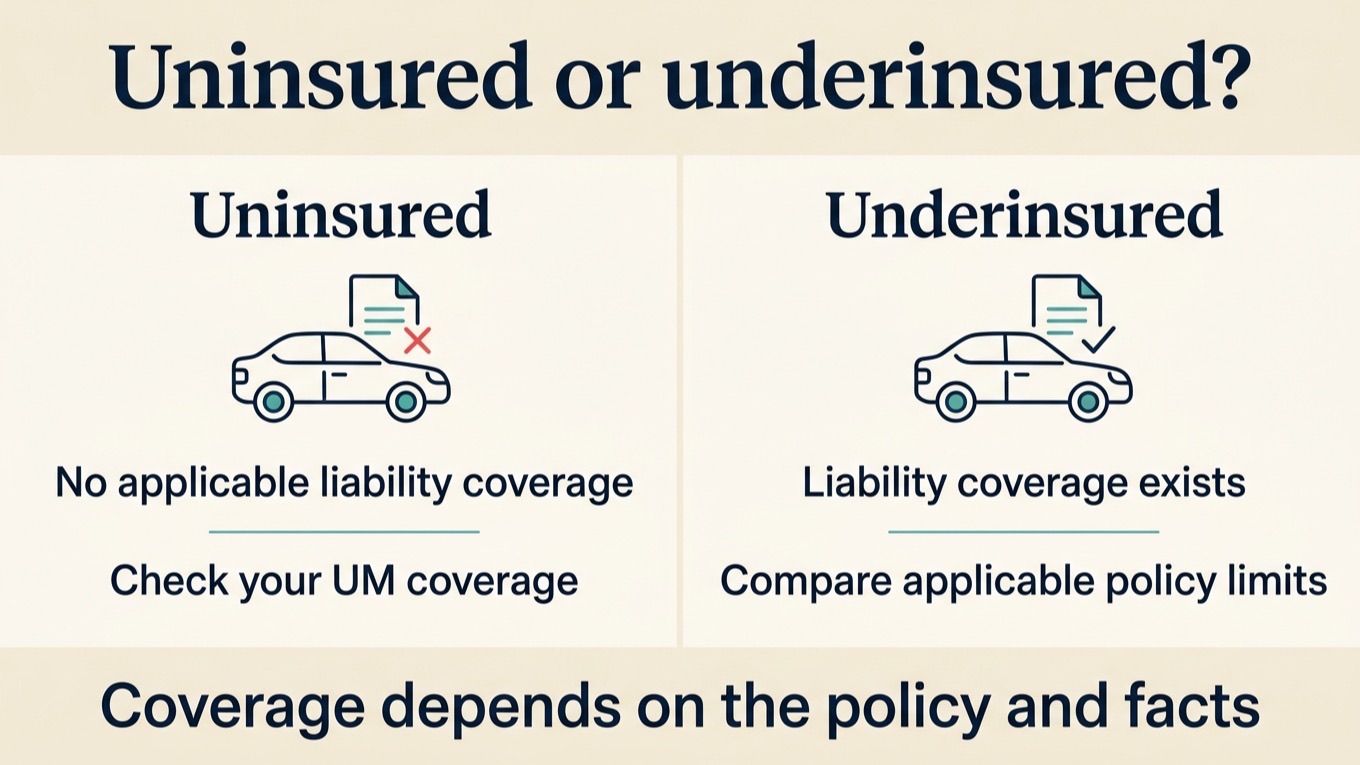
An uninsured driver has no applicable liability coverage for the crash. An underinsured driver has coverage, but Tennessee’s UM/UIM rules require a comparison of available liability limits with your applicable UM limits. Unpaid bills alone don’t establish a UIM claim.
That distinction can be confusing after an injury. The other driver may have shown an insurance card, and the adjuster may have offered the policy limit. You may still face treatment expenses and missed work. Before assuming your own policy will pay the rest, the available coverage needs a closer look.
UM stands for uninsured motorist. UIM refers to underinsured motorist. Tennessee addresses both through its uninsured motor vehicle coverage laws. The everyday labels are useful, but they don’t replace the statutory rules and policy terms.
Three situations that need different questions
| Situation | First coverage question |
|---|---|
| Identified driver with no applicable liability insurance | Are you covered by a UM policy for this crash? |
| Unknown driver who leaves the scene | Do you have applicable coverage and meet Tennessee’s unknown-driver requirements? |
| Driver with liability insurance | Are the available liability limits below your applicable UM limits, and what reductions apply? |
An insurance card doesn’t establish that a particular loss is covered. Conversely, a driver’s statement that they have no insurance doesn’t rule out every policy that may apply. Ask for coverage information and have potential sources reviewed.
If the driver was working, driving a company vehicle, or using someone else’s car, tell your attorney. Those facts may raise additional coverage or liability questions. They don’t automatically make an employer or owner responsible.
Why “their insurance isn’t enough” is only the starting point
In everyday speech, underinsured means the driver’s insurance won’t cover all the harm. Tennessee’s legal test is more specific.
Tenn. Code Ann. § 56-7-1202(a) compares the available liability limits applicable to the loss with the applicable UM limits of the policy being claimed against. The available liability limits must be lower for the statutory definition to be met.
Consider a simple example without assigning a dollar value to anyone’s case: the responsible driver’s available liability limit equals your applicable UM limit. Your proven losses are higher than either limit. That does not, by itself, create UIM eligibility. If the available liability limit is lower, further review is still needed to determine coverage and any amount payable.
The point is to compare the policies before treating UIM as a second payment source. A policy limit is not the value of your injury, and the value of your injury is not necessarily the amount insurance will pay.
Why you generally can’t just add the two policy limits
Tennessee’s § 56-7-1201(d) provides for reductions based on applicable collectible liability and primary UM limits. In plain terms, your UM limit generally isn’t an extra full limit placed on top of the other driver’s insurance.
Ask an attorney or adjuster to explain the proposed calculation in writing. The review should identify the applicable UM limit, all relevant liability coverage, and each claimed reduction. The amount payable also depends on covered losses and fault; a coverage calculation doesn’t establish the value of the case.
When several people are injured, per-person limits, accident limits, and payments to others can complicate the analysis. Don’t assume an offer described as “all that’s left” settles every question about available coverage.
Can you combine policies on multiple household cars?
Don’t assume so. Tennessee’s statute has rules about which UM policy applies when you occupy your own vehicle, ride in a vehicle you don’t own, or are not in a vehicle at all. It also limits combining coverage from multiple policies.
Provide the actual policies and facts instead of adding every declarations-page limit together. A passenger’s situation may differ from the owner-driver’s situation. A policy naming you may raise a different question from one under which you qualify only as a resident relative.
Our policy-review guide lists the documents and coverage questions to bring to that conversation.
What changes when the driver is unknown?
A hit-and-run is not simply proof that the other driver lacked insurance. When the driver can’t be identified, Tennessee imposes special requirements for a claim under UM coverage.
These include physical contact or clear and convincing evidence of the unknown motorist from a source other than occupants of the insured vehicle, a report to the appropriate law enforcement agency within a reasonable time, and reasonable efforts to identify the vehicle and driver. Have the specific facts reviewed, especially after a crash without contact.
Save original recordings and witness information, and notify your insurer promptly. Our first-steps guide explains how to begin without putting yourself at risk.
What about car repairs and medical bills right now?
Ask separately about collision, UM property-damage, medical-payments, and health coverage that may be relevant. These coverages have different terms and may handle different parts of the loss. Don’t assume that approval of repairs confirms an injury claim.
Keep bills, receipts, explanations of benefits, and records of payments. Ask your attorney about any reimbursement claims or liens before treating a settlement amount as money you can keep. The amount offered, the available insurance, and the amount ultimately received are different questions.
This is also a reason to avoid rushing into a broad release while treatment and coverage remain unclear. You need to know which claims the document ends.
Before accepting the other driver’s policy-limit offer
Get advice before signing. Tennessee’s UM settlement statute includes procedures for preserving rights when settling with responsible parties. Notice, consent, and the insurer’s recovery rights can matter.
Bring these items to a review:
- Your complete policy for the crash date, including endorsements.
- Written information about the other driver’s available coverage.
- The offer and proposed release, including any response deadline.
- Information about other injured people or other potentially responsible parties.
- Your crash evidence and current records of losses.
Don’t wait for every document before asking about a deadline. If something is missing, identify it so the next step is clear. Our UM/UIM claim guide explains how to keep the process organized.
Get a coverage review based on your actual policies
Our Tennessee car accident attorneys can help you understand the difference between an uninsured claim, an underinsured claim, and a policy that doesn’t apply to the crash. Bring the paperwork and any proposed settlement before making a final decision.
Call 615-244-2111 or reach out through our online contact form.
Because we care,
Stillman & Friedland