

To start a Tennessee uninsured or underinsured motorist claim, notify the insurer promptly, request the policy that applied on the crash date, and collect proof of the crash and your losses. Get legal advice before releasing the other driver or accepting a settlement that could affect UM/UIM rights.
UM means uninsured motorist coverage. UIM refers to underinsured motorist coverage. These coverages may help when a responsible driver has no applicable liability insurance or when the available liability limits are below your applicable UM limits. They don’t guarantee payment, and a large medical bill alone doesn’t establish eligibility.
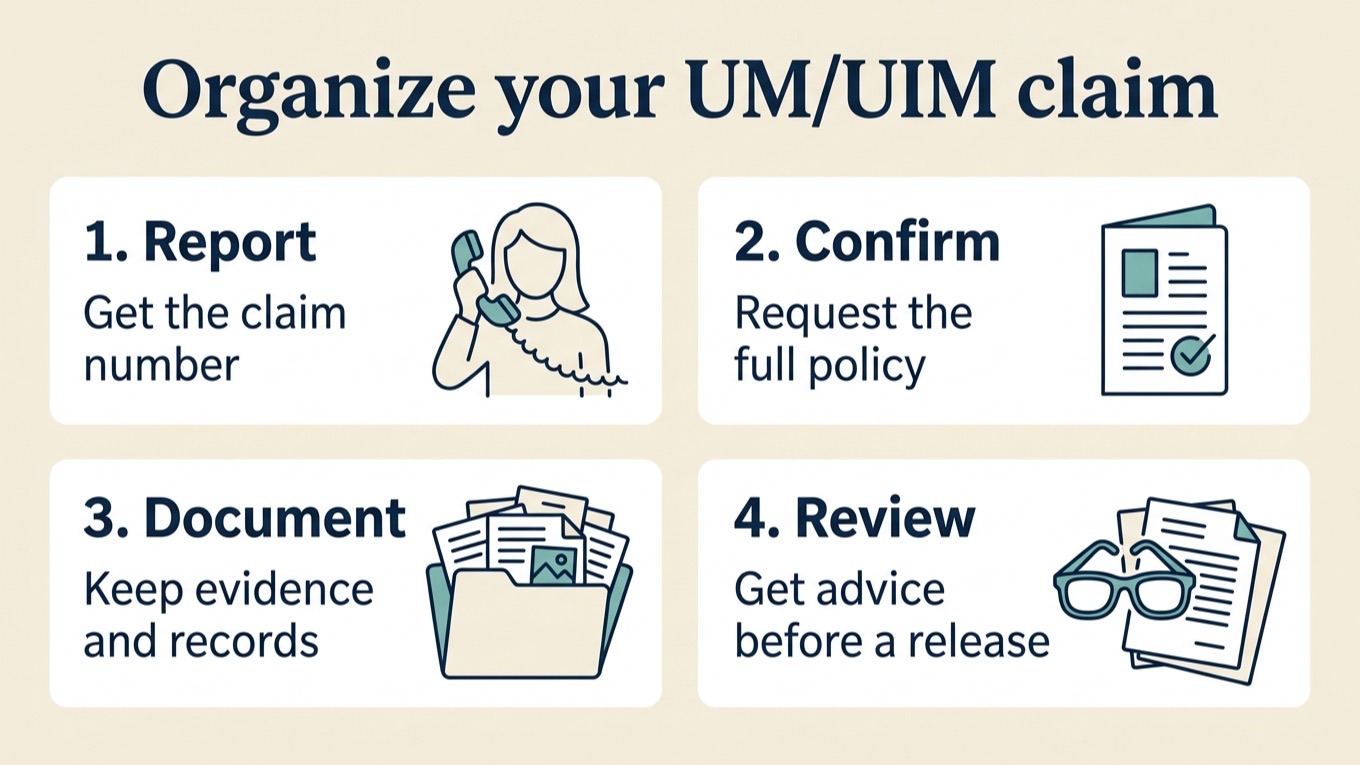
The steps below help you keep the claim organized while coverage and fault are being reviewed.
Step 1: Report the crash to the right insurers
Notify your own auto insurer even if you already have a claim number from the other driver’s company. If you were a passenger or driving a vehicle you don’t own, ask about the vehicle’s policy too. Tell an attorney about other potentially relevant household policies rather than choosing one yourself.
Give the date, location, people involved, report number if available, and a truthful description of what you know. State clearly if the other driver fled or if you’ve been told coverage was denied. Don’t delay reporting while you wait for a final police report or a formal denial letter.
Ask for the adjuster’s name, claim number, and a written list of requested information. The NAIC’s auto-claim guidance recommends prompt notice, cooperation, and keeping records of insurer conversations.
Step 2: Confirm coverage and the reason UM/UIM may apply
Request the complete policy, including endorsements and any signed coverage-selection forms, for the date of the crash. Our policy-review checklist explains where to start.
Ask the adjuster to separate these questions:
- Are you an insured under the policy for this incident?
- Is the responsible vehicle uninsured or underinsured under the applicable law and terms?
- What evidence is needed to establish the other driver’s fault?
- Which injury and property-damage coverages are being evaluated?
- What limits, exclusions, credits, or deductibles may affect the claim?
If another insurer says it won’t cover the crash, request that position in writing. A missing insurance card at the scene doesn’t, by itself, establish that no coverage exists. A policy might cover the vehicle, its owner, or another responsible party.
Step 3: Build one claim folder
Use paper, a secure digital folder, or both. You don’t need a complicated system; you need a record you can find when someone asks for it.
| Folder section | What to keep |
|---|---|
| Crash | Report number, photographs, original video, witness contacts, your factual notes |
| Coverage | Policy documents, claim numbers, denial letters, written coverage explanations |
| Treatment | Appointment records, discharge instructions, bills, receipts, work restrictions |
| Work and daily life | Employer records of missed work and dated notes about actual limitations |
| Communications | Letters, emails, document requests, offers, and a call log |
Keep original evidence and a backup. Describe the impact on your life honestly. “Missed my scheduled shift on Tuesday” is more useful than a broad claim that the crash changed everything, especially when supported by an employer’s records.
Our guide to connecting medical records to a Tennessee injury claim explains why accurate treatment records matter. Ask your provider for care advice; don’t change treatment to make a claim look stronger.
Step 4: Respond carefully to information requests
Your own policy may require cooperation, statements, records, or other steps. Keep track of requests and their deadlines. If you need more time, ask promptly and keep the response.
For a recorded statement, be accurate about what you saw and what you don’t know. Ask to clarify confusing questions. If pain or medication affects your ability to respond, say so and ask about a suitable time. An attorney can help you understand your obligations without leaving requests unanswered.
Review medical authorizations for their scope and purpose. Ask which records are needed and why. Don’t alter records, omit relevant facts, or assume every insurer request is optional.
Step 5: Pause before signing the other driver’s release
An offer from the other driver’s insurer may sound like the first step toward collecting UIM benefits. But the order of the steps matters.
Tenn. Code Ann. § 56-7-1206 sets out procedures that can affect settlements, notice to the UM insurer, arbitration, and the insurer’s right to pursue a responsible party. A routine claim email or verbal approval may not satisfy the procedure that applies to your situation.
Before agreeing to a settlement or signing a release, have an attorney review the offer, all available liability coverage, your UM policy, and any required notices or consent. Don’t assume you can settle first and sort out UIM later.
Also distinguish a vehicle-damage settlement from an injury settlement. Ask exactly which claims and people a proposed release covers. Read the actual document rather than relying only on its label.
Step 6: Check deadlines while the claim is still being discussed
An open insurance file isn’t the same as filing a lawsuit. Negotiations, a pending police investigation, and requests for additional records don’t automatically stop legal deadlines.
Ask an attorney to identify the deadlines and required legal steps for your particular claim. Unknown-driver cases can involve special procedures; naming and serving the correct parties and insurer requires care. Don’t use a general blog timeline as your filing calendar.
For a hit-and-run, tell the attorney immediately if there was no physical contact, if reporting was delayed, or if you have a lead on the other driver. Those details can affect what must be proved.
If the insurer denies or undervalues the claim
Ask for a written explanation. A dispute about whether a policy applies is different from a dispute about fault or the amount of loss. Save the letter, the policy language cited, and any response deadline.
An attorney can compare the insurer’s position with the policy, evidence, and law. Tennessee’s insurance consumer resources also explain how to seek regulatory help. A complaint doesn’t decide every legal issue or extend court deadlines.
There is no single completion time for every UM/UIM case. Treatment, available evidence, coverage disputes, and whether litigation is needed can all affect the process. Ask what is still missing and who is responsible for the next step.
Get help before a claim decision becomes final
Our Tennessee car accident attorneys can review a UM/UIM claim, a denial, or a proposed release. Bring the policy, claim correspondence, and any settlement papers so we can focus on the questions in your case.
Call 615-244-2111 or reach out through our online contact form.
Because we care,
Stillman & Friedland