


The call every parent dreads often begins with a shaken voice: “I’ve been in a wreck.”
You may not know whether your teenager is hurt, where the car is, who else was involved, or what the police are saying. You may also be trying to calm your child while finding keys, insurance information, and a safe way to reach the scene.
You do not have to solve fault, insurance, and every legal question during that call. The first priorities are safety, truthful information, medical care, and protecting records that may be difficult to replace later.
Here is a practical Tennessee-focused guide for those first hours and days.
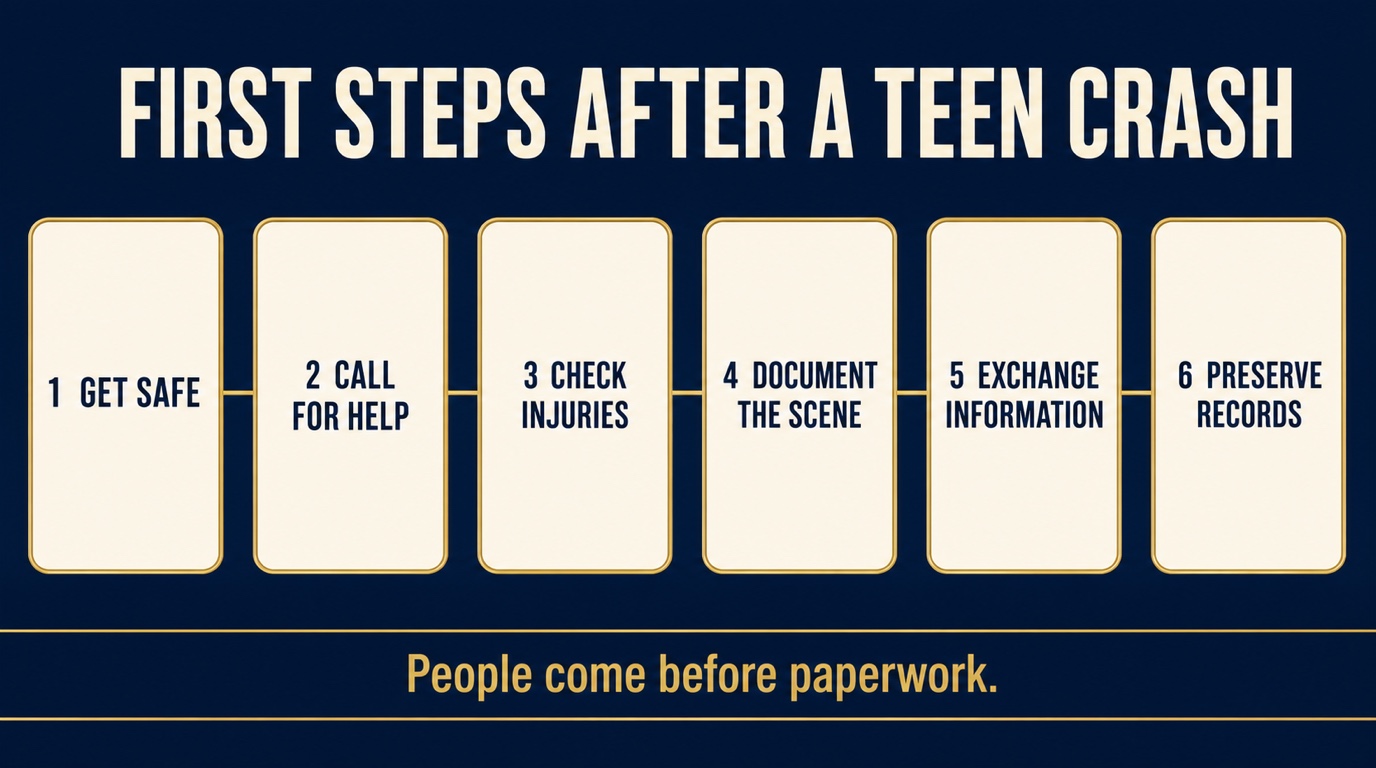
First, Find Out Whether Everyone Is Safe
Ask your teen to take a breath and answer a few short questions:
- Are you in immediate danger from traffic, fire, or another hazard?
- Is anyone hurt or saying they are hurt?
- Has someone called 911?
- Where are you?
- Are police, firefighters, or emergency medical personnel there?
If the vehicle is in a travel lane, your teen should follow the directions of 911 dispatchers and responding officers about moving it. The safest decision depends on the scene, vehicle condition, injuries, and traffic.
Tell your teen not to walk through moving traffic or stand between damaged vehicles. A photograph is never worth another injury.
Take Possible Injuries Seriously
Adrenaline can make a person feel “fine” in the first minutes after a crash. Teenagers may also minimize symptoms because they are scared, embarrassed, worried about losing driving privileges, or focused on the damaged car.
Encourage an honest report of pain, dizziness, confusion, nausea, numbness, vision changes, or any other symptom. Let emergency professionals decide what evaluation is appropriate. If symptoms appear or worsen later, seek medical guidance promptly.
Our February series explains why some crash injuries appear later and why medical records matter to an injury claim.
Let Your Teen Tell the Truth Without Guessing
Your child should cooperate with responding officers and provide truthful identifying and insurance information. But being honest does not require guessing.
If your teen does not know a speed, distance, or exact sequence, “I don’t know” is better than an estimate invented under stress. Do not coach your child to accept blame or deny responsibility before you understand the facts. Do not argue with the other driver at the scene.
Statements such as “I’m sorry” may be an expression of concern rather than a complete account of fault, but insurers may later ask about every statement. The safest approach is calm, factual, and respectful.
Document the Scene If It Is Safe
If your teen can do so safely—or if you arrive while the scene is still intact—collect photographs and video showing:
- All vehicles from several angles.
- Damage and debris.
- Final vehicle positions before they are moved, if safely possible.
- Traffic lights, signs, lane markings, crosswalks, and road conditions.
- The approach each driver took.
- Weather, lighting, and visibility.
- Any obvious camera locations nearby.
Also exchange names, contact information, driver-license information, vehicle details, and insurance information. Collect witness names and phone numbers rather than relying on the police report to contain everyone.
Do not photograph an injured person for dramatic effect or post scene images online. The goal is an accurate record, not content for social media.
Preserve the Original Digital Evidence
Original files often contain better detail and metadata than screenshots. Ask your teen to preserve:
- Photos and videos in their original form.
- Dashcam or in-car camera recordings.
- Navigation and route information.
- Messages about the trip, destination, passengers, or permission to drive.
- Phone settings and application data that may become relevant.
- School, work, or event information that explains why the teen was traveling.
Do not delete messages because they look unhelpful, and do not reset the phone. Do not repair, sell, or dispose of a seriously damaged vehicle before asking whether onboard data or physical evidence should be preserved.
Get the Crash Report Information
Write down the investigating agency, officer’s name, report number, and where the vehicle was towed. Tennessee’s official crash-report portal explains how reports investigated by the Tennessee Highway Patrol or another agency may be obtained.
A crash report is important, but it may not be the last word on fault. It can contain errors, omit a witness, or reflect information available only during the officer’s initial investigation. Preserve your own records too.
Check Whether an Owner Operator Report Is Required
Tennessee has a separate reporting requirement that families can easily overlook. According to the Tennessee Department of Safety and Homeland Security’s Owner Operator Report guidance, a vehicle owner or driver involved in a crash must submit that report when the crash caused death or injury, more than $1,500 in property damage, or more than $400 in damage to state or local government property.
The department says the report is required regardless of fault, is in addition to a report filed by an investigating officer, and must be submitted within 20 days. Failure to file when required may affect driving and registration privileges.
Do not assume the police report completed this separate obligation for your family.
Notify the Insurer, but Slow Down Before a Recorded Statement
Most auto policies require reasonably prompt notice and cooperation. Report the crash through the appropriate channel and keep the claim number, adjuster’s information, and a copy of anything submitted.
Before a lengthy recorded statement, broad medical authorization, release, or settlement discussion, make sure you understand:
- Which policy and coverage the adjuster represents.
- Whether the teen is an insured or listed household driver.
- Whether the adjuster is calling for your policy or another driver’s insurer.
- What documents are being requested and why.
- Whether injuries and vehicle damage are fully understood.
Cooperating with your own insurer does not require rushing through questions while your teen is frightened or still being evaluated.
Do Not Rush Repairs or a Total-Loss Decision When Evidence Matters
Families often need transportation restored quickly. That is understandable. But serious crashes can leave evidence in vehicle damage, onboard systems, tires, restraints, or other components.
Before authorizing destruction, salvage, or repairs, take complete photographs and ask whether an inspection or data preservation is needed. Keep towing, storage, repair, rental, and personal-property receipts.
If the vehicle contains school materials, sports gear, medication, or other personal items, coordinate a safe retrieval with the tow yard rather than entering a damaged vehicle without permission.
Watch What Is Shared Online
Teenagers may want to reassure friends or respond to rumors. Ask them not to post photographs, explanations, jokes, apologies, injury updates, or comments about the other driver.
They should also avoid deleting existing posts or messages once a claim is possible. Preserve first and get advice about what must remain available. A private account does not guarantee that a post stays private.
Organize One Family Crash File
The first week becomes easier when everything is in one place. Keep:
- Crash and Owner Operator Report information.
- Insurance policies, cards, claim numbers, and adjuster contacts.
- Medical visit summaries, bills, and provider names.
- Photographs, video, witness contacts, and original files.
- Tow, repair, rental, mileage, and other receipts.
- The teen’s current license and restrictions.
- A dated note of important calls and events.
This record helps the family answer questions consistently without relying on memory during a stressful time.
You Do Not Have to Decide Everything on Day One
The vehicle may be replaceable. Evidence may not be. Take care of people first, meet required reporting obligations, preserve original records, and avoid signing away rights before the injuries, facts, and coverage are understood.
If the crash involved a school zone, passenger restriction, disputed permission, serious injury, or an insurer denying coverage, get case-specific guidance early. Those issues rarely become simpler when documents and video have disappeared.
We’re Here to Help
If your teenager was injured in a Tennessee crash—or if your family is trying to understand what happens after a young driver caused one—we can help you sort out the immediate priorities, reporting questions, insurance policies, and evidence.
Call 615-244-2111 or reach out through our online contact form.
Because we care,
Stillman & Friedland