


“How long will my case take?” is one of the most reasonable questions an injured person can ask. Medical bills are arriving. Work has been interrupted. The insurance company may be calling. Waiting without a clear explanation can feel like the legal process has stopped.
The honest answer is that no responsible attorney can give every Tennessee car accident case the same finish date.
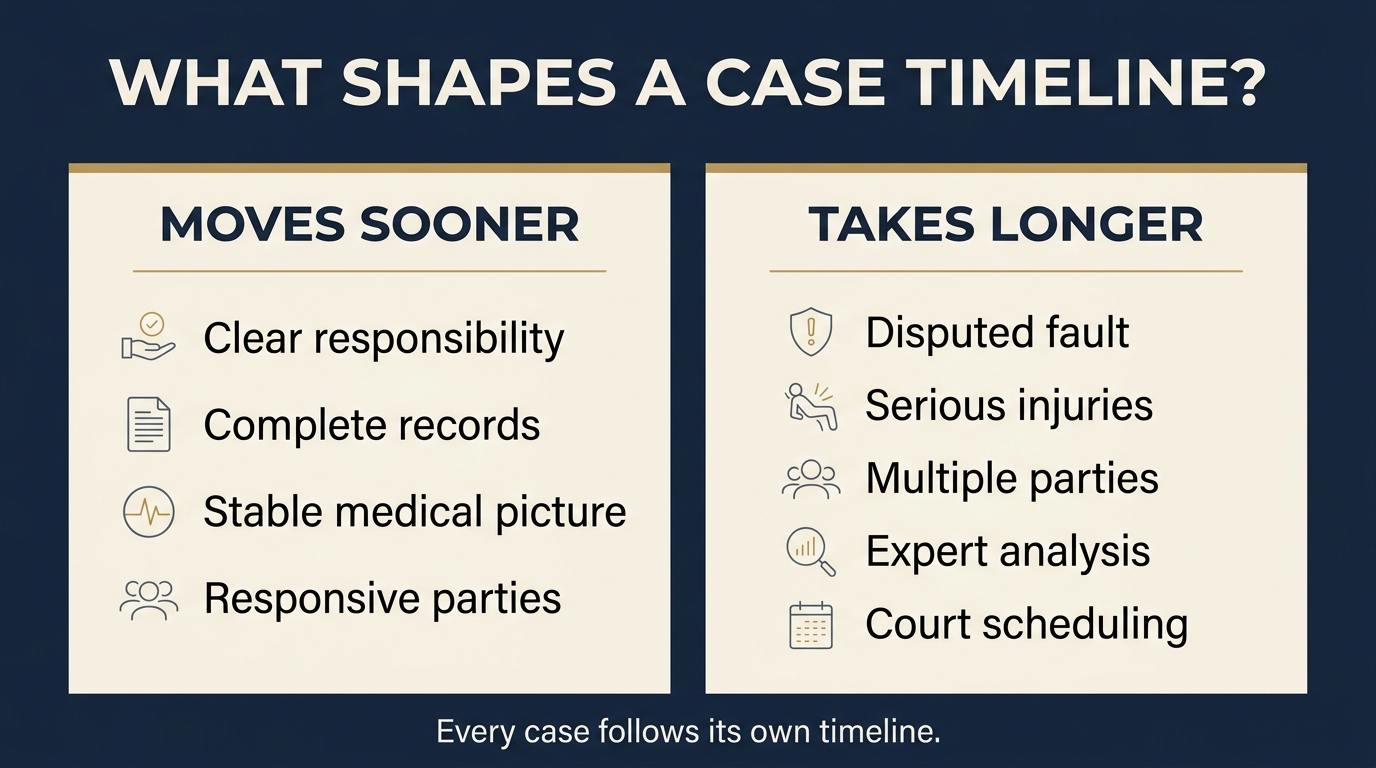
A claim with clear responsibility, limited treatment, complete records, and adequate insurance may resolve relatively quickly. A claim involving disputed fault, serious injuries, several parties, difficult-to-obtain evidence, or a filed lawsuit may take much longer.
Instead of promising a date, a useful timeline explains the stages, the factors that control them, and what is happening now.
The First Days: Protect People, Proof, and Deadlines
The earliest work should focus on urgent needs:
- Obtaining appropriate medical evaluation.
- Reporting the crash to the necessary insurers.
- Preserving photographs, video, vehicle data, and witness information.
- Identifying the drivers, owners, employers, and other potential parties.
- Confirming the crash date and applicable legal deadlines.
This stage can move quickly because some evidence will not wait. Surveillance video may be overwritten, and vehicles may be repaired or destroyed.
Tennessee also has a short filing period for many injury actions. Tenn. Code Ann. § 28-3-104 generally requires an action for injury to the person to be commenced within one year after it accrues. Exceptions, different claims, and special defendants can change the analysis, so the safest approach is to obtain case-specific advice promptly rather than calculate a deadline from a general article.
The limitation period is a deadline to commence a lawsuit. It is not a promise that a claim will be resolved within that year.
The Medical Timeline Often Shapes the Claim Timeline
The legal team needs a fair picture of the injury before advising a client about a permanent settlement. That picture may become clear after a short course of care, or it may take longer because:
- Symptoms change after the initial visit.
- Imaging or specialist appointments are delayed.
- Therapy must be tried before another treatment is considered.
- A procedure is scheduled and recovery must be evaluated.
- Work restrictions or long-term limitations remain uncertain.
Waiting for medically useful information is different from delaying for no reason. A settlement signed before the condition is understood may leave the client responsible for later consequences that were never included in the evaluation.
Your attorney should not keep a claim open merely to make it look larger. Treatment decisions belong to the patient and medical providers. The legal timeline should respond to the real medical evidence.
Records Collection Is Slower Than Most People Expect
Once treatment reaches a useful point, the firm may request medical records and itemized bills. Providers, billing companies, imaging facilities, insurers, and employers do not always respond at the same speed. A single missing report can matter if it contains the diagnosis, work restriction, or future-care opinion the insurer will evaluate.
The legal team must then review the records, match bills to providers, identify missing dates, and make sure the documents accurately reflect the client’s experience.
You can reduce avoidable delay by telling the firm about every provider, updating new appointments, and sending benefit statements or bills that reveal a missing account. Our February post explains how medical records connect treatment to a Tennessee injury claim.
Investigation Can Continue While Treatment Continues
The case does not have to sit untouched while the medical picture develops. The attorney may obtain crash reports, interview witnesses, request video, inspect vehicles, identify insurance coverage, and research other responsible parties.
A simple rear-end collision may require less investigation than a crash involving:
- Conflicting driver accounts.
- A commercial truck or fleet vehicle.
- A rideshare or delivery app.
- A dangerous road condition.
- Several vehicles or injured people.
- A disputed traffic signal.
- A possible vehicle or component defect.
The more organizations and data sources involved, the more time it may take to preserve, obtain, and understand the evidence. Read the second post in this series for a closer look at how an injury attorney investigates and builds a case.
Pre-Suit Negotiation Has Its Own Pace
When the evidence and medical information are ready, the attorney may prepare a settlement demand. The insurer needs time to review it, verify coverage, obtain authority, and respond.
The first response may be an offer, a denial, or a request for more information. Counteroffers and additional documentation can follow. A case with a narrow disagreement may move faster than one where the sides dispute responsibility, medical cause, future limitations, or available coverage.
There is no benefit in exchanging numbers endlessly when the insurer will not seriously address the evidence. At that point, the client and attorney may discuss whether filing a lawsuit is appropriate. The decision must account for the filing deadline; negotiations do not automatically pause it.
Filing a Lawsuit Adds Formal Stages
A lawsuit can provide tools to obtain evidence and move the dispute toward a decision, but it adds procedural steps. The complaint must be filed, defendants must be properly notified, and responses must be received. The court may set deadlines for discovery, motions, mediation, and trial.
Discovery can include written questions, document requests, depositions, subpoenas, and expert work. Tennessee Civil Procedure Rule 16 permits courts to establish case schedules, and the Tennessee Rules of Civil Procedure govern the discovery and pretrial process.
Timing after filing depends on factors that neither the client nor attorney fully controls:
- How many parties must be served.
- The volume and complexity of discovery.
- Scheduling among clients, lawyers, witnesses, experts, and court reporters.
- Disputes that require a judge’s ruling.
- The court’s calendar.
- Whether the parties mediate.
- Whether an appeal follows judgment.
Litigation can still end in settlement. In fact, information obtained during discovery may help the parties evaluate the case more realistically.
Factors That Commonly Extend a Case
Some delays are preventable; others are part of handling the claim responsibly. A case may take longer when:
- The injuries are serious or the future medical picture is uncertain.
- Several people or companies dispute responsibility.
- Insurance coverage is unclear or limited.
- Important evidence is held by a reluctant third party.
- Experts need time to inspect, test, or form opinions.
- The client has prior injuries that must be separated from the new harm.
- Medical providers or lienholders are slow to supply information.
- A trial date depends on a crowded court calendar.
- Post-trial motions or an appeal are filed.
Delay can also occur when a client misses appointments, does not return forms, changes contact information without telling the firm, or waits to disclose another claim or prior condition. Staying responsive does not control the whole timeline, but it prevents avoidable gaps.
Faster Is Not Always Better
An insurer may offer money before all records are collected or before the injury is fully understood. Speed can feel attractive when bills are pressing, but a permanent release may close the claim for good.
The right question is not simply, “How fast can this end?” It is, “What information do I need before I can make a sound decision?”
That may include:
- A stable diagnosis and treatment plan.
- Complete records and bills.
- A clear view of available coverage.
- An investigation of disputed fault.
- An estimate of fees, expenses, balances, and liens.
- Advice about the risks of settlement versus litigation.
A long delay without explanation is not acceptable. But careful work that protects the client’s decision is different from unexplained inactivity.
Ask for a Stage-Based Status Update
If you are unsure why the case is taking time, ask questions that produce a useful answer:
- What stage is my claim in now?
- What has been completed since the last update?
- What records, decisions, or events are still outstanding?
- Who controls the next step?
- Is there a deadline or expected response date?
- Is there anything you need from me?
- What could change the current timeline?
The answer may not include a guaranteed completion date. It should give you a clear picture of the path ahead.
A Realistic Timeline Is Specific to the Case
Two people can be injured on the same road on the same day and have very different legal timelines. One may recover quickly with clear insurance coverage. The other may need surgery, face a dispute over who entered the intersection first, and discover that several policies or companies are involved.
A trustworthy attorney should explain the difference, update the estimate as the evidence changes, and avoid treating speed as the only measure of good work.
We’re Here to Help
If you are wondering how long your Tennessee car accident claim may take, we can help identify the current stage, protect the deadlines, and explain the factors likely to shape your case’s timeline.
Call 615-244-2111 or reach out through our online contact form.
Because we care,
Stillman & Friedland