


The word “trial” can make an injured person picture a crowded courtroom, an aggressive cross-examination, and a surprise verdict delivered after one dramatic day.
Real Tennessee civil cases are usually less theatrical and much more methodical. Preparation begins months before anyone enters a courtroom. Documents are exchanged. Witnesses give depositions. Legal issues are narrowed. Exhibits are organized. The client practices explaining what happened truthfully and clearly.
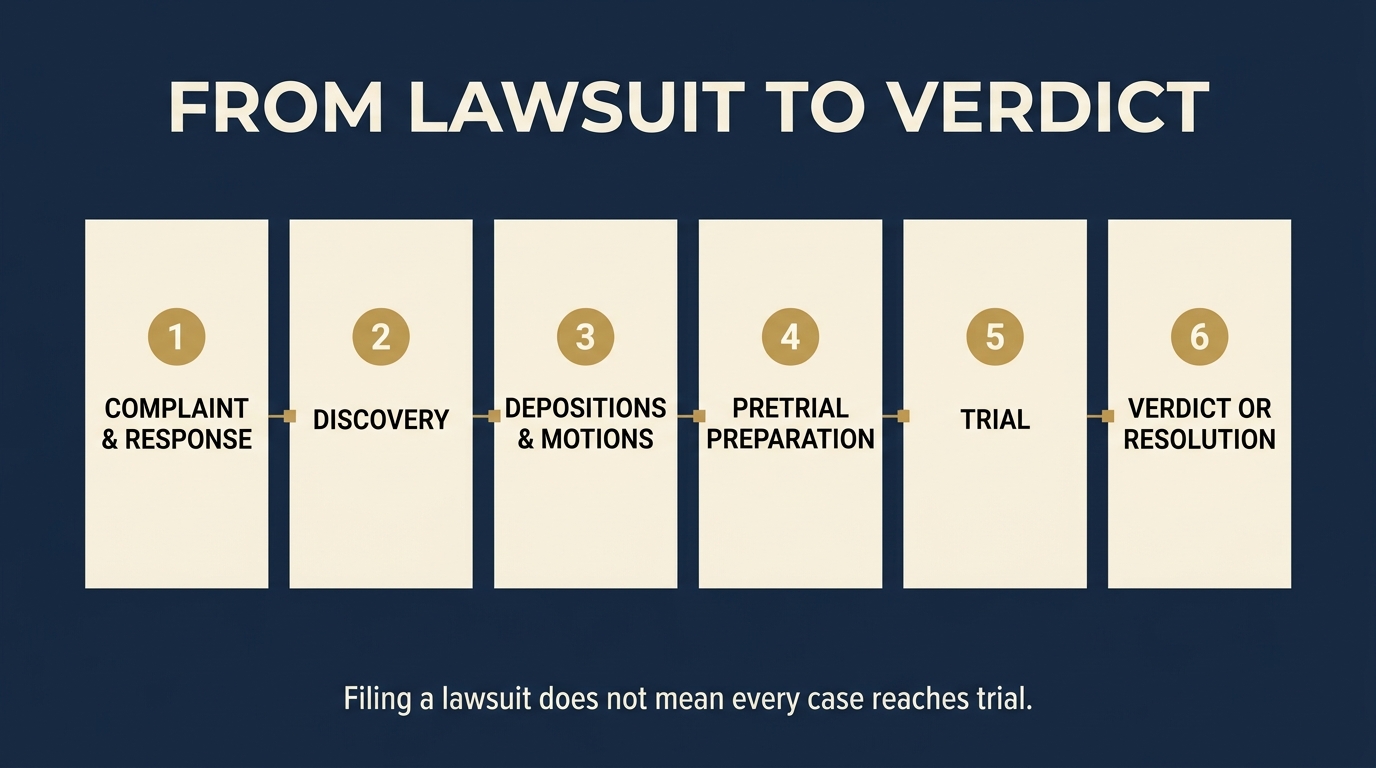
Many lawsuits resolve before trial. When settlement is not possible, trial gives the parties a structured way to present evidence and ask a judge or jury to decide the disputed issues.
Filing a Lawsuit Is Not the Same as Going to Trial
A lawsuit starts when the plaintiff files a complaint and follows the required process for notifying the defendant. The complaint identifies the parties, states the legal claims, describes the requested relief, and begins the court case.
The defendant then has an opportunity to respond. The response may admit some allegations, deny others, raise defenses, or challenge part of the complaint.
This pleading stage frames the dispute. It does not mean the case will immediately be placed before a jury. The parties usually have substantial work to do before a trial date is reached.
The Court May Set a Schedule
Under Tennessee Civil Procedure Rule 16, a court may use scheduling and planning orders to set deadlines for adding parties, amending pleadings, filing motions, and completing discovery. The schedule may also identify pretrial conferences and a trial date.
The exact process depends on the court, judge, county, and complexity of the case. A straightforward two-car collision and a commercial-truck case involving several companies may not move at the same pace.
Clients should take court deadlines seriously. Your attorney may need quick help obtaining a document, preparing a discovery response, scheduling a deposition, or updating medical information.
Discovery Lets Each Side Test the Evidence
Discovery is the formal exchange of information after suit is filed. Tennessee’s Rules of Civil Procedure allow methods that can include:
- Interrogatories: written questions answered under oath.
- Requests for production: requests for documents, photographs, electronic information, and tangible evidence.
- Requests for admission: statements the other party must admit or deny.
- Depositions: sworn testimony given before trial.
- Subpoenas: commands requiring certain nonparties to provide testimony or records.
- Expert discovery: information concerning qualified experts and their opinions when expert proof is used.
Discovery is not one-sided. The defense may request your medical history, employment information, photographs, online activity, prior claims, and testimony about the crash and injuries. Your attorney will object when a request is improper, but relevant information generally cannot be hidden because it feels private or uncomfortable.
Your Deposition Is Important, but It Is Not a Performance
A deposition usually takes place outside the courtroom. A court reporter administers an oath and creates a record while the opposing lawyer asks questions. Your attorney attends and can object where appropriate.
The best deposition preparation is not memorizing a script. It is reviewing the important facts, understanding the process, listening carefully, and answering only the question asked.
Good habits include:
- Tell the truth.
- Do not guess.
- Ask for clarification when a question is unclear.
- Take time to think before answering.
- Avoid exaggerating or minimizing symptoms.
- Correct an answer if you realize it was inaccurate.
The defense lawyer may ask about difficult facts. That is expected. Learning how those facts will be presented can help your attorney evaluate the case and prepare for trial.
Motions Can Resolve or Narrow Issues
Before trial, either side may ask the judge to decide a legal or procedural issue. Some motions concern discovery disputes, deadlines, experts, or what evidence the jury may hear. Other motions may ask the court to resolve a claim without a trial when the legal standard is met.
A motion is not automatically a sign that something has gone wrong. Motions are part of how courts manage disputes and determine which issues should reach the jury.
The judge may also hold a pretrial conference. Tennessee Civil Procedure Rule 16.03 allows the participants to address issues such as witnesses, documents, admissibility questions, pending motions, settlement, and the trial schedule. A final pretrial conference may produce a plan that makes the trial more focused and efficient.
Settlement Can Still Happen
Filing suit does not end negotiation. The evidence learned in discovery may make one side reconsider its position. A deposition may strengthen or weaken a disputed point. A court ruling may narrow the risks.
The parties may negotiate directly or participate in mediation. Tennessee Supreme Court Rule 31 permits courts to order mediation in eligible civil actions, but the parties themselves retain the decision whether to agree to a settlement.
Some cases settle shortly before trial. Others do not. Your attorney should prepare the case as if it will be tried while continuing to communicate any serious settlement opportunity.
Jury Selection Comes First
When a civil case is tried to a jury, the court and lawyers begin by selecting jurors through a process often called voir dire. Potential jurors may be asked about experiences, relationships, opinions, or other matters that could affect their ability to consider the case fairly.
The process is not about finding jurors who promise to favor one side. It is about identifying a panel that can listen to the evidence, follow the judge’s instructions, and decide the case impartially.
Tennessee Civil Procedure Rule 39.01 explains that issues properly designated for a jury are tried by a jury unless the parties agree otherwise or no jury right applies. Some civil cases are tried by a judge without a jury.
Each Side Presents Its Case
The Tennessee AOC’s guide to the state legal system describes the familiar sequence of a civil trial. The details vary, but a jury trial commonly includes:
- Opening statements. Each side previews what it expects the evidence to show. Statements are not evidence.
- The plaintiff’s proof. Witnesses testify and exhibits are offered. The defense may cross-examine the witnesses.
- The defense proof. The defense presents its witnesses and exhibits, subject to cross-examination by the plaintiff’s lawyer.
- Closing arguments. The lawyers explain how they believe the admitted evidence fits the law.
- Jury instructions. The judge explains the legal rules the jury must follow.
- Deliberation and verdict. The jurors discuss the case privately and return their decision.
Under Tennessee Civil Procedure Rule 43.01, witness testimony at trial is taken under the Tennessee Rules of Evidence. Rule 51.03 requires the court to instruct jurors about their duties, the order of proceedings, and the legal principles governing the case.
The Client’s Testimony Makes the Injury Real
Medical records can show diagnoses and treatment. They do not fully explain what it was like to miss a child’s event, need help getting dressed, lose sleep, or fear that the same work will no longer be possible.
Your testimony may address the collision, symptoms, treatment, work, limitations, and recovery. Other witnesses may explain changes they personally observed. Medical or technical experts may explain issues requiring specialized knowledge.
Credibility matters. A calm, accurate answer is more persuasive than a dramatic one. If you do not remember, say so. If your recovery includes good days and bad days, explain that honestly.
A Verdict May Not Be the Final Step
After a verdict, the court enters a judgment. Depending on the issues, a party may file post-trial motions or an appeal. Appeals focus on claimed legal errors; they are not simply a new trial because one side dislikes the outcome.
Post-trial work can add substantial time and uncertainty. Your attorney should explain what the verdict means, whether any remaining issues must be resolved, and what options each side has.
Trial is unfamiliar, but it should not be mysterious. Careful preparation turns a large process into a series of understandable steps.
We’re Here to Help
If your Tennessee injury claim is moving toward litigation or trial, you should know what each stage means and what will be expected of you. We can help prepare the evidence, explain the decisions, and stand with you through the process.
Call 615-244-2111 or reach out through our online contact form.
Because we care,
Stillman & Friedland