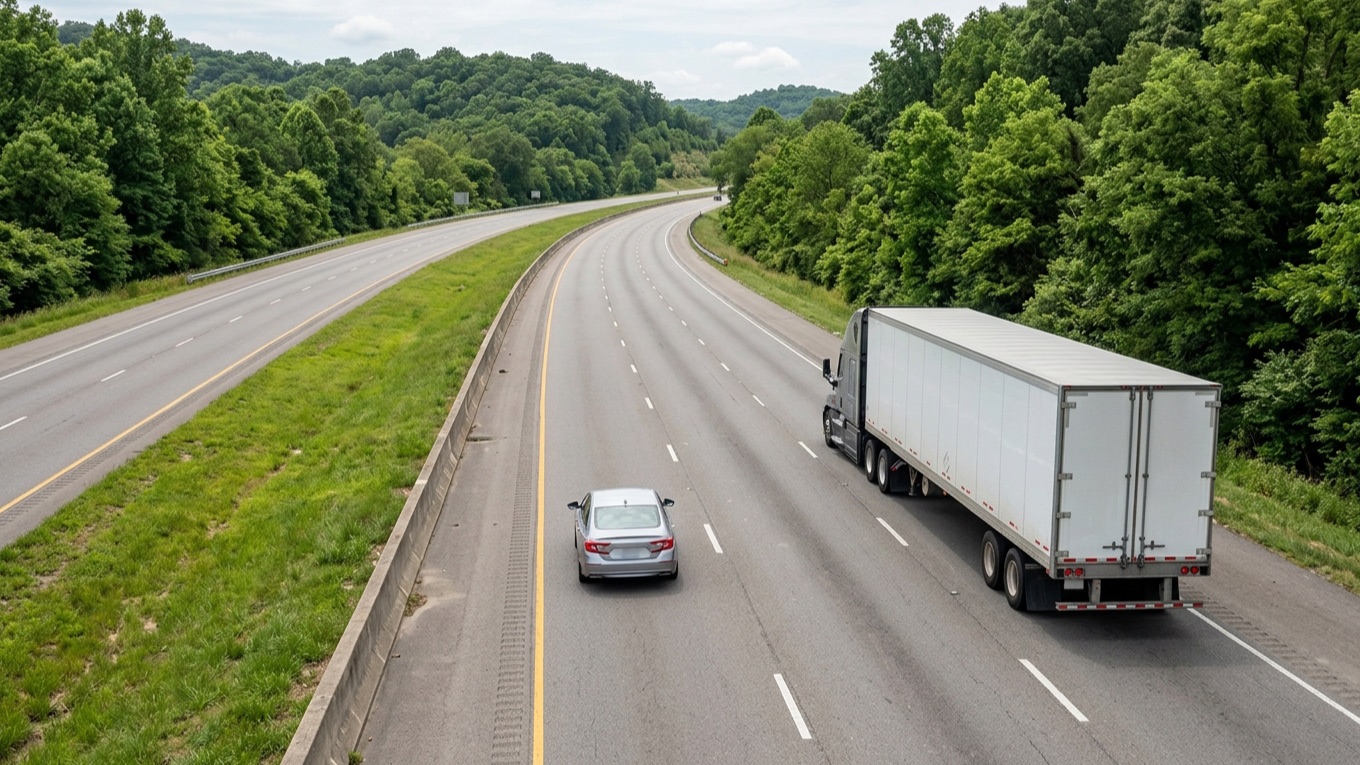

Being in a truck’s blind spot does not, by itself, decide fault for a Tennessee crash. The investigation needs to consider what both drivers did, including lane position, signals, speed, visibility, and the opportunity to avoid the collision. A driver’s statement that they didn’t see you is part of the evidence, not a final legal ruling.
This question often comes up after a sideswipe, a merge, or a wide turn. You may remember staying in your lane while the truck moved toward you. The driver or insurer may say your position made the collision unavoidable.
You don’t have to accept or reject that explanation on the spot. Start with the evidence that can show how the vehicles came together.
What are a truck’s blind spots called?
Truck blind spots are often called “No-Zones.” They are areas around a large vehicle where the driver may have limited or no direct or mirror visibility. Safety diagrams commonly show zones in front, behind, and along both sides.
Those diagrams are general illustrations. The actual view can vary with the truck, trailer, mirrors, cameras, the driver’s position, and the vehicles around it. A diagram isn’t a measurement of what a particular driver could see at the moment of impact.
FMCSA’s guidance for passenger-vehicle drivers recommends avoiding prolonged travel in blind spots and allowing trucks space to turn, merge, and stop. Those are useful safety practices. A fault investigation still needs to address the actual driving conduct and circumstances.
Does a blind spot give a truck the right to move into your lane?
A blind-spot claim is not a substitute for examining whether a lane change was safe. On roads with clearly marked lanes, Tennessee’s lane-use law generally requires a driver to determine that a move can be made safely before leaving the lane. The relevant provision is Tennessee Code Annotated section 55-8-123, quoted in this Tennessee court opinion.
The questions may include who crossed the lane line, whether a signal was used, what nearby traffic was doing, and how long each vehicle had been in its position. A turn signal communicates an intention; it doesn’t, by itself, establish that another lane is clear.
Your conduct matters too. An investigation may examine whether you were speeding, making a sudden pass, moving between lanes, or staying beside the truck when you had a safe opportunity to create space. The evidence should be considered fairly for everyone involved.
What evidence matters after a truck sideswipes your car?
Start with the sequence before impact, not only the final resting positions. A collision can push or rotate vehicles, leaving them somewhere different from where contact began.
| Evidence | What it may help explain |
|---|---|
| Dashcam or nearby video | Lane positions, signals, movement, and traffic before contact |
| Photographs of damage | Contact areas and possible directions of movement |
| Road markings and lane signs | Lane layout, merges, turn lanes, and restrictions |
| Witness accounts | What someone could see before and during the collision |
| Truck and vehicle records | Available camera views, event data, and other relevant operating information |
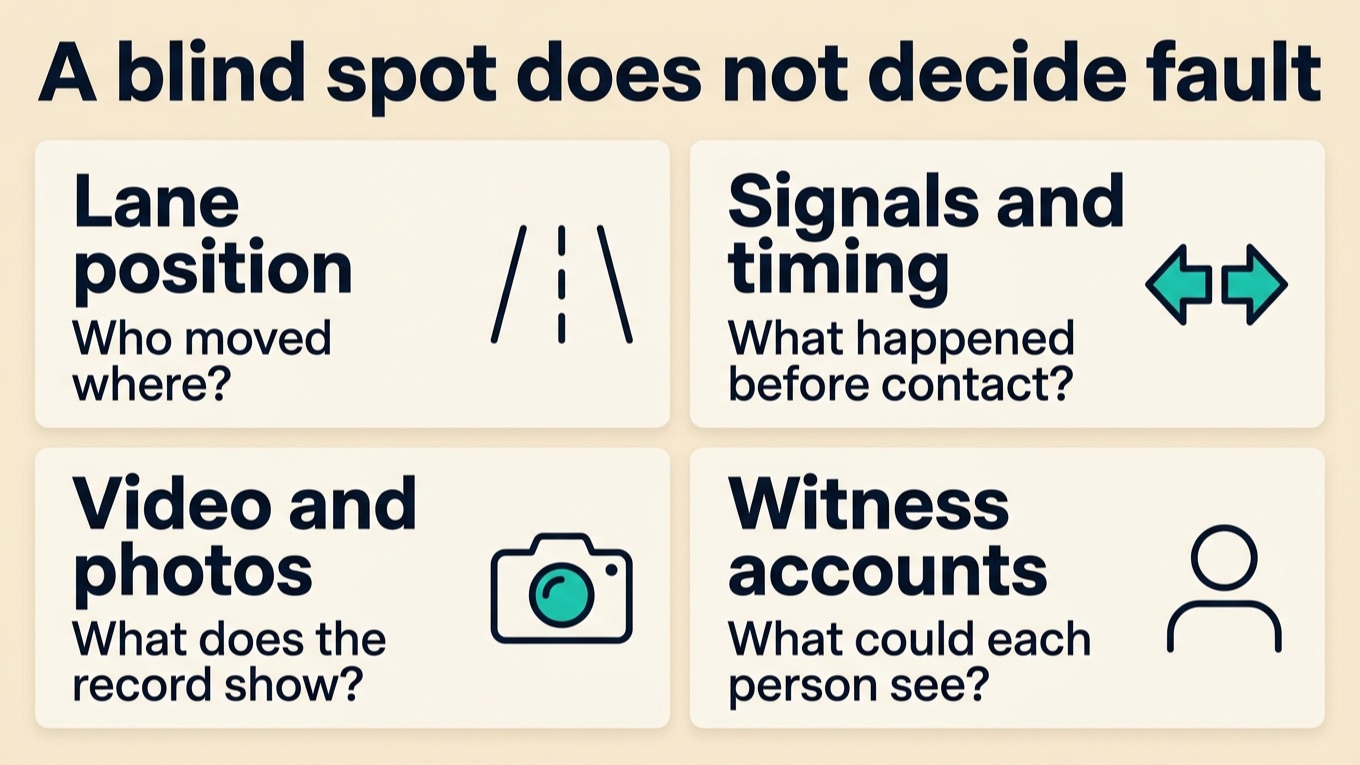
Damage alone may support more than one explanation. A qualified reconstruction expert may be needed to compare it with video, measurements, and the rest of the evidence.
Save original files when possible. A short clip uploaded to social media may leave out the moments that explain how the vehicles approached one another. Don’t edit or discard footage because part of it seems unhelpful.
What if the truck was making a wide right turn?
A turning truck can follow a path that surprises nearby drivers. Its trailer may take a different path from the cab, and the driver may need room to complete the maneuver.
FMCSA advises drivers to wait for large vehicles to finish turning and to be alert when a truck moves left before turning right. For a crash investigation, the key questions remain specific. Where was the car before the turn began? Were the truck’s intentions visible? Was the car moving into a narrowing space or already stopped where traffic required it to be?
Photographs of the intersection, turn lanes, curb, signs, and damage may help. Footage showing the approach to the turn can be especially useful. Don’t return to a dangerous intersection or stand in traffic to recreate the view yourself.
What if traffic left you with nowhere to go?
That circumstance deserves attention. A car beside a truck in slow traffic is different from a car accelerating into a gap during a turn. So is a car stopped at a light compared with one making a sudden lane change.
Write down what you remember about traffic ahead, behind, and beside you. Include whether you were stopped, slowing, or moving at a steady pace. Note where you first saw the truck begin to move and whether you had any safe path away.
Don’t supply a precise time or distance unless you know it. A clear description of what you observed is more useful than a confident estimate created afterward.
Can the insurer blame you partly and still owe compensation?
Tennessee generally follows a modified comparative-fault rule. An injured plaintiff who is less than 50% at fault may recover damages reduced by the plaintiff’s percentage of fault. A plaintiff who is 50% or more at fault is generally barred from recovery under that rule. The Tennessee Supreme Court discusses these principles in Ali v. Fisher.
An adjuster’s proposed percentage isn’t automatically the final answer. Ask what facts support it and preserve the records that may confirm or contradict those facts. An attorney can explain how the rule applies to your claim.
Our Tennessee comparative-fault guide provides more background. Don’t assume that a warning about blind spots, by itself, proves that you caused the crash.
Does the truck’s camera settle the dispute?
It may help, but first find out what it recorded. A forward-facing camera may not show the truck’s side. A side camera may have a limited view. The relevant file may include several angles or only a triggered clip.
The absence of visible contact in one camera view doesn’t necessarily mean the contact did not occur. Equally, footage that supports the other driver’s account shouldn’t be ignored. The full record needs review.
Our truck electronic-evidence guide explains why cameras, vehicle modules, and driver logs are separate sources. Ask about preservation promptly rather than assuming an insurer or police officer has obtained every recording.
What should you do if the adjuster says it was your fault?
Ask for the explanation and supporting information in writing. Keep the crash report, photographs, witness details, and all correspondence. If something in a report appears wrong, identify the specific issue and any evidence supporting a correction.
Avoid arguing from a generic diagram or making guesses about what the driver saw. You can explain your own lane position and observations without claiming to know what was visible inside the truck’s mirrors.
If injuries or responsibility are disputed, get a case-specific review before agreeing to a settlement or release. Our insurance-call guide can help you prepare for that next conversation.
Get the crash reviewed on its facts
Our Tennessee truck accident attorneys can help you understand a disputed crash and identify evidence that may clarify lane position, visibility, and each driver’s actions.
Call 615-244-2111 or reach out through our online contact form.
Because we care,
Stillman & Friedland